

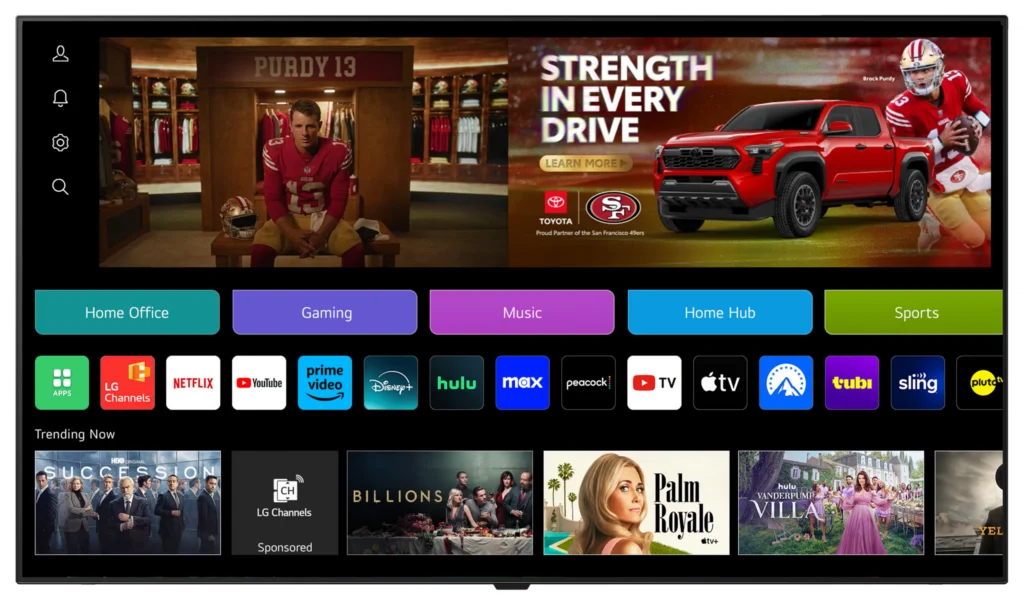
SAN FRANCISCO — In a move that signals a paradigm shift in the automation of digital advertising, the Northern California Toyota Dealers Association has become the first advertiser to utilize "agentic AI" to secure premium home screen inventory on LG Smart TVs. Announced on Wednesday, October 14, 2026, the collaboration involves sell-side advertising platform Magnite, LG Ad Solutions, and the independent agency H/L.
The campaign, which features San Francisco 49ers star quarterback Brock Purdy, arrives on the heels of a significant divisional victory for the 49ers against the Seattle Seahawks. However, the true story lies in the "plumbing" of the media buy—a sophisticated deployment of AI agents that marks the next evolutionary step beyond traditional programmatic advertising.
Main Facts: The Anatomy of an Agentic Buy
The partnership introduces a streamlined method for agencies to access high-impact "hero" placements on the LG home screen. Traditionally, securing such prime real estate required a mix of manual negotiation and complex programmatic bidding across multiple dashboards. Under the new framework, Magnite and LG Ad Solutions have opened their inventory to "agentic pipes," allowing AI agents to handle the heavy lifting of the transaction.
The creative execution itself is a masterclass in modern attention-grabbing. Displayed in a split-screen format within the LG home screen’s hero placement, the ad features a video component on the left and a static image on the right. The static side showcases Brock Purdy alongside a red Toyota Tacoma, grounding the high-tech buy in regional sports culture. To respect the user experience while maximizing engagement, the audio component of the video only activates when a viewer hovers over the ad with their remote.
This deployment is powered by the Model Context Protocol (MCP), an open-source specification that serves as a universal adapter for AI. In this instance, a "buyer agent" representing the agency H/L communicated directly with a "seller agent" within Magnite’s ClearLine platform. These agents negotiated the placement, confirmed the audience parameters—specifically NFL enthusiasts in the market for a vehicle—and executed the setup with minimal human intervention.
Chronology: From Linear to Agentic
The path to this moment has been paved by a decade of shifting consumer habits. As of late 2026, the advertising landscape has moved through three distinct eras:
- The Linear Era: Advertisers bought 15- and 30-second spots based on broad Nielsen ratings, with little to no interactivity.
- The Programmatic Era: The rise of Connected TV (CTV) allowed for automated bidding and data-driven targeting, though the process remained bogged down by fragmented DSP (Demand-Side Platform) and SSP (Sell-Side Platform) workflows.
- The Agentic Era: This week’s announcement marks the maturation of the third era. Here, AI agents do not just follow "if-then" rules; they understand the "intent" of a campaign brief and collaborate across platforms to find the most efficient path to execution.
The timeline for this specific campaign was accelerated by the integration of Magnite’s existing infrastructure, including SpringServe (its video ad serving platform) and ClearLine (its direct-to-buyer platform). By layering agentic AI on top of these established tools, the transition from a conceptual brief to a live home screen ad was achieved with unprecedented speed.
Supporting Data: The Battle for the "First Screen"
The move toward home screen inventory is driven by a stark reality in consumer behavior: the "second screen" phenomenon. According to data cited by H/L, a vast majority of viewers now use smartphones or laptops simultaneously while streaming content. Furthermore, the proliferation of ad-free subscription tiers has made it increasingly difficult for brands to reach audiences once they have entered a specific app like Netflix or Disney+.
“Home screen ads have become ‘table stakes’ in our strategy,” noted Jeremy Cobb, VP at H/L. The home screen represents the "last mile" of the viewer’s undivided attention before they disappear into an ad-free environment or succumb to the distractions of their mobile devices.
Market data suggests that:
- Attention Spans are Fragmenting: The average viewer spends less than two minutes on the home screen before selecting content, making the "hero" placement the most valuable real estate on the device.
- Efficiency Gains: Agentic buying reduces the "transactional tax" of time and labor. By using MCP to bridge the gap between buyer and seller, the manual hours required to set up complex, multi-format campaigns can be reduced by as much as 40-60%.
- Targeting Precision: The campaign successfully isolated a niche but high-value segment—NFL viewers in Northern California who are actively searching for automotive upgrades—demonstrating that AI agents can handle granular targeting without losing the scale of a mass-market brand play.
Official Responses: Human Oversight in an Automated World
Despite the high level of automation, leaders at Magnite and H/L are quick to emphasize that the "human-in-the-loop" remains a critical component of the process.
Mike Laband, Group SVP of revenue at Magnite, explained that the agent-led media plan was ultimately vetted and approved by human eyes at both LG and H/L before going live. “The agentic infrastructure sits on top of our existing products,” Laband said. “It makes the transaction workflow faster and cleaner, but it doesn’t replace the strategic oversight required for a brand as significant as Toyota.”
Jeremy Cobb of H/L offered a philosophical take on the shifting nature of the marketing funnel. “The standard marketing funnel is dead,” Cobb asserted. He argued that the traditional linear path from awareness to consideration to purchase has been replaced by a more chaotic consumer journey. In this environment, upper-funnel branding—like the Brock Purdy home screen takeover—is essential to “ensure consumers come down the funnel the way we want them to.”
Cobb further noted that while people generally dislike intrusive advertising, they respond to well-timed, high-attention formats. “Getting it right requires choosing moments of high attention while also respecting the user experience with less interruptive ad formats,” he said. For this campaign, the primary metric of success is cost per reach, focusing on an optimal balance between how many people see the ad and how often they see it.
Implications: What This Means for the Future of Advertising
The successful launch of the Toyota campaign on LG screens via agentic AI has several long-term implications for the industry:
1. The End of "Button Pushing":
As agentic AI becomes the standard, the role of the media buyer will shift from manual data entry and platform management to high-level strategy and prompt engineering. If an AI agent can set up a campaign based on a natural language brief, the value of an agency will lie in its ability to craft that brief and interpret the results.
2. The Standardization of AI Communication:
The use of the Model Context Protocol (MCP) is a significant milestone. For AI agents to work effectively across the open web, they need a "universal language." The adoption of MCP by major players like Magnite suggests that the industry is moving toward an open-source standard for AI interoperability, rather than a series of closed "walled gardens."
3. The Revaluation of the Home Screen:
As streaming services continue to hike prices for ad-free tiers, the smart TV home screen will become the primary "billboard" of the digital age. We can expect to see more interactive formats, such as "click-to-buy" features or QR code integrations, appearing in these hero placements.
4. Normalization of Performance and Brand:
The TV industry’s long-standing obsession with "performance" (direct sales) is beginning to harmonize with "branding" (awareness). The Toyota campaign proves that high-tech, data-driven tools can be used for "upper-funnel" goals, acknowledging that attention is the prerequisite for all business outcomes.
In conclusion, while the 49ers and Brock Purdy are chasing a Super Bowl trophy, the partnership between Toyota, H/L, Magnite, and LG is chasing a different kind of victory: a more efficient, less friction-filled future for the $70 billion television advertising market. As Jeremy Cobb noted, agentic buying may not fundamentally change what marketers are trying to achieve, but it is undoubtedly making the process "better, faster, and stronger."
