

Introduction: A Vanishing Act Reclaimed
For centuries, a delicate pen-and-brown-ink drawing by the eighteenth-century Venetian master Canaletto has existed in the quiet seclusion of private collections, far removed from the scrutiny of art historians and the public eye. Now, this "hitherto unrecorded" work is poised to emerge from the shadows. On October 21, the Oxford-based auction house Mallams will bring this rare sketch to the block, offering collectors a fleeting chance to acquire a piece of Venetian history that has remained hidden for generations.
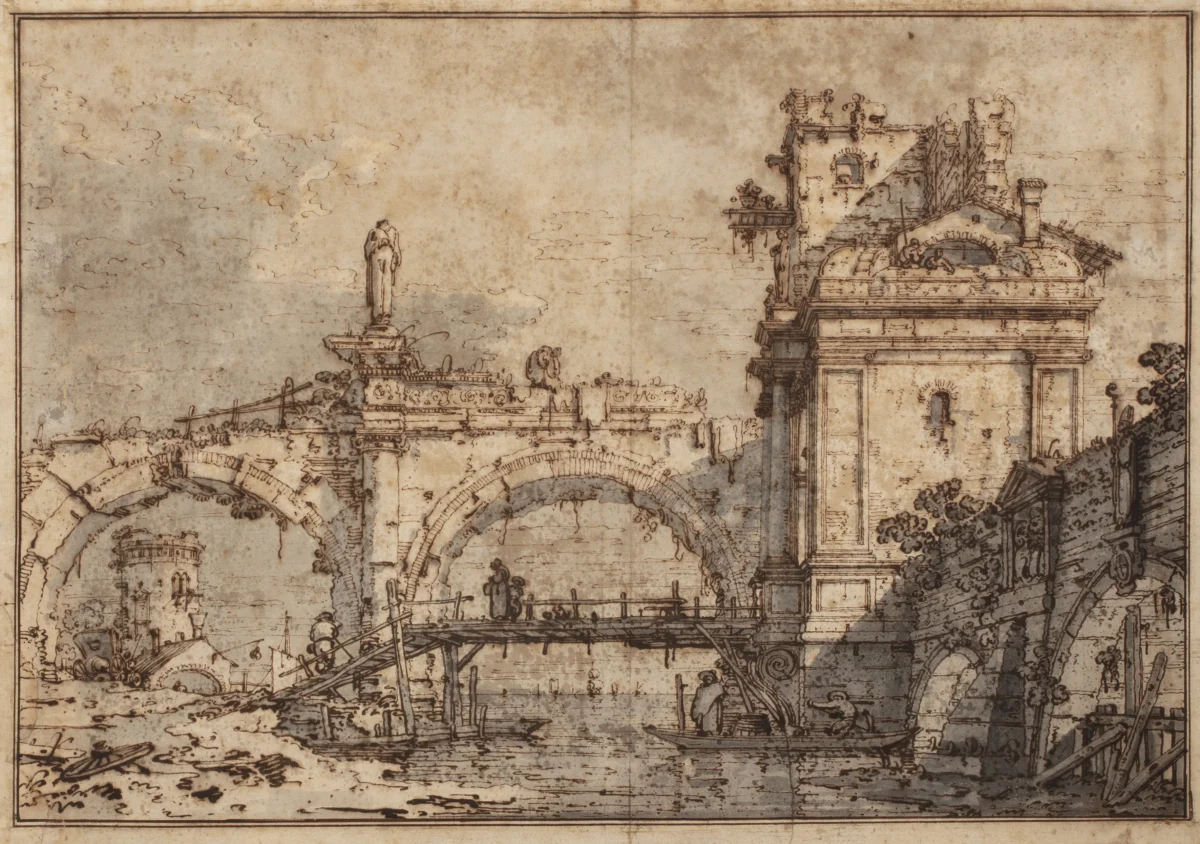
Estimated to fetch between £40,000 and £60,000 ($53,000 to $79,000), the drawing depicts a crumbling, atmospheric stone arcade spanning a tranquil body of water. While the figure itself is modest compared to the monumental oil canvases for which Canaletto is globally celebrated, its significance to the artist’s oeuvre is profound. It serves as a bridge between the artist’s rigid, topographical reality and the soaring heights of his imagination.
Main Facts: The Anatomy of a Discovery
The drawing is a quintessential example of the capriccio—a genre of art that fuses reality with architectural fantasy. Canaletto, a luminary of the Venetian school, typically gained fame for his rigorous, photographically precise depictions of the Venetian Grand Canal and the London skyline. However, his capricci reveal a different side of his genius: a propensity for constructing ruins, impossible vistas, and idealized landscapes.
The work currently under the hammer at Mallams features all the hallmarks of the master’s hand:
- The Architecture: A weathered stone arcade, rendered with the delicate precision of a master draftsman.
- The Staffage: Small, expressive groups of figures that provide both scale and a sense of human narrative to the desolate surroundings.
- The Atmosphere: A synthesis of light and shadow that suggests both the decaying grandeur of Italy and the theatrical drama of the eighteenth-century imagination.
According to experts, the drawing dates to the period between 1746 and 1755. This decade was a pivotal time for Canaletto, marking his lengthy sojourn in England, where he sought to capture the aesthetic tastes of the British aristocracy.
Chronology: Tracing the Provenance
The journey of this drawing from Canaletto’s studio to the auction block is a testament to the longevity of artistic legacy.
The Mid-18th Century Origins
While the drawing was likely created during Canaletto’s English period, it was never intended for the public market in the same way as his commissioned paintings. Its early history is illuminated by an inscription found on the reverse of the sheet, which confirms it was once given as a gift.
The Burney Connection
By the late eighteenth century, the work had entered the possession of the renowned music historian and composer Charles Burney. Burney, a key figure in the cultural life of Enlightenment-era Britain, moved in the same circles as the artists and thinkers who championed the works of the Italian masters. From Burney, the drawing descended through generations of his heirs, largely forgotten by the scholarly community until it recently resurfaced.
Authentication and Modern Rediscovery
The work remained in private hands until its recent emergence, at which point it was submitted to renowned Canaletto expert Charles Beddington. Beddington’s authentication was the final piece of the puzzle, confirming the drawing’s status as a preparatory sketch for a finished painting. That painting—the realization of the arcade and water vista depicted in the ink sketch—last appeared on the market in 1995, where it achieved a price of $354,000 (an equivalent of approximately $766,000 in contemporary currency).
Supporting Data: The Value of the Capriccio
To understand why this drawing is drawing such intense interest, one must look at the rarity of the capriccio within Canaletto’s broader catalog.
The Rarity Factor
Canaletto’s body of work is dominated by his vedute (view paintings). The capricci represent only a small fraction of his output. Because these works were often created for personal experimentation or specific, private commissions rather than for the open tourist market, they are significantly rarer than his standard Venetian cityscapes.
Market Dynamics
The valuation of £40,000–£60,000 is considered by many market analysts to be a conservative estimate for an authenticated work by a master of Canaletto’s caliber. While the drawing is a sketch, the provenance—stretching back to the household of Charles Burney—adds a layer of historical pedigree that often drives auction prices well above the upper estimates.
Technical Analysis
Art historians note that the drawing demonstrates the "brilliant observation" that defined Canaletto’s career. Despite the fantastical nature of the scene, the architectural elements are anchored by the same geometric precision found in his paintings of St. Mark’s Square or the Thames. The ink work showcases the artist’s ability to manipulate light and shadow using minimal materials—a stark contrast to the thick, impasto-heavy surfaces of his later oil paintings.
Official Responses and Expert Commentary
The excitement surrounding the discovery is shared by the experts who have spent years studying the Venetian school. John Rolfe, a prominent art historian who has reviewed the findings, provided a nuanced perspective on what this drawing reveals about Canaletto’s creative process.
"His capriccio pictures form a small portion of Canaletto’s oeuvre, and this drawing includes many elements typical of this genre," Rolfe told Artnet News. "They show brilliant observation, an eye for detail, but also imagination, fantasy, and drama."
Rolfe emphasizes that the drawing is not merely a "first draft." Instead, it represents a moment of creative distillation. "When you look at the staffage—those tiny, fluidly drawn figures—you see a master who wasn’t just copying architecture, but choreographing life within that architecture," Rolfe noted. "The fact that this was a gift suggests it was a work Canaletto himself valued enough to bestow upon a contemporary, rather than just a discard from his studio."
Mallams, in their role as the custodians of this sale, have emphasized the pristine nature of the provenance. "To find a piece that has effectively stayed within the same familial line for centuries is an auctioneer’s dream," a spokesperson for the house remarked. "It offers a rare, untainted look at an artist’s private hand."
Implications: What the Sale Means for the Art Market
The sale of this drawing on October 21 is more than a commercial transaction; it is a significant moment for the historiography of eighteenth-century art.
The Re-evaluation of Sketches
For years, the market has prioritized finished oil paintings, often neglecting the preparatory sketches that reveal the "bones" of an artist’s vision. The intense interest in this Canaletto sketch suggests a shifting trend: collectors and institutions are increasingly seeking works that offer a deeper, more intimate connection to the artist’s cognitive process.
The Institutional Opportunity
There is a high probability that this drawing will be targeted by museums and private foundations. Given its historical link to Charles Burney, it holds a specific appeal for collections focused on British-Italian cultural exchanges during the eighteenth century. A museum acquisition would be the ideal outcome for a piece that has been absent from the public record for so long, ensuring that it remains accessible for future study.
The "Unknown" Factor
Finally, this discovery poses an important question: how many other masterpieces are currently hiding in the attics, estates, and portfolios of private families? The resurgence of this Canaletto serves as a reminder that the canon of art history is not a closed book. It is a living, breathing record that continues to expand, one discovery at a time.
As the gavel prepares to fall in Oxford this October, the art world will be watching closely. Whether the drawing sells at the lower end of its estimate or triggers a spirited bidding war that far exceeds expectations, the primary victory has already been achieved: a lost piece of the Venetian master’s legacy has been brought back into the light, ready to be studied, appreciated, and finally, seen.
