

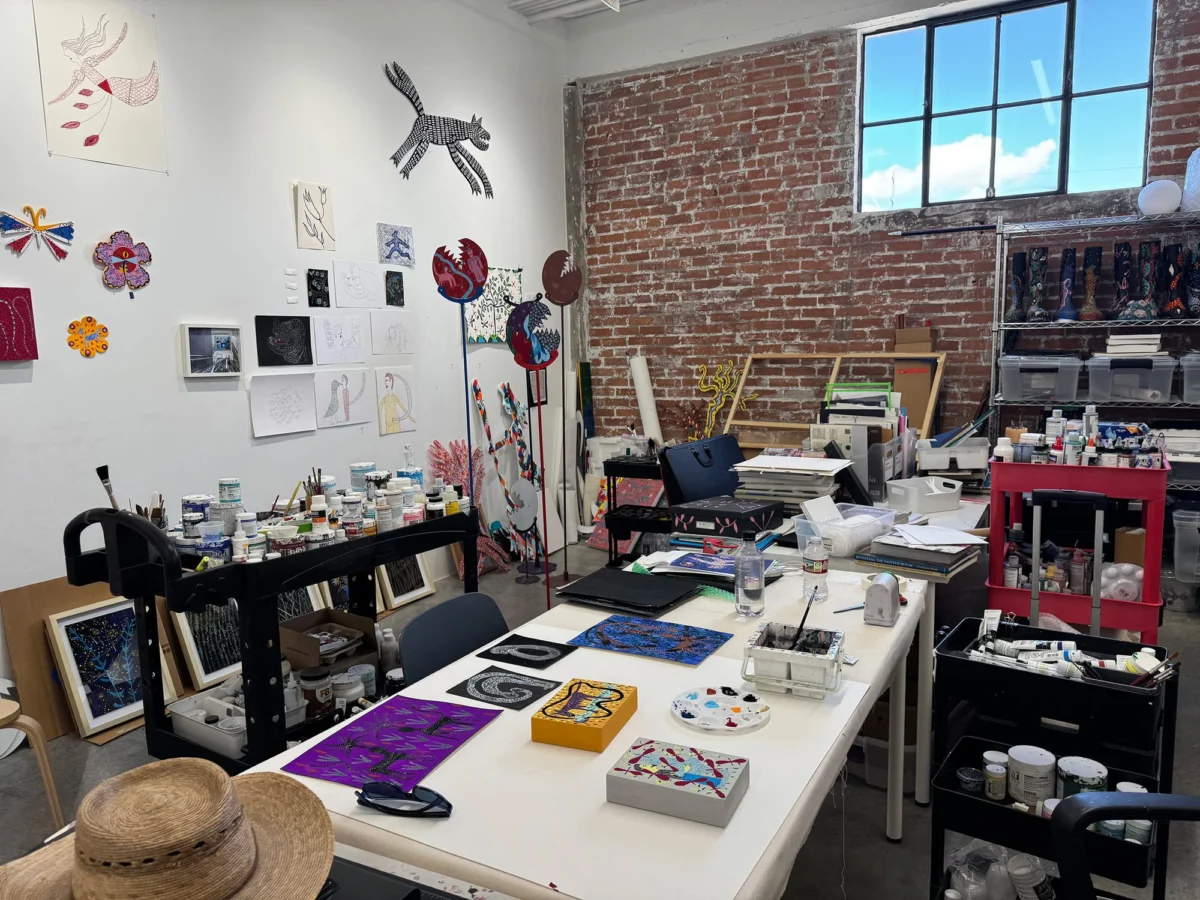
In the 360th installment of A View From the Easel, we journey to the sprawling industrial landscapes of Houston, Texas, to visit the workspace of artist Gerardo Rosales. For many, the studio is a sanctuary—a place of quiet reflection or frenetic creation. For Rosales, it is a physical manifestation of his artistic evolution, a place where, as he puts it, "my favorite material is the next one, the one I haven’t worked with yet."
The Evolution of Space: A Chronological Retrospective
To understand Rosales’s current practice, one must look at the trajectory of his workspace over the last quarter-century. The relationship between an artist’s physical environment and their output is often symbiotic, and for Rosales, the shift from domestic constraint to industrial expansion marks a definitive pivot in his career.
The Domestic Era (2000–2015)
For the first fifteen years of the millennium, Rosales operated within the confines of his own living room. This period necessitated a specific, intimate approach to creation. Without the square footage for expansive canvases, Rosales honed his skills in drawing and small-scale painting. During this time, he also pioneered a method of "installation by assembly," creating components in his home that would only be realized as large-scale, cohesive works once they reached the gallery floor. This period was defined by ingenuity; he learned to synthesize grand ideas within the limitations of a residential space.
The Expansion (2016–Present)
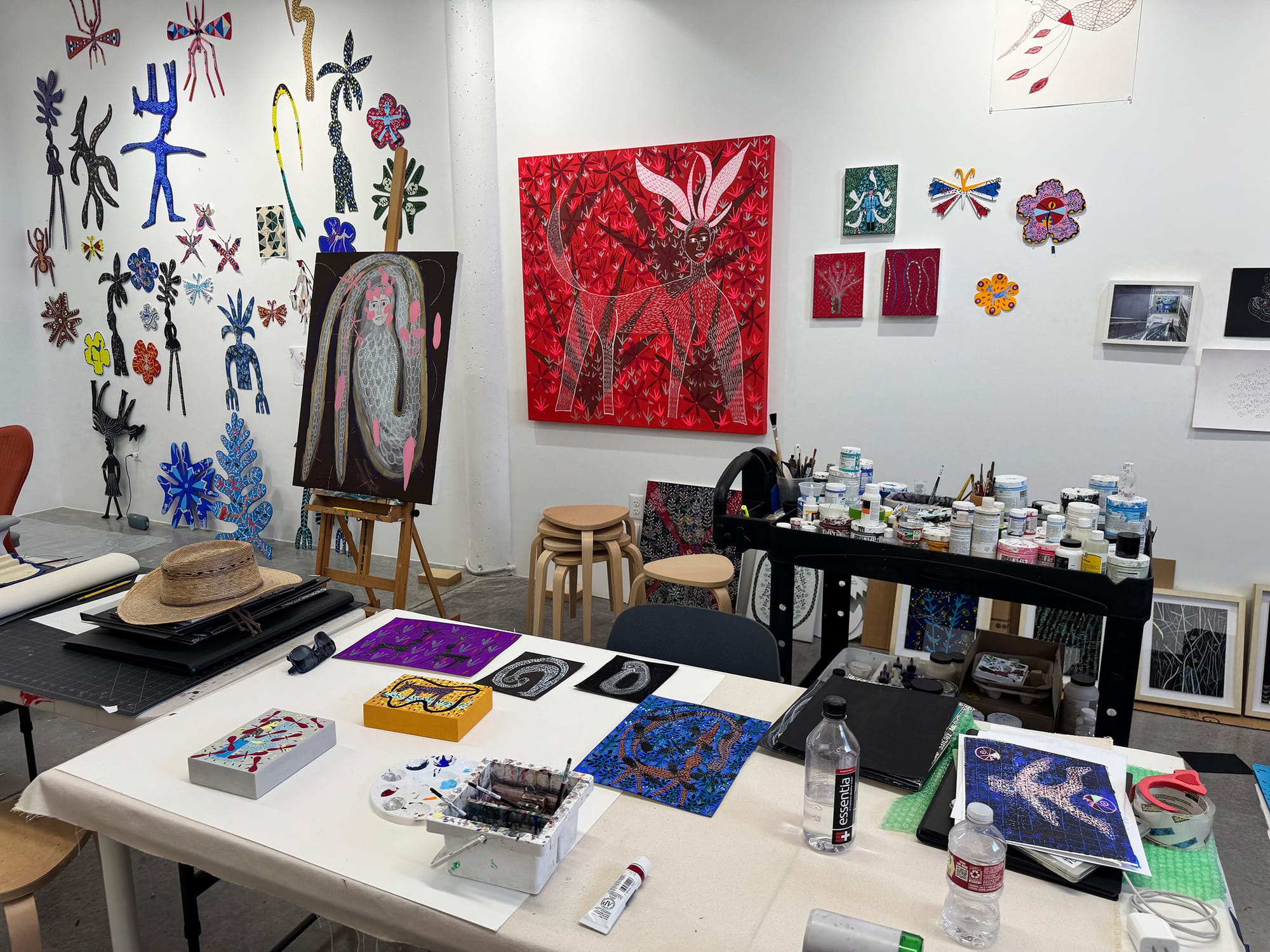
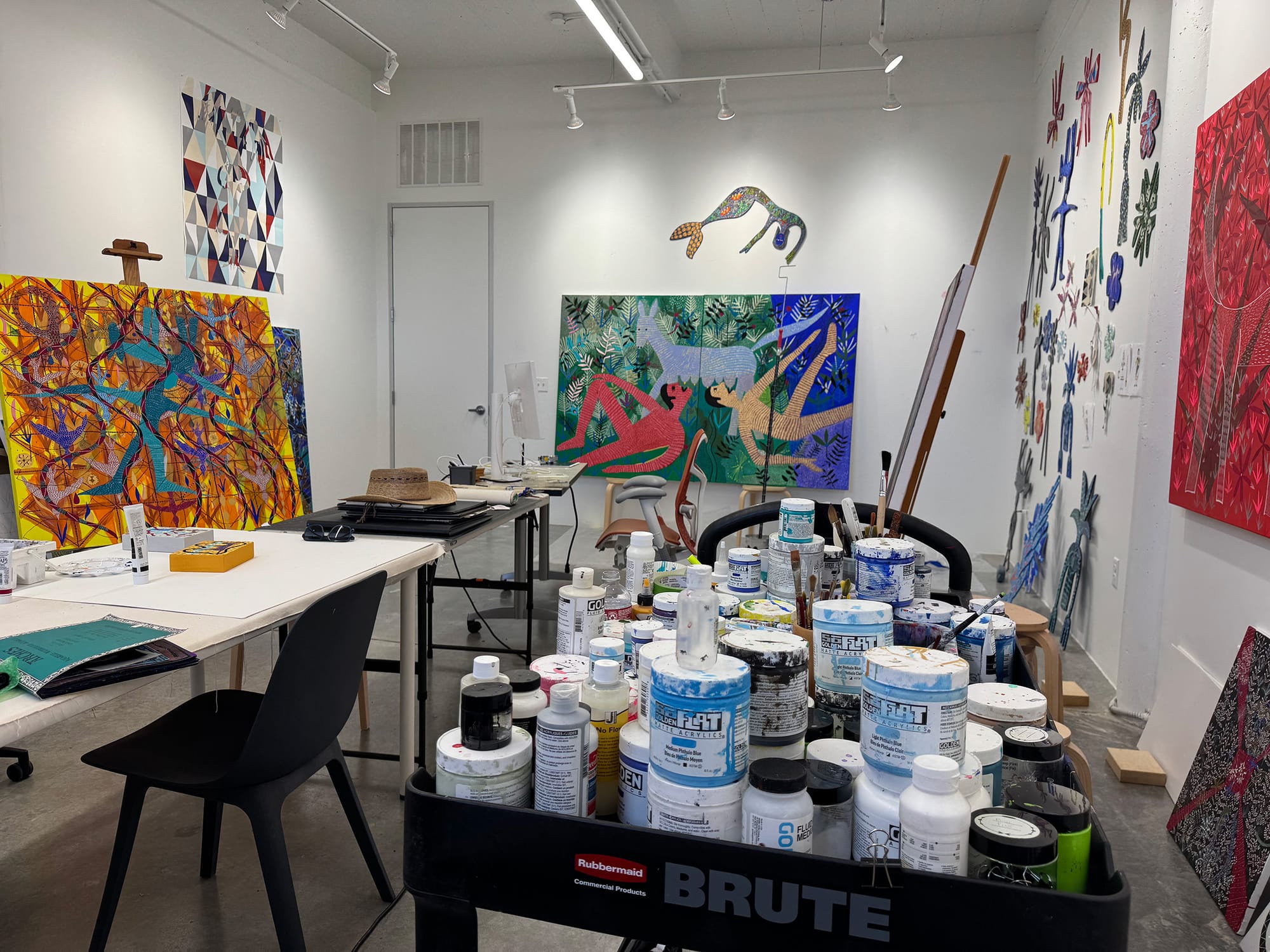
The year 2016 served as a professional inflection point. Access to larger, dedicated studio facilities allowed Rosales to shed the constraints of his living room. The immediate impact was visible in the scale of his work: he transitioned from manageable, intimate formats to monumental canvases measuring up to 96 by 120 inches. This shift was not merely an increase in size; it was an expansion of vision. The ability to work on a larger surface invited him to explore wall-mounted paintings and complex, immersive installations that required the physical depth only a high-ceilinged, industrial space could provide.
The Daily Ritual: An Anatomy of the Creative Process
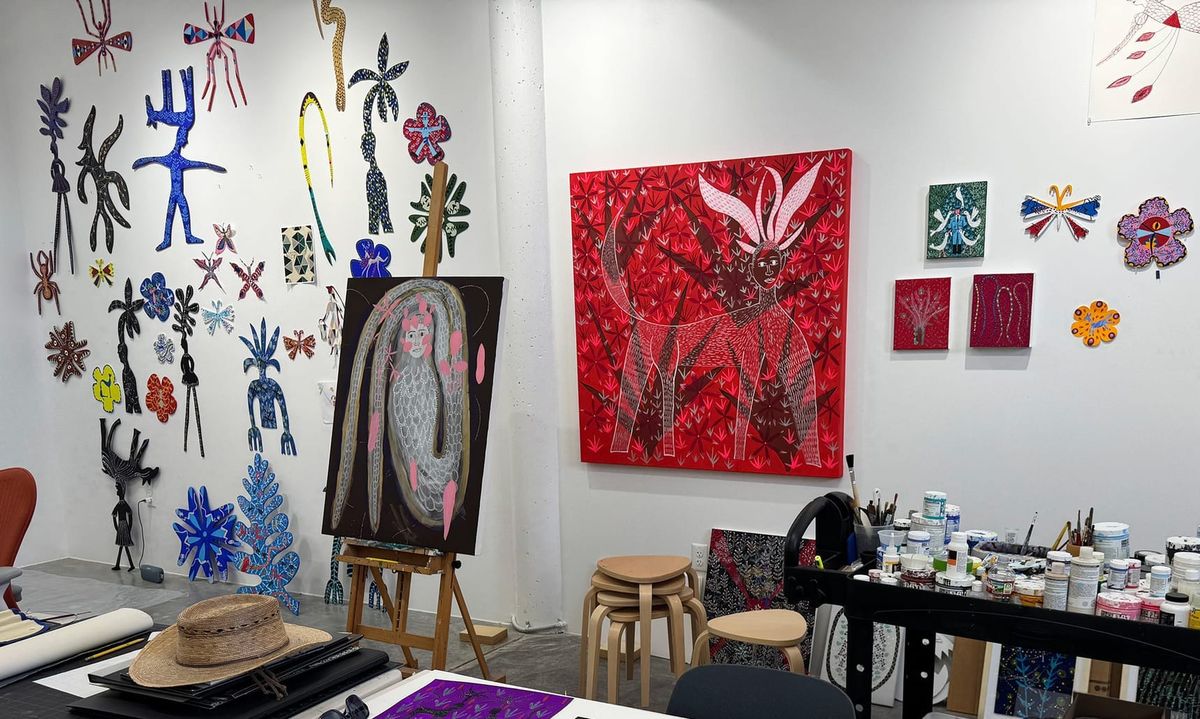
Rosales’s daily routine is characterized by a deliberate lack of structure, favoring a dual-studio approach that separates conceptual labor from physical execution.
The Home-Studio Dichotomy
His practice is split between two spheres. The home environment is his "think tank"—a space for digital sketching, preliminary research, and quiet reflection. It is where the initial spark of an idea is captured. Conversely, his primary studio is a site of tactile, messy production. It is a space where the artist is permitted to be untethered, working late into the night when the quiet allows his creative flow to reach its peak.
The Soundtrack of Creation
For Rosales, the auditory environment is as essential as the physical one. His studio soundscape is famously eclectic, bridging disparate worlds of sound to catalyze his creative energy. Recent sessions have been soundtracked by the rhythmic intensity of Chaka Khan, the complex musicality of Caetano Veloso, and the solemn beauty of Gregorian chants. Beyond music, literature plays a structural role in his output; he treats audiobooks as intellectual companions, recently moving from the evocative Before Night Falls by Reinaldo Arenas to the profound, existential explorations of James Baldwin’s Giovanni’s Room.
Supporting Data: The Environment and the Industry
Rosales’s current studio is situated within a massive complex in Houston, housing upwards of 300 artists. This data point highlights a recurring tension in the modern art world: the paradox of density.

- Proximity vs. Isolation: Despite being surrounded by hundreds of peers, Rosales reports a sense of professional isolation. The studio complex functions more as a collection of individual silos than a unified, collaborative ecosystem.
- The Logistical Advantage: The location offers tangible benefits that directly serve his output. Proximity to specialized art supply retailers and local coffee culture provides a support system that facilitates a high-intensity, late-night working rhythm.
- The Financial Burden: Like many contemporary artists in metropolitan hubs, Rosales expresses concern over the escalating costs of studio rent. The economic barrier to entry—and continued occupancy—remains a significant challenge for even the most established practitioners.
Professional Reflections: The Artist on His Craft
When asked about his material preferences, Rosales offers a philosophy that defines his entire career: "I don’t have a favorite material. I like to experiment and use different materials depending on what is most appropriate for each project."
This refusal to be categorized by medium is his greatest strength. By viewing each new project as an opportunity to master an unfamiliar material, he avoids the trap of repetitive aesthetic tropes. His studio serves as a laboratory, a place where the physical limitations of his past have been replaced by the intellectual freedom to experiment with the unknown.
Implications: The Future of the Artist’s Studio
The case of Gerardo Rosales highlights broader systemic issues within the art world, particularly in urban centers like Houston. While the "Artist Studio" remains a vital component of the cultural infrastructure, the current landscape reveals several critical implications:
The Need for Intentional Community
Rosales’s desire for a smaller, more collaborative community suggests that sheer scale—like that of his current 300-unit facility—does not necessarily lead to artistic enrichment. Artists are increasingly seeking environments that foster the exchange of knowledge across disciplines. The future of studio spaces may well lie in "hybrid hubs" where interaction is architecturally designed rather than left to chance.
The Accessibility Crisis
The economic pressure of maintaining large-scale studio spaces in a city with rising real estate costs is a common theme among working artists. If large-scale painting and installation work are to continue, there must be a shift in how municipalities and private developers view artist spaces—not as luxury real estate, but as essential urban infrastructure.
The Evolution of the "Workspace"
Rosales’s transition from a living room to an industrial space underscores the reality that an artist’s ambition is often throttled by their square footage. As he noted, the move to a larger space did not just allow for bigger paintings; it allowed for a fundamental shift in the scale of his thinking.
Conclusion: Looking Toward the Next Material
As Rosales continues his work in the quiet hours of the Houston night, he remains a testament to the idea that a studio is more than just a room—it is a mirror of the artist’s inner life. Whether he is drawing on a computer at home or applying layers of paint to a ten-foot canvas in his studio, his process remains anchored in a relentless, curious pursuit of the "next" thing.
For those looking to document their own creative sanctuaries, the call remains open. Whether your studio is a dedicated industrial loft or a corner of a home office, your space is a vital part of the creative narrative. As the series A View From the Easel continues its documentation, it serves as a reminder that every masterpiece begins with a setting—a place where the artist, the materials, and the time collide to create something entirely new.
Gerardo Rosales stands as a prime example of this collision: an artist who has moved from the intimacy of the living room to the vast potential of the industrial studio, all while keeping his eyes firmly fixed on the horizon, waiting for the next material to present itself.
