

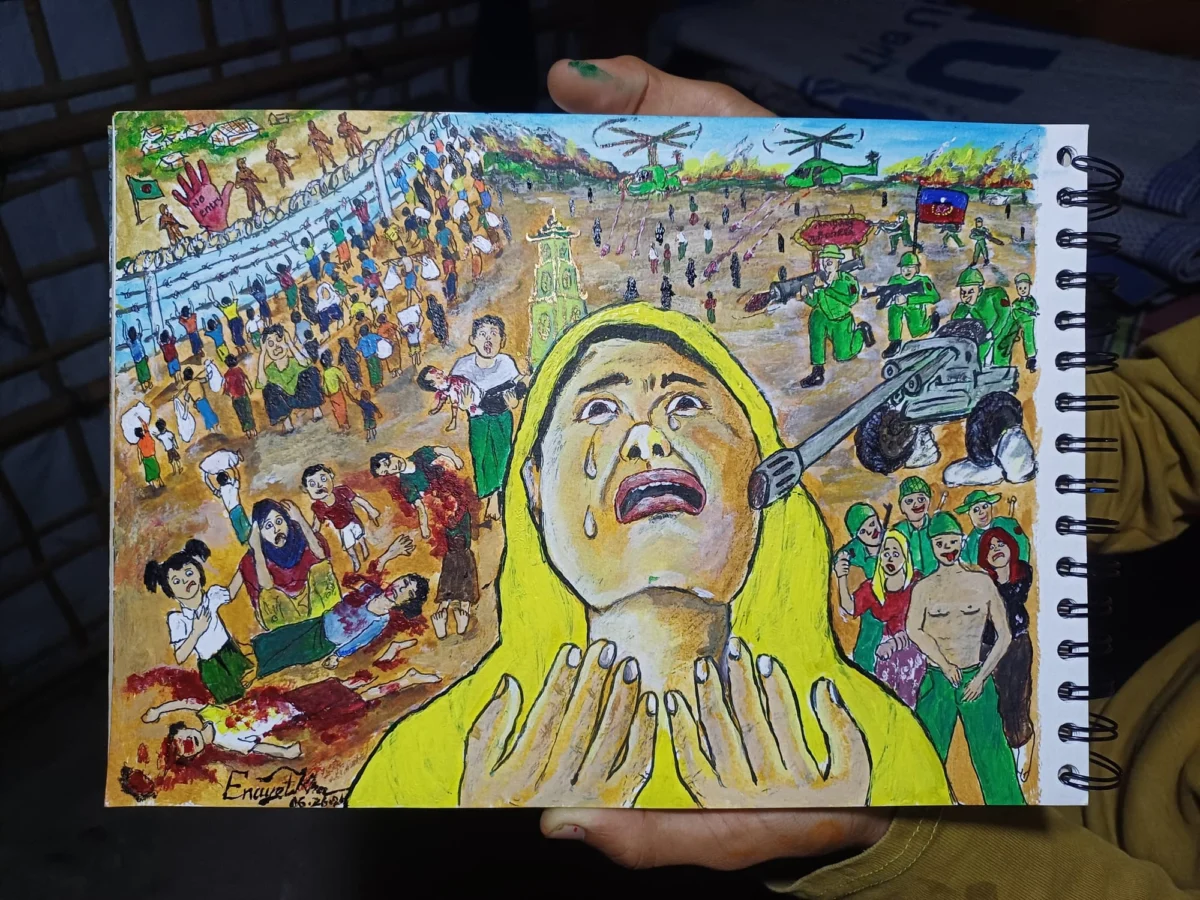
In the shadowed corners of refugee camps and the stark, sterile confines of detention centers, a quiet revolution in human rights documentation is taking place. For millions of people fleeing genocide, war, and systemic state violence, the traditional tools of justice—written testimony, bureaucratic records, and sworn affidavits—are often inaccessible. In their place, a new, visceral medium has emerged: the visual record.
Art, long dismissed as a mere therapeutic outlet for the traumatized, is increasingly being recognized by international legal experts, human rights investigators, and scholars as a critical form of evidence. As the global tally of forcibly displaced persons reaches an unprecedented 117.8 million, the intersection of creative expression and forensic accountability is reshaping how we define truth in the face of mass atrocities.
A Witness in Paint: The Rohingya Experience
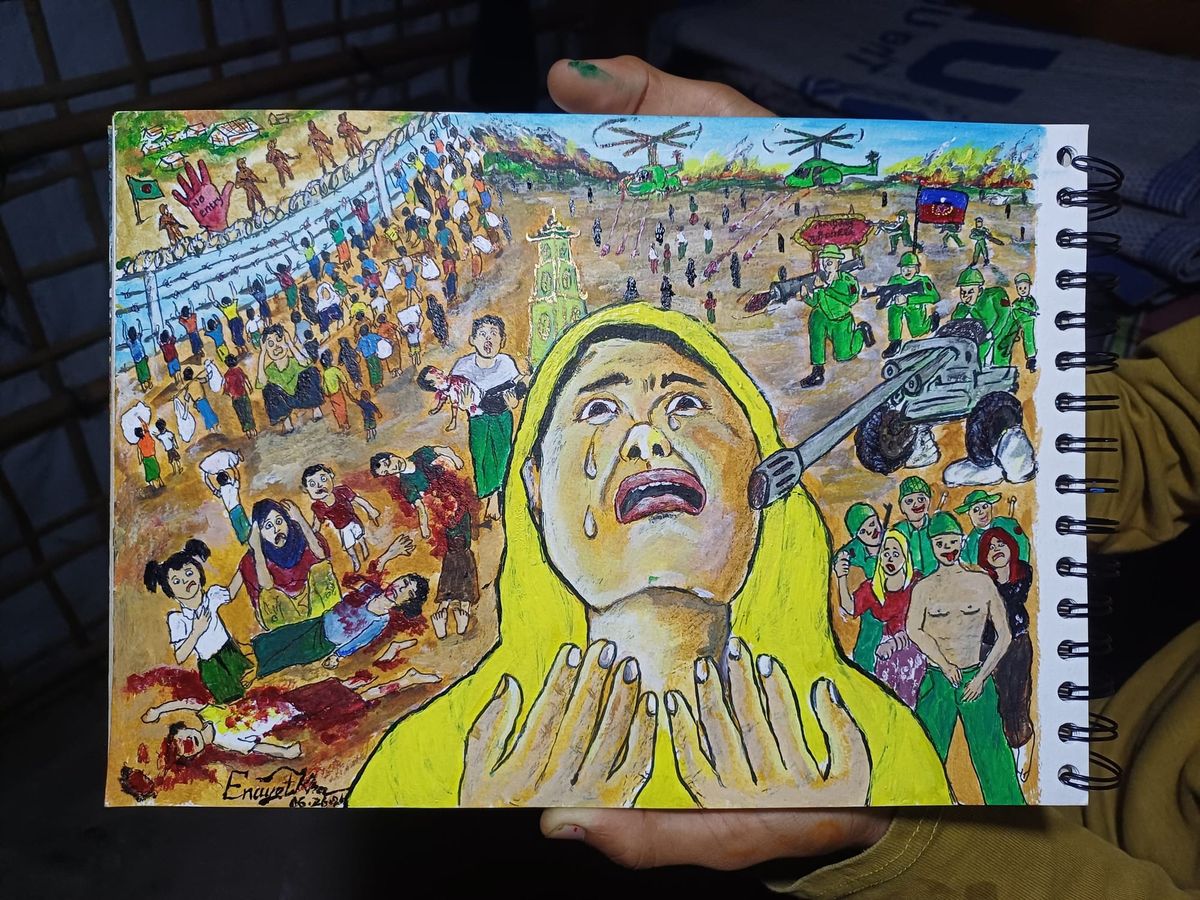
The story of Enayet Khan is illustrative of this shift. Fleeing Myanmar in 2017, Khan’s journey was a harrowing odyssey through burning landscapes. As he traveled, his home was reduced to ash, and he bore witness to the summary executions of his neighbors.
"I lost everything," Khan told Hyperallergic. "Home, documentation, property, a sense of security."
Settling in the sprawling refugee camps of Cox’s Bazar, Bangladesh—now home to nearly one million Rohingya—Khan found himself navigating the profound silence that follows trauma. He turned to painting, capturing the burning homes and fleeing families he had seen with his own eyes. Eventually, his work evolved from solitary processing to a community movement: the Rohingya Art Club (RAC).
By teaching other refugees to render their experiences onto canvas, Khan and his peers are doing more than healing; they are archiving the history of a genocide. For a population stripped of citizenship by a 1982 law and subjected to decades of state-sponsored repression, these paintings serve as a vital counter-narrative to the denialism often promulgated by regimes accused of mass atrocities.
Chronology of a Crisis: From Atrocity to Evidence
To understand the legal significance of this artwork, one must look at the timeline of the Rohingya crisis, which mirrors the growing international reliance on non-traditional evidence.
- 1982: The Myanmar government enacts a citizenship law that effectively strips the Rohingya of their rights, rendering them one of the world’s largest stateless populations.
- August 2017: A brutal military crackdown—termed "clearance operations"—triggers a mass exodus. Over 700,000 Rohingya flee into Bangladesh.
- 2018–2020: As investigators from the UN and independent NGOs begin documenting the crimes, the difficulty of obtaining formal testimony becomes apparent. Language barriers, fear of reprisal, and the high rate of illiteracy among survivors hinder traditional documentation.
- 2021–2023: Legal organizations, including Legal Action Worldwide, begin incorporating visual art into dossiers prepared for the International Court of Justice (ICJ).
- 2026: The use of visual evidence is officially debated in broader legal frameworks, with art now being treated as a legitimate form of survivor testimony in human rights proceedings.
Supporting Data: The Rising Demand for Accountability
The legal urgency for such documentation is underscored by a staggering increase in global conflict. According to the United Nations High Commissioner for Refugees (UNHCR), the number of displaced people has risen for 12 consecutive years, reaching 117.8 million.
As the volume of displacement grows, so too does the caseload for international courts. Between 2016 and 2021, the European Union reported a 44% increase in new investigations into "core international crimes"—a category that includes genocide, crimes against humanity, and war crimes.
The International Criminal Court (ICC) has described the current demand for justice as "unprecedented." However, the burden of proof in these courts is immense. Investigators are often forced to rely on fragmented, often traumatized testimonies. When traditional paper trails are destroyed by regimes to cover their tracks, the visual record becomes a crucial, if unorthodox, source of forensic truth.
The Legal Paradigm: Why Art Matters
Antonia Mulvey, executive director of Legal Action Worldwide and a former United Nations investigator, has been at the forefront of this shift. In her work regarding the ICJ case against the Myanmar military, Mulvey recognized that traditional statements were often failing to capture the full scope of the suffering, particularly for women and children who might struggle to articulate complex traumatic memories in a formal interview setting.
"The high illiteracy rate among Rohingya people, especially women and children, makes it difficult to record traditional statements," Mulvey explained. "In those contexts, drawings became a vital way to convey their testimonies."

From a legal standpoint, this artwork offers several advantages:
- Corroboration: When dozens of independent paintings from different refugees depict the same specific military insignias, vehicles, or architectural details of destroyed villages, it creates a corroborative map of events.
- Emotional Context: While legal documents are cold and detached, art conveys the psychological impact of the violence, which is relevant in cases involving crimes like torture and sexual violence.
- Accessibility: Art bypasses the barriers of language and literacy, allowing the most vulnerable victims to participate in the legal process directly.
Implications: A New Standard for Human Rights
The integration of art into legal proceedings is not without its challenges. Critics argue that art is inherently subjective and can be influenced by memory distortion. However, human rights lawyers counter that all testimony—written or oral—is subject to the same human fallibility. By treating art with the same rigorous cross-examination techniques used for verbal testimony, legal bodies are finding that the "truth" in a painting can be just as durable as the truth in an affidavit.
The implications for the future of international law are profound. We are seeing a move away from a purely text-based justice system toward a more inclusive, multisensory approach to truth-telling.
For survivors like Enayet Khan, the act of painting is a reclamation of agency. By moving their stories from the private sphere of the refugee camp to the public and legal sphere of the international court, they are ensuring that their experiences are not just remembered, but utilized as a weapon against impunity.
As international bodies continue to grapple with the surge in mass atrocities, the "Rohingya Art Club" and similar initiatives serve as a blueprint. When history is being erased by fire and force, the brush and the pencil become the last lines of defense. Justice, it seems, may eventually be found not just in the words of a judge, but in the indelible lines drawn by those who survived the impossible.
