

The vibrant, calcium-carbonate architectures that underpin marine biodiversity are currently facing an existential threat. Across the Florida Reef Tract—the third-largest barrier reef system in the world—a relentless pathogen known as Stony Coral Tissue Loss Disease (SCTLD) has been systematically erasing colonies of reef-building corals. However, a glimmer of hope has emerged from the laboratories of the Smithsonian Marine Station. Researchers have successfully utilized a beneficial bacterial strain to combat the disease, offering a potential lifeline for the iconic Montastraea cavernosa, or great star coral.
In a landmark study published in the journal Frontiers in Marine Science, scientists detailed a novel "whole-colony bagging" technique that significantly curtails the progression of SCTLD, providing long-term protection that has far outperformed traditional lesion-targeted treatments.
The Main Facts: A Biological Defense Strategy
At the heart of this research is a probiotic strain known as MCH1-7. First identified in 2018 by Smithsonian researchers, this bacterium was discovered living on a coral colony that had demonstrated a miraculous, natural resistance to an active outbreak of SCTLD.
The mechanism behind this resistance involves a potent compound produced by the bacteria: tetrabromopyrrole (TBP). TBP serves a dual purpose in the marine environment. It acts as a chemical cue that encourages coral larvae to settle and begin their growth cycle, and, as the recent research confirms, it serves as a powerful antimicrobial defense against the pathogens driving tissue necrosis in infected corals.
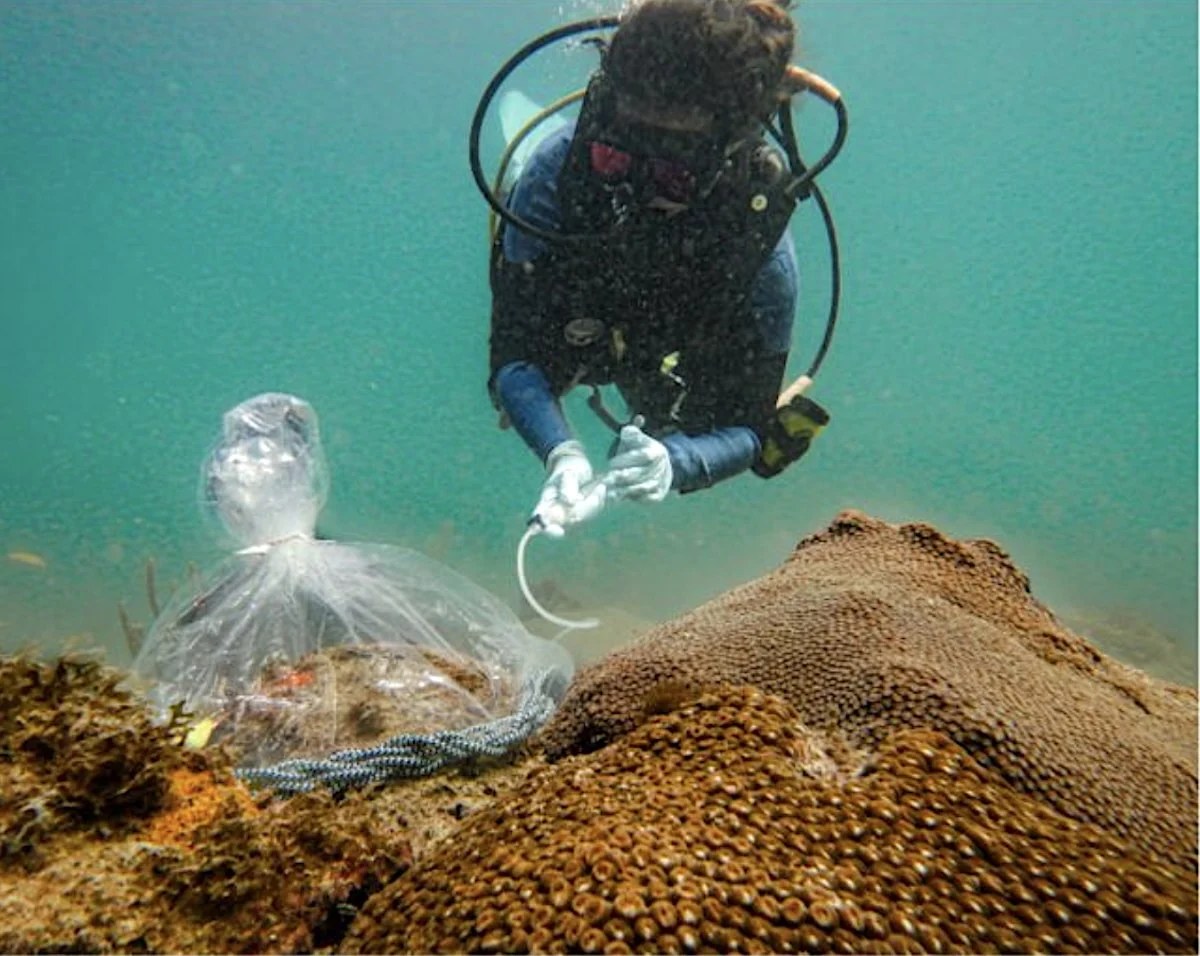
By isolating this strain, scientists have sought to replicate the natural immunity of the "survivor" corals, effectively creating a probiotic treatment that can be deployed by human intervention. The primary breakthrough lies in the method of application: rather than attempting to treat individual open wounds (lesions) on the coral surface—a method that proved largely ineffective—researchers developed a method to treat the entire colony by creating a temporary, nutrient-rich "bubble" of probiotic-enhanced seawater around the coral structure.
Chronology of Discovery: From Observation to Intervention
The journey toward this probiotic solution has been a multi-year effort defined by rigorous field observation and careful experimentation.
- 2018: The Discovery. Scientists at the Smithsonian Marine Station identify the MCH1-7 strain on a naturally resistant Montastraea cavernosa colony in Florida waters. The discovery of the TBP compound provides the first clue as to why this specific colony survived while others succumbed to SCTLD.
- 2019–2021: Preliminary Trials. Initial studies focused on identifying the safety and efficacy of the probiotic on adult coral colonies. Researchers sought to ensure that introducing this specific bacteria would not cause unintended shifts in the local microbiome or harm other healthy Caribbean coral species.
- 2022–2024: The Long-Term Study. Researchers launched a comprehensive trial using the whole-colony bagging technique. Divers placed weighted, flexible bags around targeted coral colonies, injecting the probiotic-rich water inside to ensure total contact. The team monitored these colonies, along with a control group of untreated corals, for a period of 2.5 years.
- 2025: Publication of Findings. The findings, published in Frontiers in Marine Science, marked a milestone in coral restoration, proving that the treatment was not a temporary fix but a sustained intervention that altered the disease trajectory over the long term.
Supporting Data: Why "Bagging" Outperforms the Paste
The study provides a stark contrast between two primary methods of probiotic delivery. Historically, researchers had attempted to treat SCTLD by applying a probiotic-infused paste directly to infected lesions, hoping to halt the spread at the source. The data, however, showed that the paste method was inadequate for long-term control.
In the 2.5-year longitudinal study, the results were definitive:
- Whole-Colony Treatment (Bagging): Corals treated via the bagging method experienced a total tissue loss of only approximately 7% due to SCTLD.
- Untreated Control Group: Corals that received no intervention lost an average of 35% of their total tissue.
- Longevity: The protective effects of the probiotic persisted for the entire 2.5-year duration of the monitoring period, suggesting that the bacteria successfully colonized the coral surface and established a long-term defense mechanism.
The researchers concluded that while the bagging method is logistically more complex—requiring more material, specialized equipment, and significant diver time—the disparity in survival rates makes it the superior choice for reef conservation efforts.
Official Responses and Expert Perspective
The scientific community has reacted with cautious optimism. While the results are statistically significant, the researchers involved emphasize that this is a component of a larger, multifaceted solution rather than a silver bullet.

Jennifer Sneed, a biologist at the Smithsonian Marine Station, highlighted the fascinating intersection between larval biology and disease protection: “If TBP is a natural settlement cue, and if bacteria that also produce this compound protect corals from disease, it makes sense that larvae would settle where those compounds are being produced. More of them would survive to be able to recognize the compound.”
Kelly Pitts, the study’s lead author, underscored the importance of tempered expectations. "It’s important to understand that this is the very beginning," Pitts told Mongabay News. "This is definitely not a cure-all, but we’re definitely moving in the right direction."
The research team is now shifting its focus to scalability. Because the process requires significant labor—scuba divers must physically deploy the bags and retrieve them—the next phase of the project involves streamlining the process for larger-scale implementation across broader segments of the Florida Reef Tract.
Implications: A New Era for Coral Restoration
The success of the MCH1-7 probiotic treatment has profound implications for the future of marine conservation. SCTLD is a particularly devastating disease because it moves rapidly and affects a wide variety of reef-building corals, which are essential for coastal protection, fish habitats, and economic stability in tourism-dependent regions.
1. Scaling the Science
The primary hurdle now is logistics. While the bagging method is highly effective, it is currently "high-touch." Conservationists are exploring ways to reduce the time divers spend underwater per colony, perhaps through improved delivery materials or localized, time-release systems that mimic the bagging effect without requiring constant human monitoring.
2. Ecological Integrity
A critical concern in any biological intervention is the risk of "disruption." The research team confirmed that the introduction of MCH1-7 did not negatively impact neighboring coral species. This is a vital finding, as it validates the use of site-specific probiotics without the fear of triggering secondary ecological crises.
3. Broadening the Scope
While the current study focused on Montastraea cavernosa, the success of the TBP compound opens doors for testing on other susceptible species. SCTLD affects more than 20 species of coral; identifying whether this specific probiotic—or other strains that produce TBP—can be adapted for these other species is the next logical step.
4. Policy and Funding
The study provides a clear mandate for policymakers. Evidence-based, science-driven solutions like the Smithsonian’s probiotic initiative justify continued and increased funding for marine research. As the climate changes and ocean temperatures rise, corals are increasingly susceptible to disease; biological interventions represent a necessary, proactive defense.
Conclusion: A Step Forward
The battle against Stony Coral Tissue Loss Disease is far from over. However, the Smithsonian’s research marks a transition from purely observational studies to active, effective intervention. By tapping into the natural defenses that some corals have already evolved, scientists are not just treating the symptoms of a dying reef—they are empowering the reef to defend itself.
As we look toward the future, the integration of probiotic treatments into the broader toolkit of coral restoration—alongside coral nurseries, genetic banking, and water quality improvements—offers a roadmap for resilience. While no single intervention can reverse the damage of the last decade, the discovery of MCH1-7 and the effectiveness of the bagging method prove that even the smallest organisms can play a massive role in preserving the planet’s most vital underwater ecosystems. The "bagging" of these corals may be a small, painstaking effort, but it is one that, piece by piece, is keeping the reef alive.
