

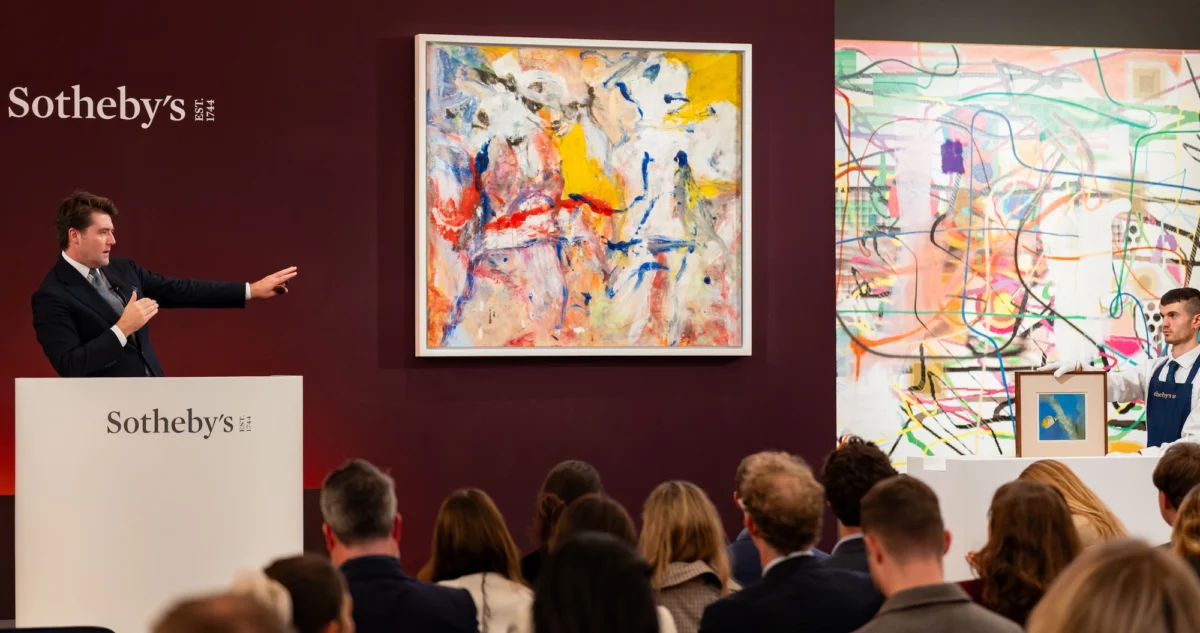
In the hallowed, wood-paneled quietude of Sotheby’s London saleroom, the atmosphere on Thursday night felt less like a celebration of art and more like the somber deliberation of a courtroom. Under the watchful gaze of auctioneer Tom Eddison, the gavel fell repeatedly on a sequence of lots that defined the current state of the global art market: steady, measured, and profoundly cautious.
The evening resulted in a total of £46.1 million ($61.1 million), a figure that sat comfortably within the pre-sale expectations of £41.7–58.6 million, though the hammer total of £36.9 million—calculated before the addition of buyer’s premiums—fell short of the low estimate. In a week where the art world converged on London for Frieze, the auction served as a barometer for a high-end market currently grappling with economic uncertainty and a newfound sense of discernment.
The Chronology of an Evening: From Tension to Triumph
The proceedings were brisk, unfolding over a trim one-hour session that featured 34 lots. The tension in the room was palpable from the outset, exacerbated by the pre-sale withdrawal of three high-profile works by Damien Hirst, Anselm Kiefer, and Leon Kossoff.
As the bidding began, the audience—a mix of seasoned collectors, advisors, and industry insiders—maintained a stoic composure. The highlight of the evening, a 1977 untitled abstraction by Willem de Kooning, commanded the most attention. Measuring five feet in width, the work carried an estimate of £8–12 million. Bidding remained measured, ultimately hammering at £8.2 million and reaching a final price of £9.8 million ($12.9 million) with fees. For a piece that last sold in New York in 2015 for $6.1 million, the result confirmed the enduring, if not explosive, blue-chip status of the Abstract Expressionist master.

Following the de Kooning, the market’s temperament was tested by an eight-foot-wide Abstraktes Bild (1992) by Gerhard Richter. Estimated at £6–8 million, the work failed to ignite a bidding war, hammering below expectations at £5.4 million (£6.7 million/$8.9 million with fees). The evening’s third major anchor, a dark-hued 1969 untitled abstract by Mark Rothko, performed at the lower end of its spectrum, hammering at its base estimate of £3 million and totaling £3.8 million ($5 million) with fees.
The latter half of the sale saw a stark divergence in performance. While secondary-market stalwarts like David Hockney and Andy Warhol maintained a consistent presence, several contemporary heavyweights—including Banksy, Georg Baselitz, and Lynette Yiadom-Boakye—failed to find buyers, signaling that even established names are not immune to the market’s current mood of extreme selectivity.
Supporting Data: The Anatomy of the Results
To understand the mechanics of Thursday’s sale, one must look at the broader context of the London art week. The £46.1 million total stands in contrast to last year’s equivalent sale, which brought in £47.6 million ($63.3 million), led by a £13 million Francis Bacon. The slight dip in performance is emblematic of a wider trend observed throughout the week.
Christie’s, having held its own evening sales just one night prior, reported a robust £218.6 million ($289.4 million) across two sessions. While this more than doubled the previous year’s total, the sentiment remained consistent: the market is being driven by "safe" blue-chip assets rather than speculative fervor.

Of the 34 lots offered at Sotheby’s, 10 were supported by third-party guarantees, a standard risk-mitigation strategy in an unpredictable climate. The failure to sell 6 lots—including works by high-demand artists like Jadé Fadojutimi—underscores the "correction" phase many dealers and consultants have been predicting for months. Collectors, it seems, are no longer willing to buy "just to buy"; they are waiting for the right work, at the right provenance, at the right price point.
The "Homey" Anomaly: The Case of Michael Andrews
If the evening had a surprise protagonist, it was the British painter Michael Andrews. While the international stars saw mixed results, the market displayed an intense, localized appetite for Andrews’ 1978 work, Butterfly Fish.
With a high estimate of £120,000, the painting triggered an extended, spirited contest among bidders, eventually hammering at £550,000 and closing at £704,000 ($933,117). The result established a new high for a work on paper by the artist.
Ivana Miloradovic, an art historian and consultant who attended the sale, noted the unique dynamic of the moment. "British sales on British soil are always joyous," she observed. "Everybody knows the artist, the gossip, and the history. It was a homey atmosphere." This sentiment highlights a shift in the market: when global capital becomes hesitant, regional pride and historical significance can act as a catalyst for demand.

Official Perspectives: A Market in Transition
Sotheby’s leadership remains optimistic, framing the results not as a failure, but as a realistic reflection of the current climate. Ottilie Windsor, head of contemporary art at Sotheby’s London, defended the evening’s output in a post-sale interview.
"The paintings that he [Andrews] did make were often bought as they were being made by a group of collectors who followed his work really closely," Windsor explained, noting that the scarcity of his work on the open market contributes to its resilience.
Addressing the broader performance of the evening, Windsor remained pragmatic. "Any dealer at the [Frieze] fair would be thrilled to sell nearly 30 secondary market lots," she argued. "There is both interest and money in the market, but the market continues to be selective and continues to surprise us with what it’s looking for."
This "selectivity" is the defining characteristic of the 2026 autumn season. As the industry moves away from the era of "easy money," the focus has shifted toward institutional-grade provenance and long-term value.

Implications: The New Era of Discerning Collection
What does the outcome of the Sotheby’s sale mean for the future of the contemporary art market? Several key implications emerge:
- The End of Speculative Overreach: The failure of several contemporary works to sell suggests that the speculative "flipping" market, which dominated the post-pandemic boom, has cooled significantly. Collectors are looking for works that have stood the test of time rather than those currently inflated by trend-based hype.
- The "Flight to Quality": The consistent performance of the de Kooning and the intense competition for the Michael Andrews indicate that scarcity and historical weight remain the safest harbors for capital. When in doubt, the market retreats to artists whose legacies are already cemented in the art historical canon.
- The Power of Regional Sentiment: The success of the Michael Andrews lot proves that art does not exist in a vacuum. Context matters. In a globalized market that often feels impersonal, the "home-field advantage" of specific cultural narratives can drive value in ways that global blue-chip names cannot during a downturn.
- A Cautious Outlook: As Miloradovic noted, the market is "very cautious." This caution is likely to persist through the coming fiscal quarters. Auction houses, dealers, and collectors are all entering a phase of price discovery, where the benchmarks of the past few years are being reset to reflect a more conservative economic reality.
As the London fair week concludes, the industry is left with a clear message. The appetite for art remains strong, and there is significant liquidity waiting on the sidelines. However, the days of indiscriminate bidding are over. The modern collector is an auditor, a historian, and a strategist, and the auction room has transformed into a space where every lot must justify its own existence.
For Sotheby’s and its peers, the path forward involves a delicate balancing act: sourcing the caliber of work that can spark the interest of the elite, while navigating a client base that is increasingly looking for the next "masterpiece" rather than just the next lot on the block. The gavel may have fallen on this specific sale, but the conversation it started regarding the value, nature, and future of contemporary art is only just beginning.
