

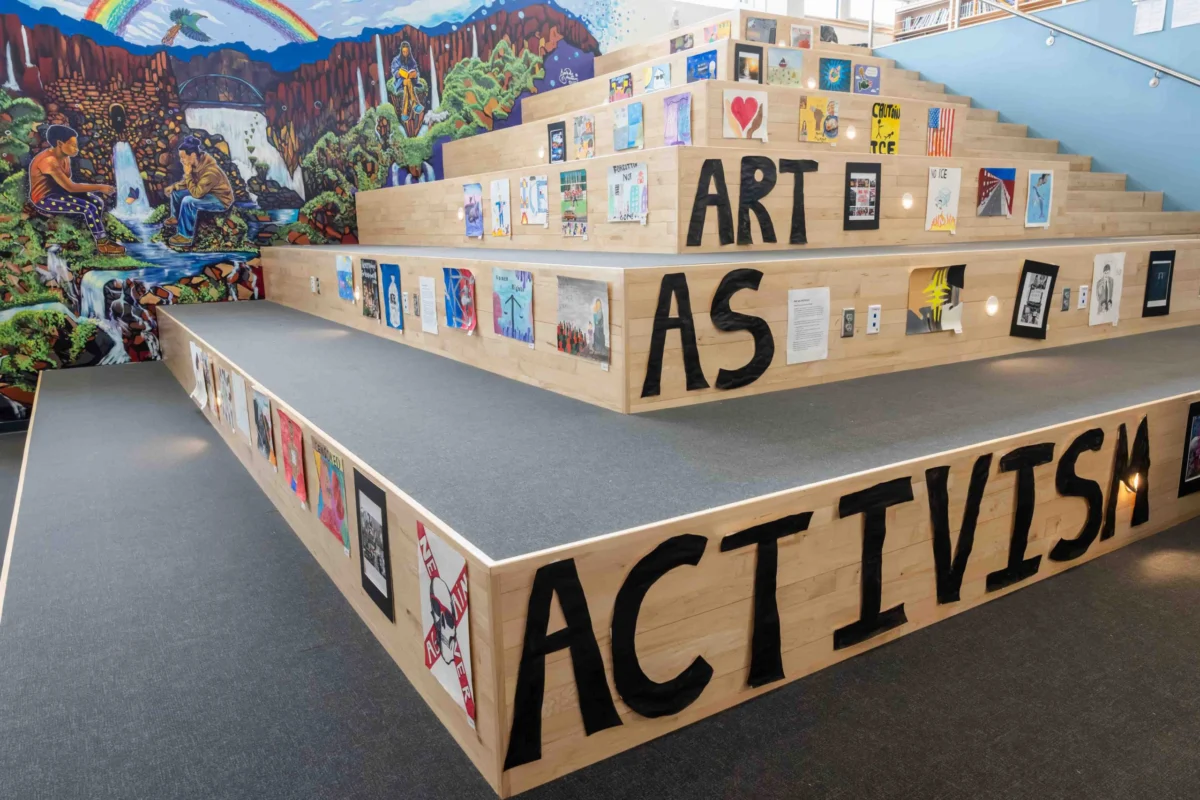
WINOOSKI, Vt. — The school day at Winooski High School began with a deceptively simple writing prompt: Do you feel safe in school? Why or why not?
For the students in this multilingual learner classroom—a cohort representing families from across the globe, including nations like Somalia, Nepal, Syria, and Bosnia—the question is far from academic. As they scribbled their responses, the tension of the current political climate was palpable.
"I feel safe in school because I saw the school doors are locked every time," one student wrote. Another added, with a sense of guarded relief, "I heard ICE is not here."

In the small, 1.5-square-mile city of Winooski, Vermont’s most diverse school district, the feeling of security is not an accident of geography; it is a hard-won victory of policy and principle. As the second Trump administration continues to challenge the fundamental role of public education, targeting diversity, equity, and inclusion (DEI) initiatives and threatening to withhold federal funding from districts that refuse to cooperate with immigration enforcement, Winooski has emerged as a rare, defiant bulwark.
The Mounting Federal Pressure
The current administration has engaged in an aggressive campaign to reshape the American educational landscape. This includes federal investigations into school district DEI efforts, the rescinding of long-standing policies that protected students from Immigration and Customs Enforcement (ICE) actions on school grounds, and explicit encouragement for states to challenge the landmark 1982 Supreme Court decision Plyler v. Doe, which guarantees undocumented children the right to a public education.
While many school districts across the country have chosen to self-censor or retreat into silence to avoid federal scrutiny, the Winooski School District—led by Superintendent Wilmer Chavarria—has chosen the opposite path.

Last year, Winooski became the first district in Vermont to codify a "sanctuary school" policy. This policy formalizes the protection of student data from immigration officials and strictly restricts access to school campuses for federal agents without a signed judicial warrant. When the administration later demanded that districts sign a document certifying their compliance with a federal ban on DEI efforts, Chavarria refused.
A Chronology of Conflict
The friction between the federal government and the Winooski district is not merely theoretical; it has become deeply personal and increasingly dangerous.
- June 2025: Superintendent Wilmer Chavarria, a naturalized U.S. citizen, was detained by immigration officials for several hours at the Houston airport while returning from a family trip to Nicaragua. His electronic devices were seized, and he was subjected to extensive interrogation regarding his marriage and professional background.
- November 2025: A second-grade student in the district was detained alongside his mother during a federal enforcement action. Despite the desperate appeals of his teachers—who were denied permission to even send the boy his schoolwork—the family was held in a detention center in Dilley, Texas, for seven weeks before ultimately choosing to self-deport.
- December 2025: Tensions boiled over when a student raised the Somali flag on a pole outside the high school. A video of the event went viral on right-wing social media, triggering a deluge of racist vitriol. The district was forced to temporarily shutter its website and disconnect school phones as they received hundreds of death threats, which were subsequently referred to the FBI and Vermont State Police.
- Spring 2026: Following the threats, the district implemented heightened security measures, including locking internal hallways and restricting access between building sections, fundamentally altering the school’s daily atmosphere.
Demographic Realities and Institutional Values
Nestled along the Winooski River on the edge of Burlington, Winooski is a district that defies the homogeneity often associated with rural Vermont. Nearly 60 percent of its 800 students are people of color, more than one-third are English language learners, and approximately 71 percent live in poverty.

For three decades, the town has served as a federal refugee resettlement hub. However, this commitment has been tested by federal policy shifts. In 2026, the administration slashed the national refugee admission cap to 7,500—the lowest level since the program’s inception. Consequently, refugee resettlement in Vermont has slowed to a trickle, with only about 50 individuals relocated to the state this year.
Despite these headwinds, the community support for the school’s stance remains robust. "Wilmer has been a brave voice in a time in our country where that’s being punished," said Robin Merritt, a parent of three, as she dropped her children off at school. "Most of the public is pretty proud of his leadership."
Official Responses and Political Fallout
The administration’s stance remains uncompromising. White House spokesperson Abigail Jackson, when pressed on the death threats directed at Winooski, distanced the administration from the individuals making them but reiterated a hardline rhetoric: "Aliens who come to our country, complain about how much they hate America, fail to contribute to our economy, and refuse to assimilate into our society should not be here. And American schools should fly American flags."

For Chavarria, the choice to stand firm is a moral calculation rather than a financial one. While federal funding accounts for about 6 percent of the district’s annual budget—a sum the district could potentially lose—the superintendent argues that the cost of compliance is far higher.
"When somebody wants us to lose funding, we’re going to lose it anyways," Chavarria said. "The difference is, did we lose it while bending the knee, or did we lose it while standing up for our values? Either way, the outcome will be the same."
Implications for Public Education
The impact of Winooski’s policy reaches far beyond its own borders. In May, the Vermont Legislature passed a law modeled directly after the Winooski sanctuary policy, mandating that all school districts in the state establish clear protocols regarding immigration enforcement.

Ignacia Rodriguez Kmec, policy counsel at the National Immigration Law Center, argues that these protections are essential for the health of the entire educational ecosystem. "You want to be able to show that you support all families," she said. "They should participate and not be afraid of coming to school."
Research supports this view. A 2022 study published in the Journal of Immigrant and Minority Health found that students from mixed-status families performed better academically and reported fewer social issues when attending schools with "safe zone" policies.
"I really see the impact in the classroom," said Caitlin MacLeod-Bluver, an English and history teacher at Winooski High and the 2025 Vermont Teacher of the Year. "When kids feel seen and heard and valued, it shows up in the work they’re doing."

The Human Toll and the Road Ahead
Despite the protections afforded by the school district, the reality outside the school walls remains precarious. Teachers like MacLeod-Bluver and her colleagues have taken to volunteering as temporary guardians for students whose parents are at risk of detention.
The psychological toll on the leadership is equally significant. Chavarria and his husband were forced to relocate to a hotel for several days following the December death threats. The fear, he admits, is constant. "It does feel like we are alone in an ocean," he said. "It is very, very scary. It is draining. It’s like a nightmare that you wish one day ends, because you feel like nobody else understands it."
Yet, inside the classroom, there are moments of profound normalcy. During a recent reading lesson, teacher Becky Savage pulled up images of the moon captured by the Artemis II mission. For a few minutes, the students—many of whom have fled war-torn nations or live in fear of federal agents—were transported 250,000 miles away. They asked questions about technology, space, and the internet.

For those few minutes, the political firestorm surrounding their school was set aside, replaced by the universal curiosity of youth. But as the bell rings and the students prepare to return to the world outside, the reality of the "Know Your Rights" pamphlets on the classroom table serves as a stark reminder of the unique, dangerous, and essential role that Winooski High School continues to play in the lives of its students.
