

By Adriane Quinlan
As one wanders east from the bustling commercial corridors of West Broadway toward the intersection of Prince and Macdougal, the cacophony of modern Soho begins to recede. Here, the scale shifts. The neighborhood’s signature cast-iron lofts—the gargantuan monuments to 19th-century commerce—give way to a quieter, more intimate architecture: a pair of three-story brick townhouses dating back to the 1830s.
While the neighboring No. 205 is well-known to locals for its lush, tropical facade tended by long-term artist residents, No. 203 Prince Street has maintained a more stoic, enigmatic presence. Marked only by a discreet bronze plaque denoting its landmark status, the home is now on the market for $10.75 million—a staggering departure from the $17,000 price tag it carried when Gordon McCollum first purchased the property in 1969. The sale marks the end of a multi-decade labor of love, a house that served not merely as a residence, but as a vessel for architectural history and a centerpiece of a social life that defined an era of Manhattan refinement.
The Foundations of a Restoration
In 1969, the landscape of Soho was radically different. The area was transitioning from an industrial manufacturing hub into a bohemian frontier. When McCollum, a commercial real estate broker, partnered with fellow broker Raf Borello to acquire the property, the building was a shell of its former self, carved into dingy, uninspired apartments.
The renovation was an exhaustive, years-long endeavor that bordered on the obsessive. McCollum, who balanced his career in real estate with rigorous night courses in architectural history at Columbia University, was driven by a desire to reclaim the building’s original Federal-style integrity. The structure, built in 1834, sat at a fascinating crossroads of American design—a period when the austere, balanced proportions of the late 18th century were being infused with the decorative flourishes of the Greek Revival movement.
To execute this restoration, McCollum leveraged a high-level network of preservationists, most notably James Biddle, the former curator of American Decorative Arts at the Metropolitan Museum of Art and a former president of the National Trust for Historic Preservation. Whenever a period-appropriate home in New York was slated for demolition or gut renovation, Biddle would tip off McCollum.
“They would go rushing up with vans to get fireplaces, balustrades, and moldings,” says Andrea Anson, McCollum’s longtime partner. “Bit by bit, he reconstructed the history of the house.”
A Chronology of Care
The evolution of 203 Prince Street is a study in stewardship. The timeline of its transformation reveals a deep commitment to historical continuity:
- 1834: The townhouse is constructed during the early development of the neighborhood, serving as a residence for a merchant family.
- 1888: An architect expands the attic into a full-height third floor, seamlessly integrating windows to match the aesthetic of the lower levels.
- 1969: Gordon McCollum and Raf Borello purchase the property, which is then divided into rooming-house units.
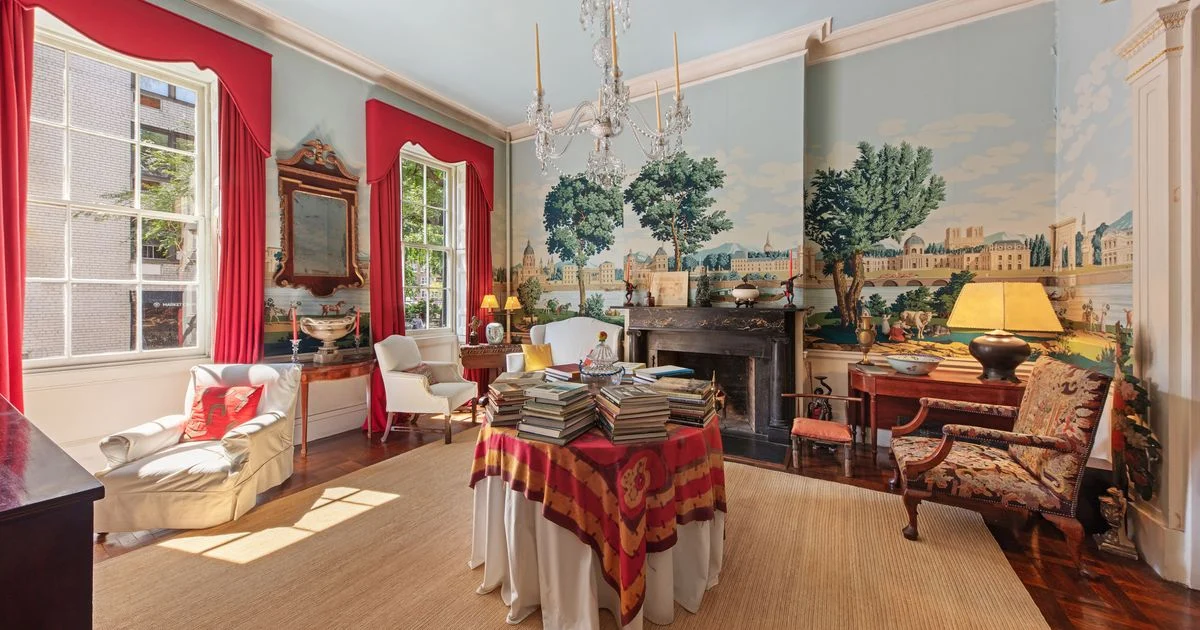
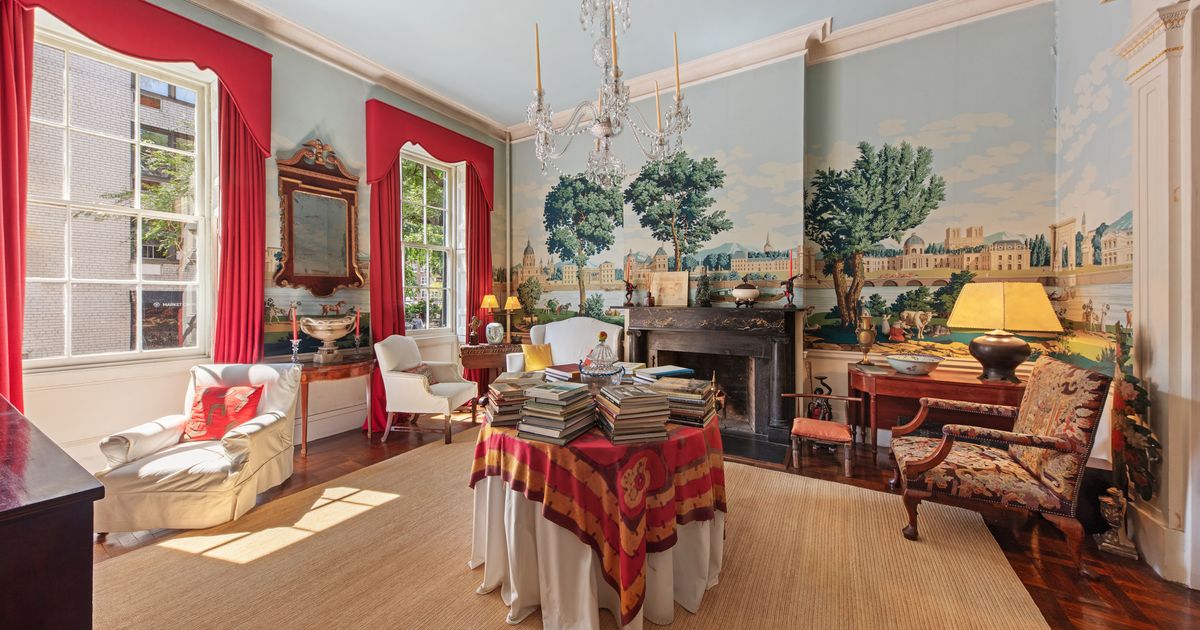
- 1970s: The interior is painstakingly restored. McCollum installs a 1970s reproduction of the 1814 Zuber wallpaper, Monuments of Paris, which remains a focal point of the parlor today.
- 1978: McCollum meets Andrea Anson, who becomes his partner and collaborator. The house evolves from a strict historical museum into a vibrant home for dinner parties, hosting luminaries like Angela Lansbury.
- 1980s: The garden-level studio is reclaimed and transformed into a library to house the American Architectural Library collection, purchased from the late architect and professor Alan Burnham.
- 2000: Gordon McCollum passes away, leaving the home and its extensive archives to be cared for by Anson.
- 2024: The property is listed by Richard Orenstein of Brown Harris Stevens.
Supporting Data: The Anatomy of a Landmark
The property at 203 Prince Street is a testament to the durability of 19th-century craftsmanship, reinforced by modern preservation. The residence spans multiple levels and features:
- Price: $10,750,000.
- Taxes: Approximately $2,771 per month.
- Specifications: 6 bedrooms, 3.5 bathrooms, and a private rear garden.
- Architectural Features: Six original wood-burning fireplaces, a cellar equipped with modern laundry facilities and climate-controlled storage, and a garden-level studio apartment.
- Provenance: The main staircase was salvaged from an 1830s Connecticut mansion; the entry hall features 19th-century Chinese portraits; and the library remains a monument to the collection of Alan Burnham, featuring original folios of McKim, Mead & White drawings.
The Human Element: Anson and the “AAA” Legacy
The house was not just a monument to the past; it was a living entity. The garden level, which served as a home for the American Architectural Library (often marked by the stenciled “AAA” visible from the street), became a sanctuary for scholars. When McCollum fell ill with cancer in 2000, his connection to the house deepened. Following his passing, the Avery Library at Columbia University was invited to catalog and curate the collection, with many pieces donated in McCollum’s honor.
For Anson, who has spent 22 years in the home since McCollum’s death, the decision to sell is rooted in the practical realities of aging in a vertical, historic space. “I’m 75,” Anson notes. “With all the stairs, lugging the suitcases up is a killer.”
The departure of Anson signifies the conclusion of a 55-year tenure that saved a rare piece of Soho’s architectural heritage from being lost to the city’s rapid cycle of demolition and renewal.
Implications for the Soho Real Estate Market
The listing of 203 Prince Street provides a rare window into the “lost” Soho—the version of the neighborhood that existed before the high-fashion boutiques and international luxury retailers transformed the area into a global shopping destination.
For potential buyers, the property represents an opportunity to acquire not just a home, but a finished historical project. Unlike many townhouses that require significant structural retrofitting, 203 Prince Street has been under the constant, meticulous care of a preservation-minded owner for over half a century.
However, the property also highlights a growing trend in Manhattan’s high-end market: the shift away from massive, converted lofts toward the restoration of traditional townhouses. As buyers seek more defined, intimate spaces that offer character and history rather than open-floor-plan industrialism, properties like 203 Prince Street are seeing renewed interest.
The sale of this townhouse is expected to draw interest from architectural historians and high-net-worth individuals who value the narrative of the home as much as its location. As the keys prepare to change hands for the first time in over 50 years, the legacy of Gordon McCollum—and the preservation movement he championed—remains etched into every detail of the house, from the Greek Revival cornices to the whispering fountain in the garden.
Ultimately, 203 Prince Street stands as a reminder that in a city defined by constant change, there are still pockets of history that, with enough devotion, can remain entirely, beautifully, the same.
