

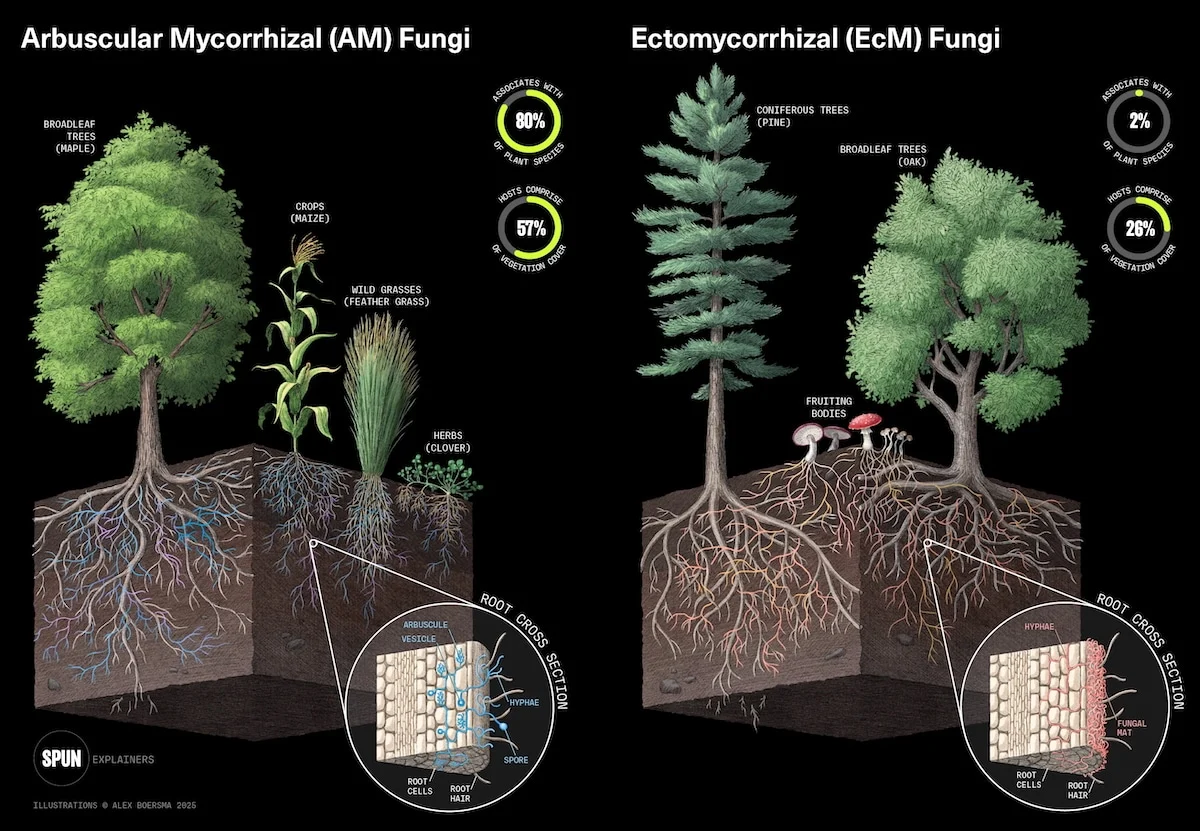
For centuries, humanity has looked to the skies to predict the weather and to the surface to map our forests, mountains, and oceans. Yet, beneath our feet lies a vast, intricate, and largely invisible biological infrastructure that governs the health of the entire planet. Mycorrhizal fungi—the symbiotic organisms that bridge the gap between soil minerals and plant roots—are now being recognized as the "circulatory system" of the Earth.
However, a landmark study published in the journal Nature by researchers at the Society for the Protection of Underground Networks (SPUN) warns that these critical ecosystem engineers are at a breaking point. With 90 percent of mycorrhizal biodiversity hotspots currently located outside of protected areas, the global community faces a hidden extinction crisis that threatens food security, carbon sequestration, and climate resilience.
The Main Facts: An Invisible Crisis
Mycorrhizal fungi are not merely soil inhabitants; they are the architects of terrestrial life. By forming subterranean networks, these fungi provide essential nutrients to plants, allowing them to thrive in diverse environments. In exchange, they receive carbon from the plants, which they store deep within the soil.
The scale of this operation is staggering: these networks draw more than 13 billion tons of carbon into the soil every year—a figure equivalent to approximately one-third of global fossil fuel emissions. When these networks are disrupted by deforestation, intensive agriculture, or industrial development, the result is a cascade of environmental failures: forest regeneration slows, crop productivity plummets, and the resilience of ecosystems to extreme weather events is severely compromised.
The recent SPUN analysis, which utilized over 2.8 billion fungal sequences across 130 countries, provides the first high-resolution, predictive map of these underground communities. The findings are sobering: the very areas that sustain the most unique and biologically rich fungal communities are almost entirely unprotected, leaving them vulnerable to human activity.
Chronology: A New Era of Underground Exploration
The path to this discovery has been a multi-year, global scientific undertaking. The story of our understanding of these networks can be broken down into three distinct phases:
1. The Pre-Mapping Era
For decades, mycologists were aware of the importance of fungi, but their research was limited by "fungus blindness." Because these organisms live underground, they were historically excluded from major conservation agendas. While terrestrial biodiversity was being mapped with satellites, the soil remained a "black box" of biological data.
2. The 2021 Foundation
In 2021, the Society for the Protection of Underground Networks (SPUN) was formally established. Its mission was clear: to map the world’s fungal networks and provide concrete, actionable data to policymakers. This initiative sought to transform the way we view soil health, shifting the focus from mere dirt to a complex, living network that requires protection.

3. The 2025 Breakthrough
In July 2025, the release of the Nature study, "Global hotspots of mycorrhizal fungal richness are poorly protected," marked a turning point. By synthesizing 2.8 billion DNA sequences, the team successfully created the world’s first comprehensive atlas of arbuscular and ectomycorrhizal fungi. This data has now been made available to global conservation groups, providing a roadmap for the future of land management.
Supporting Data: The Magnitude of the Network
The data generated by SPUN is unprecedented in the field of mycology. Currently, the organization’s dataset includes more than 40,000 physical specimens representing 95,000 distinct mycorrhizal fungal taxa. This represents a massive leap in our knowledge, especially considering that researchers estimate only 0.001 percent of the Earth’s surface has been sampled to date.
Key data points from the research include:
- The 90 Percent Gap: 90 percent of identified biodiversity hotspots for mycorrhizal fungi currently lack any form of legal protection.
- The "Protected" Failure: Only 9.5 percent of fungal biodiversity hotspots are located within existing, internationally recognized protected areas.
- Carbon Sequestration: The networks are responsible for sequestering approximately 13 billion tons of carbon annually, acting as a natural, biological carbon sink that rivals any technological solution currently under development.
The "Underground Explorers" program, an international network of 96 scientists from nearly 80 countries, is currently working to expand this dataset by sampling some of the most remote ecosystems in the world, including the high-altitude regions of Bhutan, the vast landscapes of Mongolia, and the ecologically sensitive regions of the Guinean forests in West Africa.
Official Responses: Shifting the Global Paradigm
The scientific and conservation communities have reacted to the study with a sense of urgency. Dr. Toby Kiers, Executive Director of SPUN, notes that the implications of the findings go beyond simple biology.
"If we have healthy fungal networks, then we will have greater agricultural productivity, bigger and beautiful flowers, and can protect plants against pathogens," Kiers stated. "450 million years ago, there were no plants on Earth, and it was because of these mycorrhizal fungal networks that plants colonized the planet and began supporting human life."
Dr. Merlin Sheldrake, impact director at SPUN, emphasized the need for a change in perception: "For too long, we’ve overlooked mycorrhizal fungi. These maps help alleviate our ‘fungus blindness’ and can assist us as we rise to the urgent challenges of our times."
The work has garnered support from some of the most prominent names in conservation and literature, including Jane Goodall, Paul Hawken, and Michael Pollan. Their involvement underscores the need for these maps to reach beyond the scientific community and into the hands of policy and law makers. Jason Cremerius, SPUN’s chief strategy officer, summed up the ambition of the project: "The idea is to ensure underground biodiversity becomes as fundamental to environmental decision-making as satellite imagery."

Implications: The Future of Conservation
The implications of the SPUN research are transformative for global environmental strategy. The mapping tool provided by the project is designed to be a functional resource for governments and NGOs, allowing them to:
Identifying Biodiversity Hotspots
Conservationists can now overlay these fungal maps with existing land-use data. This allows for the identification of areas that are critical for both above-ground and below-ground health, effectively doubling the impact of protected area designations.
Restoration and Regeneration
Restoration efforts have historically been "dangerously incomplete," according to Dr. Alex Wegmann of The Nature Conservancy. By using these maps, restoration managers can establish quantitative targets, ensuring that when a forest or grassland is replanted, the appropriate fungal communities are included to ensure long-term survival.
Policy and Food Security
With the global population rising, the pressure on arable land is reaching an all-time high. By safeguarding the underground networks that increase crop resilience and nutrient uptake, policymakers can adopt a more sustainable, nature-based approach to food security that reduces the need for chemical fertilizers.
Underground Conservation Corridors
Perhaps most exciting is the potential for "underground conservation corridors." Much like animal migratory pathways, these corridors would protect contiguous tracts of land to ensure that fungal networks can remain connected and genetically diverse. This approach would allow for the preservation of endemic species that might otherwise be lost to habitat fragmentation.
Conclusion
The discovery that our planet’s "circulatory system" is largely unprotected is a wake-up call for the global community. As we face the twin crises of climate change and biodiversity loss, the work of SPUN provides a rare beacon of clarity. We are no longer operating in the dark. With the high-resolution data now available, the choice is ours: we can continue to ignore the foundation of terrestrial life, or we can begin the work of protecting the hidden networks that have supported the planet for hundreds of millions of years.
As Dr. Michael Van Nuland, the lead author of the study, aptly stated: "These maps are more than scientific tools—they can help guide the future of conservation. Food security, water cycles, and climate resilience all depend on safeguarding these underground ecosystems."
The era of ignoring the underground is over. It is time for our environmental policies to reflect the reality that what happens beneath the soil is just as important as what grows above it.
