

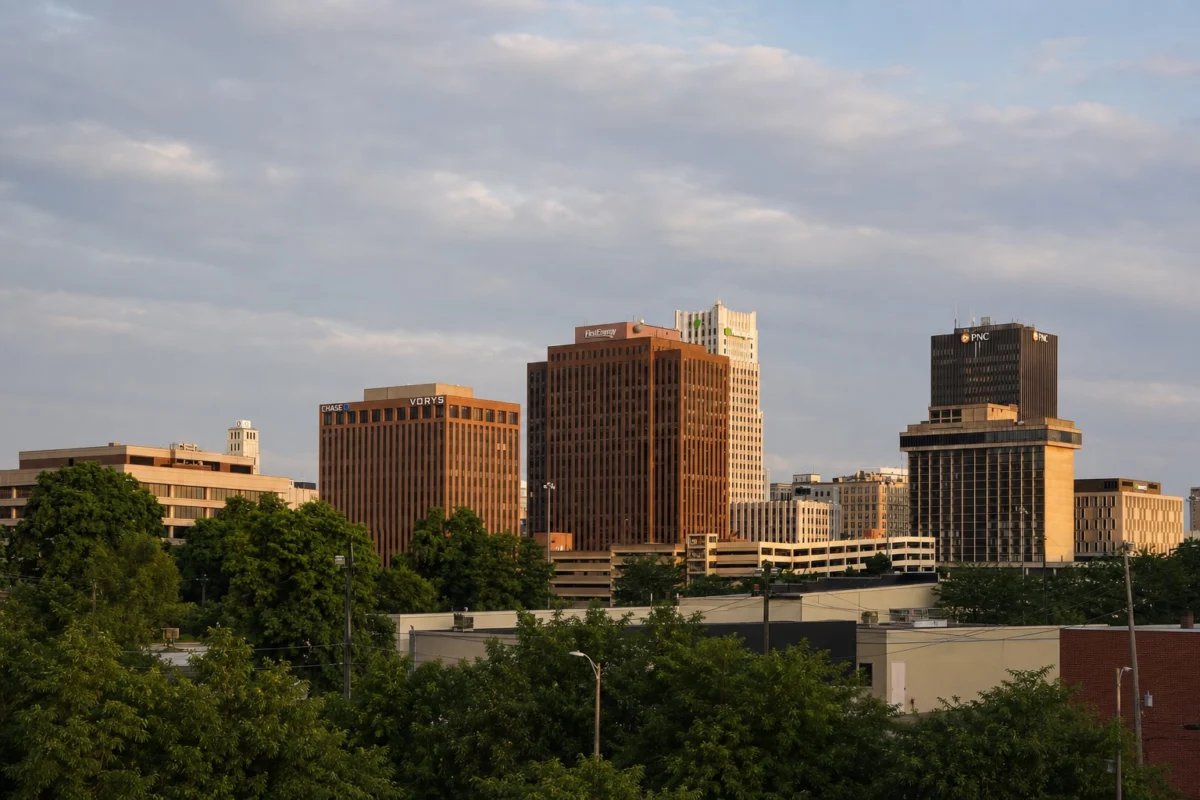
For decades, the narrative of Akron, Ohio, has been defined by a singular, melancholy arc: the rise and fall of the “Rubber Capital of the World.” Located 40 miles south of Cleveland, this heartland hub was once a global industrial titan. Today, however, city planners and local officials are orchestrating a deliberate pivot, aiming to shed the “Rust Belt” moniker by dismantling the very bureaucratic hurdles that have stifled the city’s post-industrial rebirth.
At the center of this transformation is a bold legislative push to eliminate minimum lot size requirements—a move designed to turn a long-standing “shrinking-city paradox” into an engine for residential growth. By clearing the path for developers to build on hundreds of vacant, city-owned parcels, Akron is positioning itself as an affordable, accessible alternative for a generation of Americans priced out of the overheated markets of the Sun Belt.
A Chronology of Change: From Rubber Empire to Modern Metropole
The Industrial Zenith (1870–1960)
Akron’s identity was forged in the late 19th century, anchored by the establishment of the B.F. Goodrich Company in 1870. The city’s strategic location—offering access to cheap water, robust rail infrastructure, and a skilled labor pool—attracted a constellation of industrial giants, including Goodyear, Firestone, and U.S. Rubber. At its peak in the 1960s, the city’s population swelled to nearly 290,000, as the “Big Four” tire manufacturers produced the vast majority of the nation’s rubber goods.
The Great Deflation (1970–2010)
The mid-20th century brought technological and global shifts that Akron failed to anticipate. The rise of the radial tire, coupled with aggressive foreign competition and the outsourcing of manufacturing, triggered a slow-motion collapse. As factories shuttered, the city’s tax base eroded, neighborhoods thinned, and the population began a steady descent that would eventually see the city drop to approximately 190,000 residents. During this period, city planners responded with reactionary zoning codes—rules designed for suburban sprawl rather than the dense, urban grid that defined early Akron.
The Strategy of Renewal (2017–Present)
The modern era of revitalization began in earnest in 2017, when the Downtown Akron Partnership and city leadership launched a coordinated strategy to reinvent the urban core. Focusing on Main Street, the city prioritized “public realm” improvements, streetscaping, and the aggressive incentivization of adaptive reuse projects. This pivot has successfully turned dormant industrial skeletons into modern residential assets, marking a critical turning point in the city’s history.
Supporting Data: The Economics of Adaptive Reuse
The transformation of Akron’s landscape is not merely theoretical; it is backed by significant capital investment and tangible development.
- Downtown Density: In 2019, downtown Akron hosted roughly 450 market-rate apartments. By 2024, that number has more than doubled, with over 1,000 units either completed or under construction.
- The Bowery District: Serving as a flagship project, the 2020 conversion of the Bowery District delivered 92 luxury apartments, proving the market viability of downtown living.
- The Goodrich Complex: The most ambitious undertaking currently underway involves two historic B.F. Goodrich industrial buildings.
- Goodrich Building 10: A $18 million project yielding 46 units, supported by $4.4 million in historic tax credits.
- Goodrich Building 17: A larger-scale investment totaling $30.3 million for 82 units, bolstered by $5 million in tax credits to bridge the financing gap.
These projects underscore a broader national trend: while cities like Austin, Phoenix, and Nashville saw runaway price growth during the pandemic, the Rust Belt remained relatively stable. This stability has created an “affordability hedge,” making cities like Akron increasingly attractive to remote workers and young families who can no longer afford the exorbitant costs of the Sun Belt.
Official Responses: Dismantling the Bureaucratic Barrier
The primary impediment to growth in the modern era is not a lack of land, but a lack of legal permission. Planning Director Kyle Julien has been the most vocal proponent of radical reform, arguing that the zoning codes enacted during the 1970s and 80s are fundamentally incompatible with the city’s current needs.
“We have to ask ourselves as a city, why do we make them do that extra step?” Julien stated in an interview with the Akron Beacon Journal. “Let’s remove the extra step and get them spending their time and their money building houses and putting people in quality homes instead of going through bureaucracy.”
By eliminating minimum lot sizes, the city aims to remove the “variance” process, which currently forces builders to seek special permission just to construct a duplex on an existing, narrow city lot. This initiative is being supported by urban planning experts like Nolan Gray, author of Arbitrary Lines: How Zoning Broke the American City and How to Fix It. Gray has lauded Akron’s approach on social media, noting that “arbitrary zoning rules often make it illegal to redevelop existing vacant lots and build naturally affordable housing in closer-in neighborhoods.”
The Akron Planning Commission has already taken steps to facilitate this by renewing programs to sell nearly 400 city-owned vacant lots. The ultimate goal is to convert these idle parcels into productive, tax-generating residential properties.
Implications: The Future of the Industrial Heart
The implications of these zoning changes extend far beyond the city limits of Akron. If successful, the city will serve as a blueprint for the “Legacy City” model—a strategy that relies on densification and incremental development rather than massive, government-led mega-projects.
1. Reversing the Population Trend
After posting modest gains in 2023 and 2024, Akron’s population has seen slight fluctuations. City officials are under no illusions: reversing the long-term decline requires more than just high-end, adaptive reuse. It requires a diverse housing stock that can accommodate middle-income families. Flexible zoning is the necessary prerequisite for this growth.
2. Economic Diversification
By lowering the barrier to entry for small-scale developers, Akron is encouraging a more decentralized economic recovery. When builders can easily infill vacant lots, they stimulate the local construction industry, increase the city’s property tax base, and create a denser, more walkable urban environment that supports local retail and transit.
3. A New National Narrative
Akron’s evolution highlights a shift in how the American Midwest is perceived. For decades, the region was viewed as a place of terminal decline. Now, as the volatility of the Sun Belt housing market forces a national reckoning with affordability, cities like Akron are being viewed through a lens of potential.
The “Rust Belt” label is increasingly becoming a misnomer. In its place, a new reality is emerging: one where old industrial infrastructure, combined with forward-thinking policy, creates a resilient, affordable, and vibrant urban future. As Akron moves to eliminate the red tape of the past, it isn’t just filling in empty lots; it is filling in the gaps of its own history, laying the groundwork for a new century of growth.
