

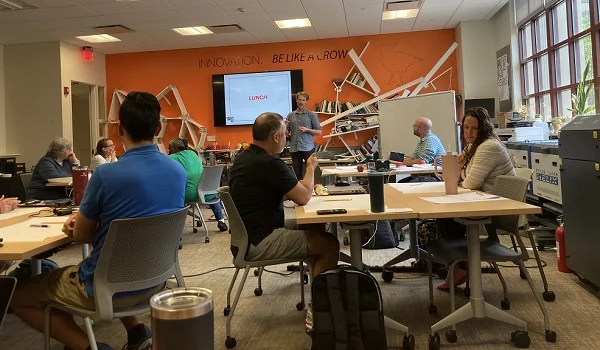
In the heart of New Jersey’s academic and defense research corridor, a quiet revolution is taking place in how the next generation is taught to innovate. This past August, NJTechWeekly.com visited the MIX Lab at Montclair State University (MSU) to observe a high-impact workshop that is fundamentally changing the way educators approach Science, Technology, Engineering, Arts, and Math (STEAM).
Led by professors Jason Frasca and Iain Kerr, the workshop serves as a crucible for K-12 teachers, providing them with the technical proficiency and pedagogical framework necessary to turn 3D printing from a novelty into a transformative classroom tool. Sponsored by the Picatinny Arsenal—a premier U.S. Army research facility—this initiative is not merely about learning how to operate a printer; it is about cultivating a culture of autonomy, agency, and creative problem-solving in schools across the state.
The Strategic Partnership: Connecting Research and the Classroom
The collaboration between Picatinny Arsenal and the MIX Lab at MSU is a marriage of military-grade innovation and pedagogical expertise. For years, the Arsenal has been a stalwart supporter of STEM and STEAM education in New Jersey’s K-12 school systems. By providing 3D printers and funding support for robotics teams, the Army facility has sought to foster a pipeline of technical talent.
However, the Arsenal recognized early on that providing hardware is only half the battle. "They engaged us many years ago to teach the teachers how to use their 3D printers," explains Jason Frasca. What began as basic technical training has evolved into a sophisticated program that addresses the deeper challenges of modern education. By covering the costs for educators to attend, the Picatinny Arsenal ensures that cost is not a barrier to entry for schools looking to integrate cutting-edge technology into their curricula.
The partnership operates on the belief that for students to truly thrive in the 21st century, they need more than just exposure to technology; they need to understand the design logic that drives it.
Chronology of a Workshop: From Analog Drawing to Digital Mastery
The workshop’s structure is meticulously designed to break down the intimidation factor often associated with Computer-Aided Design (CAD) software.
The Morning Session: Bridging the Analog and Digital
The day began not with a keyboard, but with a pencil and paper. Iain Kerr led the educators through rudimentary design exercises that encouraged them to use their entire bodies to conceptualize form. The goal was to bypass the "screen barrier"—the tendency for students to freeze when faced with a blank digital canvas.
By grounding participants in analog drawing first, Kerr built a bridge to the digital. The teachers learned to connect basic shapes—rectangles, circles, and spheres—that serve as the fundamental building blocks of both physical sketches and 3D modeling software. As Frasca noted, this process builds a "muscle memory" that allows teachers to move from an abstract idea to a physical manifestation with greater confidence.
The Afternoon Session: Independent Inquiry and Exploration
As the day progressed, the focus shifted from foundational skills to independent mastery. Kerr emphasized that the modern classroom should move away from the "follow-the-instructor" model. Instead, students—and teachers—should be encouraged to explore software tools independently, keeping multiple tabs and workflows open to facilitate a creative, non-linear design process.
A key highlight of the afternoon was the "gallery walk." Teachers moved around the room to examine each other’s work, a technique designed to turn the classroom into a community of practice. By seeing the myriad ways their peers approached a single design challenge, the educators realized that there is no "one right way" to create a design.
Redefining Design Pedagogy: The "25-Minute" Rule
One of the most radical aspects of the MSU approach is its rejection of the traditional, long-form software training model. In many academic settings, students are expected to learn every tool in a software suite for months before they are allowed to "create" anything. Frasca argues that this is fundamentally counterproductive.
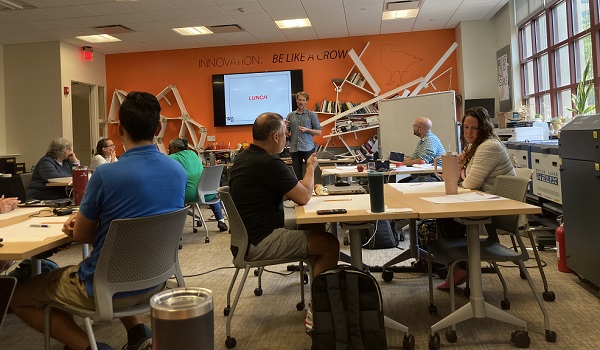
"Our approach is to, within 25 minutes, get everybody actually creating something that they could 3D-print," says Frasca. By using basic tools to create a cube and then manipulating that cube into a sphere, students learn that a single object can be the seed for virtually any design. This immediate gratification serves a psychological purpose: it proves to the student that they have agency over the machine. When a student sees their digital file become a physical object within an hour, the "fear of the software" vanishes.
Theoretical Implications: Ideation vs. Novelty
Perhaps the most thought-provoking component of the workshop involves the distinction between ideation and novelty. Frasca challenges the conventional wisdom regarding innovation: "We can only ideate what we know, what you’ve already seen and been exposed to, heard, or engaged with. And therefore, we can never ideate anything novel or unique."
This is a profound statement for educators. If a student is merely drawing from their existing knowledge base, they aren’t innovating; they are simply iterating. The MIX Lab’s framework uses design software to force the creator into a new space. By manipulating parameters within the CAD environment, students are pushed to create forms that exist outside of their initial imagination.
"We demonstrate these frameworks and approaches within the design software, so teachers, and ultimately their students, are simultaneously learning how to design beyond what they can imagine," Frasca explains. In this view, the software is not just a tool; it is a catalyst for cognitive expansion.
Implications for the Classroom: Building Agency
The broader goal of this initiative is to move the classroom away from rote memorization and toward "autonomy and agency."
Empowering the Teacher as Facilitator
By modeling this approach with the teachers, the MIX Lab ensures that the instructors are not just learning software; they are learning how to manage a classroom where students drive their own inquiry. When a teacher knows how to troubleshoot their own designs, they become better mentors. They can step back and allow students to "fail forward," viewing errors in a 3D print as a vital part of the engineering feedback loop rather than a sign of incompetence.
Developing 21st-Century Skills
The skills being imparted—spatial reasoning, iterative prototyping, algorithmic thinking, and collaborative design—are the exact competencies required for the modern workforce. Whether a student eventually goes into engineering, medicine, or the arts, the ability to visualize a solution, design it digitally, and manufacture it physically is a universal asset.
Conclusion: The Path Forward
The enthusiasm displayed by the teachers during the August workshop was palpable. As they moved from basic cube manipulation to complex, self-envisioned objects, the room transformed from a space of instruction into a laboratory of innovation.
By equipping educators with the tools to teach creativity, the Montclair State University MIX Lab and the Picatinny Arsenal are doing more than just training teachers; they are upgrading the operating system of the New Jersey K-12 education experience. As these teachers return to their classrooms, they carry with them the knowledge that 3D printing is not just about making plastic trinkets—it is about teaching students how to manifest their ideas into the physical world, fostering a generation that is not afraid to design the future.
As the landscape of technology continues to evolve at breakneck speed, initiatives like these remain the gold standard for how public-private partnerships can bridge the gap between abstract academic concepts and real-world innovation. The workshop serves as a reminder that the most important tool in any classroom is the confidence of the student—and that confidence begins with an empowered teacher.
