

The relationship between the executive branch and the Smithsonian Institution—the world’s largest museum, education, and research complex—has entered a period of unprecedented volatility. In a series of late-night communications via Truth Social, President Donald Trump has issued a sweeping set of demands aimed at the National Museum of American History, calling for a fundamental restructuring of its aesthetic and educational priorities. At the heart of this dispute is a call to replace long-standing modernist art with monumental, traditionalist iconography, specifically centered on the figure of George Washington.
This intervention, coming amidst a broader push by the administration to reorient federal cultural institutions, signals a shift in the philosophy of public history. As the Smithsonian navigates these demands, the tension between scholarly independence and executive oversight has reached a breaking point, sparking a national debate over who owns the American story and how it should be curated for future generations.
A Mandate for Monumentality: The Washington Initiative
President Trump’s recent directives focus on placing George Washington at the center of the National Museum of American History. The most prominent of these requests is the installation of an 11-foot statue of the first president outside the museum, intended to be unveiled on September 17, Constitution Day. This specific statue was previously displayed at the "Freedom 250" IndyCar race, where it stood in the museum’s Flag Hall.
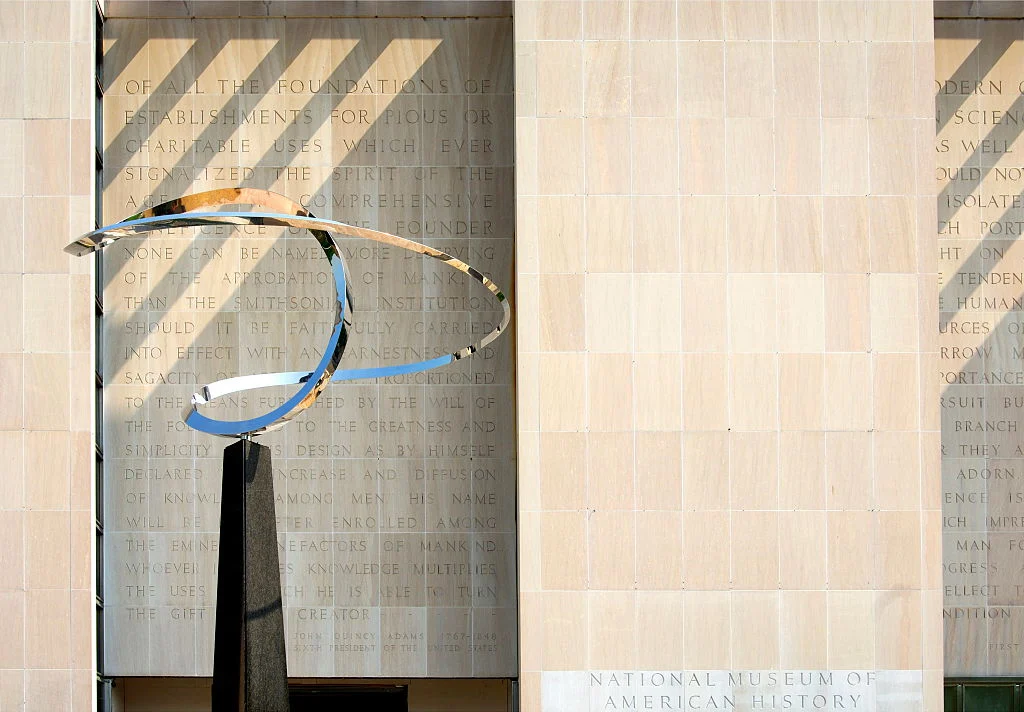
Beyond the temporary installation, the President has called for an extended, multi-year exhibition dedicated to Washington, slated to run through February 22, 2032—the tricentennial of his birth. However, the most controversial aspect of the President’s vision involves the permanent removal of Infinity, a seminal work of kinetic sculpture by New York artist José de Rivera.
Installed at the south entrance of the National Museum of American History in 1967, Infinity represents a milestone in federal patronage. It was the first modern art piece commissioned by the U.S. government under the Art and Architecture Program for the National Mall. The sculpture, a polished stainless steel ribbon that completes a rotation every six minutes, is regarded by art historians as a hallmark of 20th-century American abstraction.
President Trump has characterized the sculpture as "strange" and devoid of national meaning. "Replace a sculpture that says nothing about America with the man who, more than anyone else, says everything about America," Trump wrote while traveling to Ireland. "Washington is easily America’s Greatest Hero. Without him, our Country and our Freedoms wouldn’t exist."
The Chronology of Conflict
The current escalation follows a year of friction between the White House and the Smithsonian’s leadership. The timeline of this cultural impasse provides context for the President’s aggressive stance:
- 2019–2023: The Smithsonian continues its long-term strategic plan, which includes the creation of a "Center for Restorative History" and a "Decolonization Plan," aimed at broadening the narrative of American history to include underrepresented voices.
- Early 2024: The administration begins vocalizing its displeasure with what it terms the "politicization" of history, specifically targeting exhibitions that discuss colonialism or social justice.
- Late 2024: The Kennedy Center, another prominent federal cultural site, quietly dismantles a sculpture by Joel Shapiro. While the institution did not offer a public reason for the removal, the event was interpreted by industry observers as a sign of a new, restrictive climate for contemporary art in federal spaces.
- November 2024: Smithsonian Secretary Lonnie G. Bunch III announces his retirement, marking the end of a tenure defined by efforts to modernize the institution’s approach to inclusive history.
- December 2024: President Trump formalizes his demands via Truth Social, explicitly calling for the removal of Infinity and criticizing the Smithsonian’s framing of the period from 1492 to 1776.
Historical Debates: The "Great Unsettling" vs. Traditionalism
At the core of the President’s critique is a fundamental disagreement over how to interpret the American founding. Trump has taken particular aim at an exhibition that references the arrival of Europeans and the subsequent colonization of the continent as the "Great Unsettling." He described this framing as "twisted" and indicative of a deeper ideological problem within the museum’s curatorial staff.
"Under recently ended leadership, the Smithsonian created a ‘Center for Restorative History’ to focus attention overwhelmingly on those who have been oppressed," the President noted. "There is almost no attention paid to those who triumphed over great oppression, and against great odds."
In response to claims that the museum neglects heroic moments—such as George Washington’s crossing of the Delaware—the Smithsonian has pointed to its existing archives. The museum currently houses multiple artifacts related to the crossing, including 19th-century engravings based on the famous Emanuel Gottlieb Leutze painting, as well as numismatic representations like the 2021 U.S. quarter. Despite these records, the President argues that these items do not provide the prominence or the "heroic" celebration that such a foundational moment requires.
Implications of Executive Intervention
The central legal and procedural question is whether the President possesses the authority to direct the removal of public art from the Smithsonian. The Smithsonian Institution is technically an independent trust instrumentality of the United States, operating largely outside the direct control of the executive branch.
However, the institution relies on federal funding for a significant portion of its budget, providing the White House with considerable leverage. Furthermore, the Smithsonian is overseen by a Board of Regents, which includes high-ranking federal officials. Vice President JD Vance, a member of the Board, has emerged as a key architect of the current administration’s influence, signaling that the White House intends to use its regulatory and budgetary oversight to force a change in management and curatorial focus.
This approach reflects a broader trend of the administration bypassing traditional congressional oversight for cultural projects. A recent, albeit divided, Supreme Court ruling regarding a construction project at the White House East Wing—which the court allowed to proceed despite dissenters labeling it "likely unlawful"—has provided a potential blueprint for how the administration may approach the Smithsonian.
The Future of the National Mall
The dismantling of the Joel Shapiro sculpture at the Kennedy Center, which was subsequently purchased by former chairman David Rubenstein, serves as a harbinger for the current crisis. When cultural institutions are pressured to remove works that are deemed ideologically inconsistent with the administration of the day, the long-term impact on the "public square" becomes a matter of intense concern for curators and civil liberties groups.
If the Smithsonian is forced to reconfigure its displays to prioritize a singular, nationalist interpretation of history, the academic integrity of the institution may be irrevocably altered. Conversely, supporters of the President’s initiatives argue that the Smithsonian has become detached from the values of the American public and that a "course correction" is necessary to restore national pride in the face of what they describe as revisionist history.
As the Smithsonian prepares for a transition in leadership following the retirement of Secretary Bunch, the institution faces a defining moment. It must navigate the demands of an administration that views cultural artifacts not merely as objects of study, but as instruments of national identity and political legacy. Whether the museum can retain its scholarly independence while navigating this high-stakes political terrain remains the most pressing question for the future of American history.
