

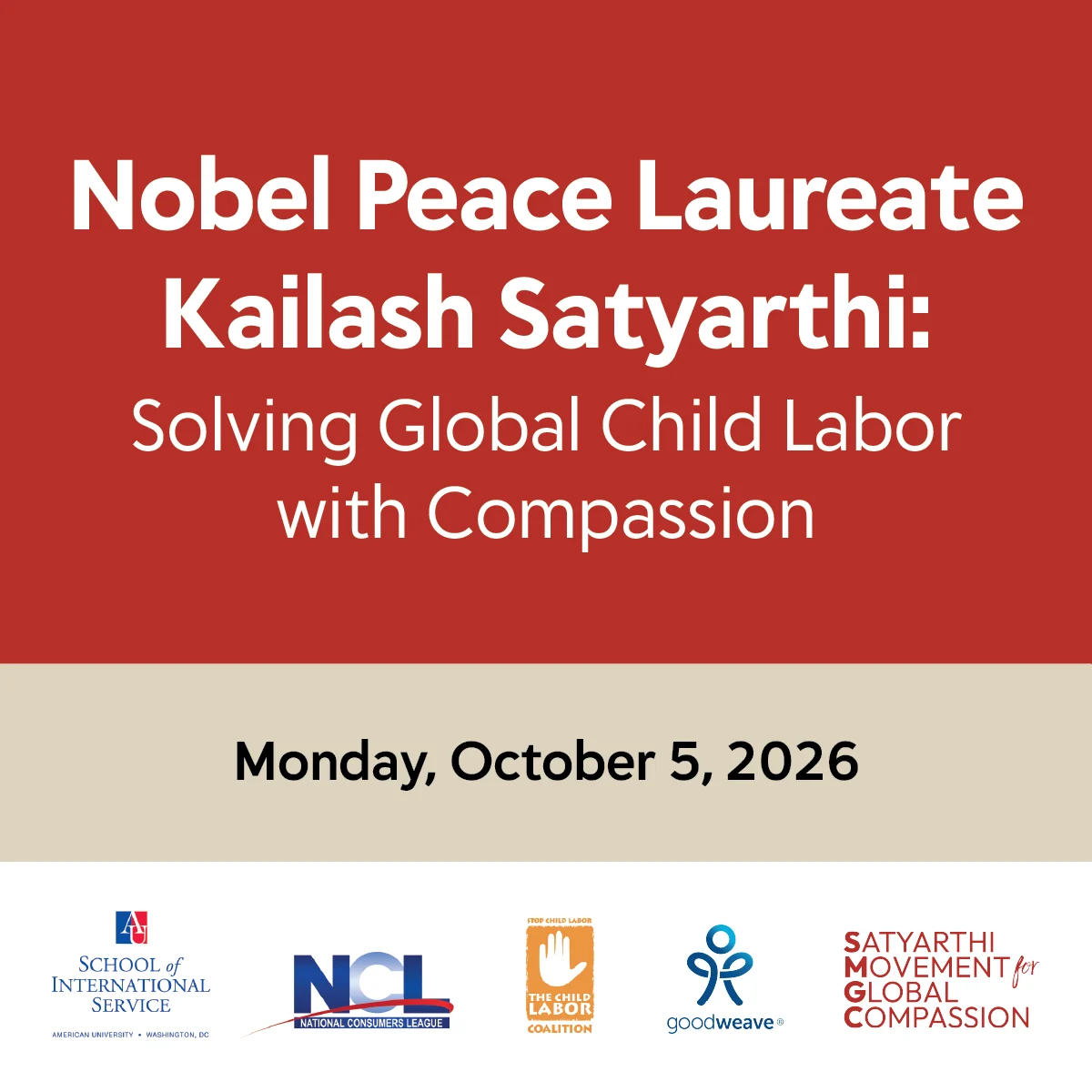
WASHINGTON, DC – As the international community grapples with the enduring scourge of child exploitation, a high-profile assembly of advocates, policymakers, and academics is set to convene in the nation’s capital. On Monday, October 5, 2026, the National Consumers League’s (NCL) Child Labor Coalition (CLC) will host a landmark public forum titled "Solving Global Child Labor with Compassion" at American University’s School of International Service (SIS).
The event will feature a keynote address by Nobel Peace Laureate Kailash Satyarthi, a figure whose decades-long crusade against child servitude has redefined the global human rights landscape. His presence signals a renewed urgency in the fight to protect the world’s most vulnerable populations from hazardous labor.
The Magnitude of the Crisis: Main Facts
Despite international treaties, national laws, and the tireless work of non-governmental organizations, millions of children remain trapped in cycles of forced labor, debt bondage, and hazardous work environments. The upcoming symposium at American University is not merely a lecture series; it is a strategic gathering designed to confront the systemic failures that allow child labor to persist in global supply chains.
The event, scheduled from 2:30 p.m. to 4:00 p.m. in the Abramson Family Founders Room, aims to bridge the gap between academic research and grassroots activism. By bringing together leaders like Mr. Satyarthi, Chairman of the Global March Against Child Labor Tim Ryan, and GoodWeave International CEO Jon Jacoby, the coalition intends to move beyond rhetoric and toward actionable, scalable solutions rooted in the principle of "compassion."
The program will be introduced by Rachel Sullivan Robinson, Interim Dean of the School of International Service, and Sally Greenberg, Co-Chair of the Child Labor Coalition. Their participation underscores the academic rigor being applied to this humanitarian crisis, emphasizing that ending child labor is as much a matter of policy and economic restructuring as it is of moral imperative.
A Legacy of Advocacy: The Chronology of a Movement
To understand the significance of the October 5 event, one must look at the historical trajectory of the anti-child labor movement. For over three decades, the National Consumers League—the oldest consumer organization in the United States—has served as a vanguard in this arena.
- The Foundational Years: Since its inception, the Child Labor Coalition has acted as a clearinghouse for 38 member organizations dedicated to the health, safety, and education of working minors. It has provided the infrastructure for policy lobbying, consumer awareness campaigns, and international pressure.
- The Satyarthi Partnership: Mr. Satyarthi’s involvement is the continuation of a long-standing partnership with the NCL. Having won the Nobel Peace Prize in 2014 for his "struggle against the suppression of children and young people and for the right of all children to education," Satyarthi has long viewed the American consumer market as a critical lever for change.
- The Evolving Landscape: The 2020s have introduced new complexities. The COVID-19 pandemic, followed by a period of global economic volatility, exacerbated poverty levels, which in turn increased the vulnerability of children to exploitation in the garment, agricultural, and mining sectors. The upcoming event at American University serves as a milestone in the post-pandemic recovery efforts, recalibrating the movement to face modern digital-age challenges.
Supporting Data: The Reality on the Ground
The urgency of the "Solving Global Child Labor with Compassion" event is supported by sobering data from international bodies such as the International Labour Organization (ILO) and UNICEF. While exact numbers fluctuate, the latest global estimates indicate that approximately 160 million children are engaged in child labor, with nearly half performing hazardous work that directly endangers their health, safety, and moral development.
The panel moderated by Judy Gearhart, a Research Professor at the Accountability Research Center, will likely delve into the "transparency gap." While many multinational corporations have adopted Corporate Social Responsibility (CSR) policies, the deeper tiers of their supply chains remain obscured.
"We are dealing with a crisis of visibility," notes one policy analyst familiar with the coalition’s work. "The clothes we wear, the food we eat, and the minerals in our electronics are often linked to child labor in ways that are intentionally hidden. This event is about pulling back that curtain."
The panel will address how "compassion" acts as a practical tool for systemic change—challenging businesses to look beyond the bottom line and encouraging consumers to demand rigorous certification standards for the goods they purchase.
Official Responses and Strategic Perspectives
In anticipation of the event, organizers have highlighted the multi-dimensional approach required to eradicate the issue.
Sally Greenberg, Co-Chair of the Child Labor Coalition, remarked, "Our goal is to create a nexus where the power of consumer advocacy meets the intellectual rigor of academia. We are honored to have Kailash Satyarthi, whose life’s work has been a beacon of hope for children everywhere. By fostering this dialogue, we are telling the world that child labor is not an inevitable byproduct of the global economy; it is a policy choice that we have the power to overturn."
The Perspective of the Satyarthi Movement: Mr. Satyarthi has consistently argued that "child labor is a denial of a child’s future." His approach, which emphasizes the "Global March" as a unified front, rejects the idea that child labor is a symptom of poverty alone. Instead, he views it as a cycle perpetuated by a lack of education and a lack of political will. His keynote address is expected to challenge the audience to view children not as economic units, but as stakeholders in the future of the global community.
Academic Institutional Support: By hosting this event, the American University School of International Service (SIS) reaffirms its commitment to producing graduates who engage with the most pressing humanitarian issues of the day. The inclusion of the Accountability Research Center suggests that the conversation will focus heavily on how evidence-based advocacy can force institutional change within global governance structures.
Implications: The Path Toward Elimination
The broader implications of this event extend far beyond the walls of the Abramson Family Founders Room. The focus on "compassion" is a deliberate rhetorical shift. For too long, the discourse on child labor has been dominated by purely economic arguments—focusing on GDP impacts or trade sanctions. By centering "compassion," the coalition is attempting to reclaim the moral high ground and re-energize the public movement.
Key Takeaways for Attendees and Stakeholders:
- Consumer Accountability: The event serves as a call to action for the American consumer. By supporting organizations like GoodWeave and the NCL, individuals can ensure that their purchasing power is not inadvertently funding the exploitation of minors.
- Corporate Responsibility: The dialogue between industry leaders and advocates will highlight the necessity of radical transparency. It will no longer be enough for a company to claim they are "child-labor-free"; they must prove it through verified, independent auditing.
- Legislative Pressure: The coalition continues to push for stronger trade agreements that include enforceable labor standards. The event will likely provide a platform for discussing how domestic U.S. policy can set a global standard for supply chain ethics.
- Education as an Antidote: A central theme will remain the role of universal education. Without access to quality, safe schooling, children are left with few alternatives to labor.
As the world looks toward the future, the message from the Child Labor Coalition is clear: the exploitation of children is a collective failure that requires a collective response. The upcoming gathering at American University serves as a rallying point for those who refuse to accept the status quo.
Registration for the event is currently open to the public, though space is limited. Interested parties are encouraged to secure their attendance via the official Eventbrite portal provided by the NCL. As the organizers prepare to welcome global leaders, the hope is that this afternoon of discussion will catalyze new partnerships, spark innovative policy proposals, and ultimately provide a clearer path toward a world where every child is free to learn, play, and grow.
About the National Consumers League (NCL):
Founded in 1899, the National Consumers League is America’s pioneer consumer organization. Its mission is to protect and promote the social and economic interests of consumers and workers in the United States and abroad. The NCL is the driving force behind the Child Labor Coalition, a partnership of organizations that have been at the forefront of the fight against child exploitation for decades.
About the Child Labor Coalition (CLC):
The CLC, co-chaired by the National Consumers League and the American Federation of Teachers, is a leading voice in the international effort to eliminate child labor. Through its advocacy, research, and public education initiatives, the coalition works to protect the health, safety, and education of working minors. Its 38 member organizations represent a diverse array of interests, all united by the goal of ending the cycle of exploitation that denies millions of children their childhood.
