

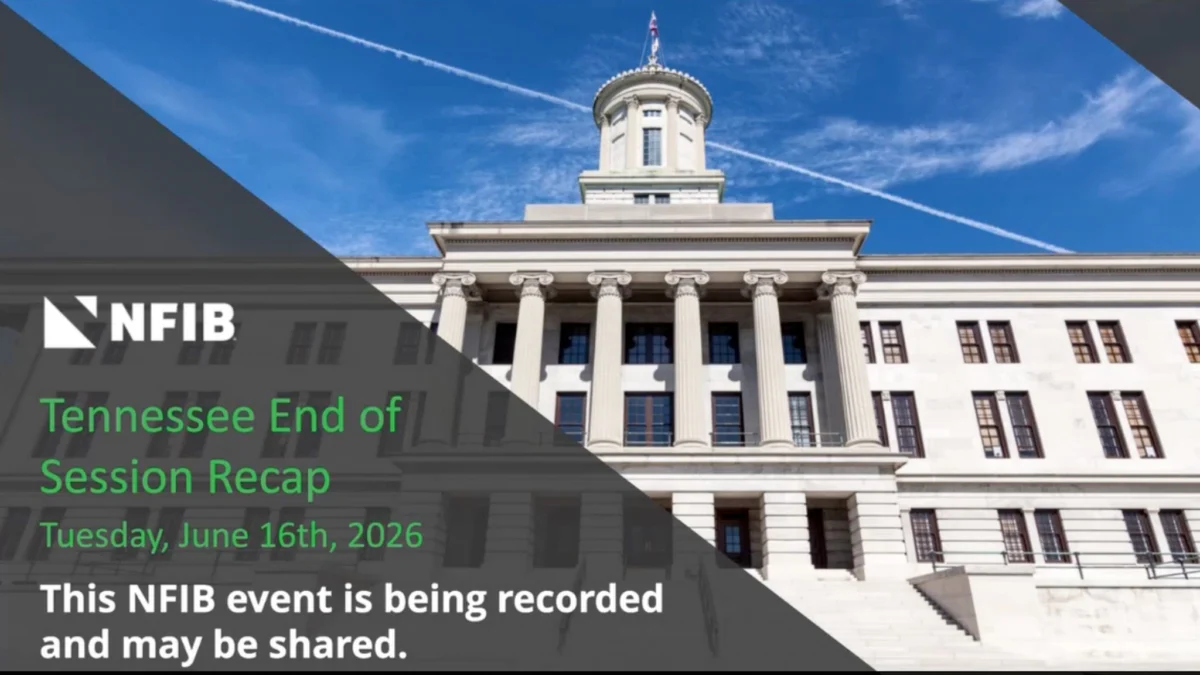
Introduction: Assessing the 114th Tennessee General Assembly
The conclusion of the 114th Tennessee General Assembly on April 23 marked a significant chapter for the state’s economic engine: its small businesses. To dissect the complexities of the legislative session and provide actionable insights for entrepreneurs, the National Federation of Independent Business (NFIB) hosted an in-depth webinar on June 16.
Moderated by NFIB State Director Jim Brown, the session featured a panel of legal heavyweights, including Michael Moschel of Littler Mendelson PC, James V. Thompson of Rainey, Kizer, Reviere & Bell PLC, and Beth Milito, executive director of the NFIB Small Business Legal Center. Together, these experts unpacked the major policy shifts that will dictate how Tennessee small businesses operate in the coming fiscal year, highlighting both hard-won victories and the ongoing challenges of regulatory compliance.
Chronology: The Road to April 23
The 114th legislative session was defined by a delicate balancing act between business-friendly deregulation and the modernization of labor laws. Throughout the session, the NFIB maintained an active presence at the Capitol, advocating for policies that reduce the administrative burden on independent business owners.
- Early Session (January–February): Legislative priorities were set, with a heavy emphasis on labor market flexibility and administrative reform.
- Mid-Session (March): Intense negotiations took place regarding non-compete agreements. Lawmakers sought to find a "middle ground" that respected the rights of employers to protect trade secrets while addressing concerns about workforce mobility.
- Late Session (April): The Regulatory Freedom Act gained traction, signaling a shift toward more transparent rulemaking processes.
- Sine Die (April 23): The session concluded, leaving behind a legislative legacy that aims to refine the state’s business climate.
Key Legislative Wins: A Closer Look
During the June 16 webinar, the panel identified two landmark pieces of legislation that represent a significant shift for the Tennessee business landscape.
The Compromise on Non-Compete Agreements (HB 1034/SB 995)
Perhaps the most discussed topic of the session was the evolution of non-compete law. Historically, Tennessee has relied on judicial precedent to govern these agreements. However, the passage of HB 1034/SB 995 brings a new level of statutory clarity to the table.
The legislation strikes a compromise that addresses the concerns of both business owners and labor advocates. Key provisions include:
- Salary Thresholds: The law prohibits non-compete agreements for employees earning less than $70,000 annually. This ensures that lower-wage workers have greater freedom to move between jobs, while protecting businesses’ investment in highly specialized, higher-earning talent.
- Protecting Proprietary Interests: The bill explicitly preserves the ability of employers to protect legitimate business interests, such as trade secrets, intellectual property, and client relationships.
- Judicial Standards: By establishing clearer criteria for courts, the law reduces the "guesswork" previously associated with litigating non-compete disputes. This provides business owners with more predictability when drafting employment contracts.
The Regulatory Freedom Act (HB 1913/SB 2199)
For many small business owners, the "invisible tax" of compliance is often more damaging than state corporate taxes. The Regulatory Freedom Act represents a victory for transparency in governance.
This act mandates that state agencies must actively solicit feedback from the specific business communities they intend to regulate. By requiring a structured comment period and an analysis of the economic impact of proposed rules, the legislation ensures that:
- Lawmakers understand the "True Cost": Policies are no longer drafted in a vacuum; they must be weighed against the actual financial burden they place on small enterprises.
- Agency Accountability: State agencies are now held to a higher standard of justification before implementing new rules.
- Community Engagement: Business owners are given a seat at the table, allowing them to provide practical, real-world data to prevent "one-size-fits-all" regulations that often disadvantage smaller firms.
Supporting Data: Why These Changes Matter
The urgency behind these legislative changes is rooted in the current economic climate of Tennessee. Small businesses—those with fewer than 50 employees—comprise over 95% of all businesses in the state.
According to recent economic surveys, regulatory compliance costs remain a top concern for Tennessee entrepreneurs. When businesses spend excessive capital on navigating complex, often ambiguous, bureaucratic processes, that is capital diverted from innovation, employee wage increases, or physical expansion.
The NFIB highlighted that the $70,000 threshold in the non-compete law is particularly relevant in the context of Tennessee’s competitive labor market. As the state attracts major industrial and tech investments, the competition for skilled labor has reached an all-time high. Ensuring that companies can protect their proprietary assets—while simultaneously ensuring that the broader workforce isn’t unnecessarily restricted—is vital to maintaining Tennessee’s status as a top-tier state for business.
Official Responses and Expert Commentary
The panel members during the webinar provided invaluable context on how these laws should be interpreted by business owners.
Beth Milito, NFIB Small Business Legal Center:
"The Regulatory Freedom Act is a win for common sense. Too often, agencies lose sight of the fact that a minor regulation can be a massive barrier to entry for a sole proprietor or a small shop. This law forces them to pause and look at the bottom line of the people they are regulating."
Michael Moschel, Littler Mendelson PC:
"Regarding the non-compete law, the takeaway for employers isn’t that they should stop using non-competes. It’s that they must be more strategic. You need to ensure your agreements are narrowly tailored and that your documentation regarding trade secrets and proprietary information is ironclad. The courts now have a clearer roadmap to follow, which means your internal processes need to match that clarity."
James V. Thompson, Rainey, Kizer, Reviere & Bell PLC:
"The legislative session was a success because it reflected a willingness to listen. Small business owners often feel like they are governed at rather than governed with. These bills are a step toward a more collaborative relationship between the General Assembly and the private sector."
Implications: Preparing for the Future
The aftermath of the 114th session leaves Tennessee businesses with a distinct "to-do" list.
1. Reviewing Employment Contracts
With the new salary threshold for non-competes in effect, HR departments and small business owners should audit their current employment agreements. Agreements for employees earning below the $70,000 mark may need to be restructured into non-solicitation or confidentiality agreements to maintain legal protection without running afoul of the new statute.
2. Engaging in the Rulemaking Process
The Regulatory Freedom Act is only as effective as the participation of the business community. Owners are encouraged to sign up for notifications from state agencies regarding new rule proposals. When an agency invites public comment, the "Regulatory Freedom" aspect of the new law relies on businesses submitting clear, evidence-based data regarding the potential costs of compliance.
3. Monitoring Future Legislative Cycles
Jim Brown noted that the work does not end with the gavel. "The legislative landscape is dynamic. We have made progress, but we must remain vigilant. The 115th session will bring new challenges, and the voice of the small business owner must continue to be the loudest one in the room."
Conclusion: A New Chapter for Tennessee
The 114th Tennessee General Assembly has set a precedent for a more business-conscious legislative agenda. Through the combined efforts of the NFIB and a responsive legislature, the state has moved toward a more transparent regulatory environment and a more balanced approach to labor law.
As Tennessee continues to grow, the ability of its small businesses to adapt to these changes will define the state’s economic trajectory. By leveraging the protections afforded by the new laws and remaining engaged in the administrative rulemaking process, business owners are not just protecting their own interests—they are helping to build a more resilient and prosperous Tennessee for all.
For those who missed the June 16 webinar, the NFIB continues to provide resources, templates, and legislative updates on its website, ensuring that every business owner, regardless of size, has the tools necessary to navigate the complexities of the law. The road ahead remains busy, but for the Tennessee entrepreneur, the path is now significantly clearer.
