

By Samuel Hine
For nearly a decade, the vibrant, kinetic energy of New York City’s street life was noticeably absent from the solo exhibitions of Ryan McGinley. Having spent the early 2000s cementing his reputation as the premier documentarian of a specific, hedonistic brand of downtown youth culture—capturing the raw, unvarnished lives of icons like Dash Snow and Kunle Martins—McGinley eventually pivoted toward the ethereal, wilderness-focused photography that defined his mid-career. However, this summer, the artist returns to his roots.
Opening June 13 at Jeffrey Deitch’s Wooster Street gallery, "Night Shift" marks McGinley’s first solo exhibition in New York since 2018. It is a sprawling, atmospheric love letter to the city, composed entirely of images captured between the hours of 9 p.m. and 5 a.m. From the manicured lawns of Central Park to the industrial grit of Queens, McGinley has spent the last year reacquainting himself with the city that made him, finding a version of New York that only reveals itself when the rest of the world is asleep.
The Architecture of the Midnight Hour: Main Facts
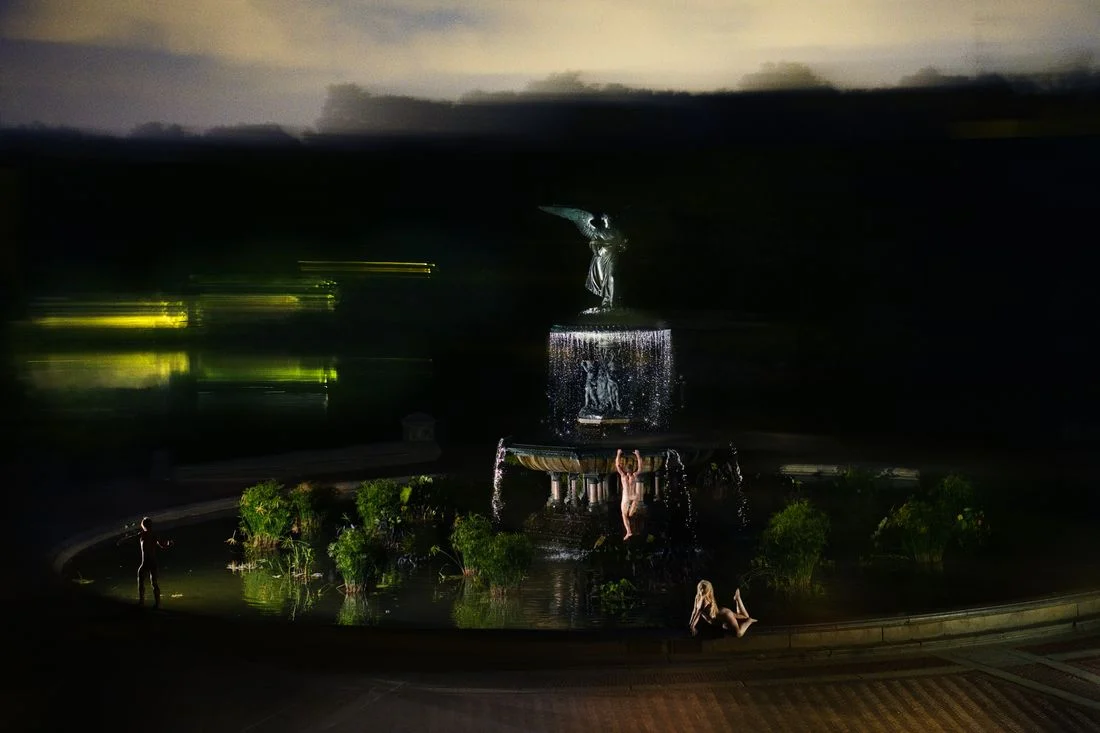
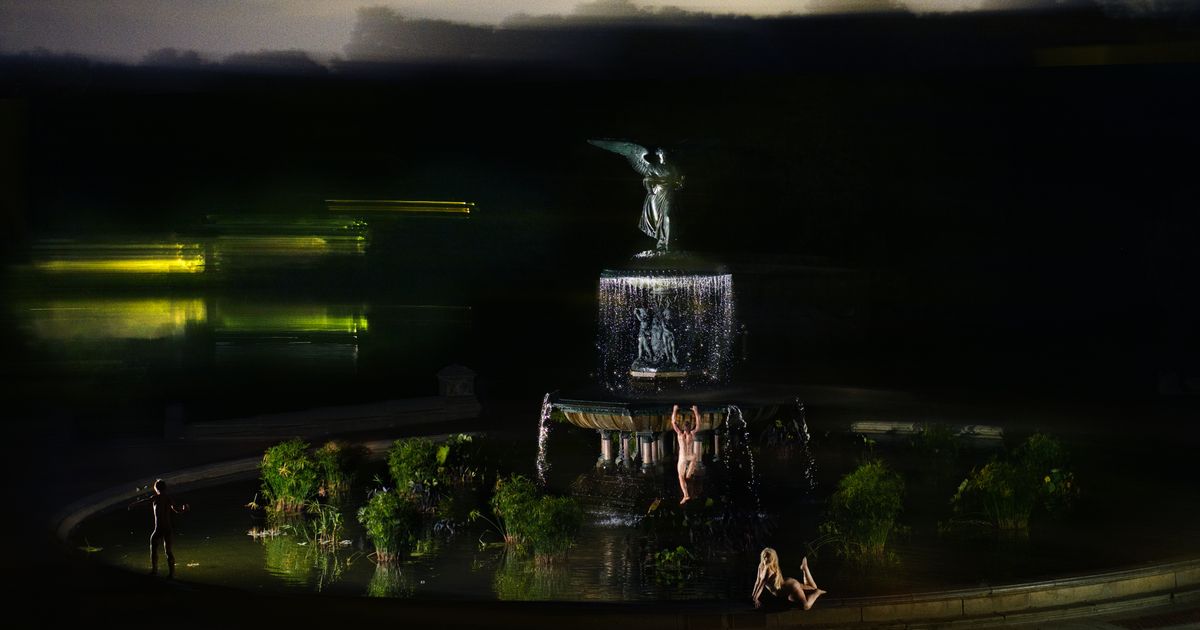
The core of "Night Shift" is a series of photographs that feel like a fever dream of urban exploration. In one particularly striking image, three nude subjects splash through the Bethesda Fountain in Central Park under the cover of a midnight sky. Using a long lens and a carefully placed strobe, McGinley transforms a familiar landmark into a surreal, private playground.
The exhibition is not merely a collection of photographs; it is a testament to the endurance of the "night owl" spirit in a city that is increasingly sanitized. By focusing on the hours when the transit lines thin out and the tourists retreat to their hotels, McGinley manages to reclaim the public sphere for his subjects. The show features nude figures—often his friends and collaborators—in various states of play, movement, and quiet contemplation across all five boroughs. As McGinley notes, the goal was to treat the city as if it were a vast, empty set waiting for a performance.
A Chronology of the Night Shift
The genesis of the project was organic, born out of a desire to see if the magic of the early 2000s could be synthesized in the modern, post-pandemic landscape.
- Summer 2025: McGinley begins conceptualizing a return to New York-based, nocturnal photography. He begins scouting locations that take on a different character after dark.
- August 2025: The "Bethesda Fountain" shoot. This pivotal session sets the tone for the rest of the project. It is during this shoot that McGinley encounters a lone violinist playing in the park, providing an unexpected soundtrack to his images.
- Autumn 2025 – Spring 2026: The production phase. McGinley and his team commit to a rigorous schedule, shooting from Sunday through Tuesday to avoid the weekend crowds. The project expands to include outer-borough locations, including the industrial rail yards of Long Island City and the sweeping curves of the West Side Highway.
- June 2026: The final edit is curated for the "Night Shift" exhibition at Jeffrey Deitch.
"The city really felt like it was ours," McGinley says of those quiet, pre-dawn hours. "When you’re out at 4 a.m. in the middle of a train yard or on the West Side Highway, the scale of New York changes. You stop being a visitor and start being a part of the city’s metabolism."
Supporting Data and the Logistics of Light
Capturing high-contrast, professional-grade photography at night is a feat of both physical endurance and technical precision. At 48 years old, McGinley admits that the "graveyard shift" is far more demanding than it was when he was in his twenties.
"It’s so hard, especially if you’re not doing it consistently," he reflects. The technical challenge involved balancing the natural ambient light of the city—the sodium-vapor glow of streetlamps, the harsh blue flicker of subway entrances—with his own mobile strobe lighting.
The logistics were further complicated by the necessity of anonymity and security. To capture the images without attracting unwanted attention, the team had to move with precision. Despite the scale of the production, there was only one significant encounter with law enforcement. While shooting near a car wash on the West Side Highway, a police cruiser pulled over. The interaction was brief, punctuated by an officer’s weary, cynical inquiry: "You call this art?" It is a moment that McGinley recounts with a laugh, highlighting the absurdity of the creative process in the modern urban environment.
The Evolution of a Style: From the Whitney to the Boroughs
To understand "Night Shift," one must look back at the 2003 Whitney Museum exhibition that launched McGinley into the stratosphere of the art world. That show was a voyeuristic, intimate look at a specific subculture—a "visual diary" of friends living on the edge.
In the years that followed, McGinley’s work moved away from the interior and into the expansive, natural landscapes of the American West. His series of leaping, nude figures in national parks became his signature. "Night Shift" represents a synthesis of these two worlds: the intimacy of his early portraits and the sweeping, environmental scale of his wilderness photography.
By bringing his nude subjects into the city streets, McGinley is effectively "wilding" the urban environment. He is asking the viewer to see the sidewalk, the fountain, and the train yard not as municipal infrastructure, but as a topography of human experience.
Implications: The City as a Living Canvas
What does "Night Shift" tell us about the state of New York in 2026? Perhaps most significantly, it suggests that the city’s capacity for subversion remains intact, even if it is harder to find.
The presence of the violinist at Bethesda Fountain, who continued playing his instrument despite the presence of a professional photography crew and nude subjects, speaks to a uniquely New York phenomenon: the refusal to be surprised. As McGinley observes, "New Yorkers don’t bat an eye. They’re like, ‘Another day in New York. Let me just keep playing my music.’"
This indifference is, in a way, the ultimate liberation. It implies that for all the changes in real estate, the cost of living, and the influx of technology, the social contract of New York remains rooted in the idea that everyone is entitled to their own reality.
Furthermore, by documenting all five boroughs—including a deliberate effort to reach the edges of Staten Island—McGinley is challenging the insular nature of the New York art world. He is mapping a city that is larger and more diverse than the gallery-centric neighborhoods of Chelsea or the Lower East Side.
The Legacy of the Nocturnal Observer
As the art world prepares for the opening at Jeffrey Deitch’s gallery, the buzz surrounding "Night Shift" is palpable. It is a homecoming in the truest sense—a middle-aged master returning to the streets where he first learned to hold a camera, but bringing with him the technical mastery and philosophical depth of a decades-long career.
The images on display are not just about nudity or shock value. They are about the quiet, meditative stillness that exists in the heart of the world’s loudest city. They are about the camaraderie of the night, the friendships that are forged in the dark, and the enduring, defiant beauty of the human body set against the cold, unyielding architecture of the metropolis.
Whether or not "Night Shift" will be regarded with the same historical weight as his 2003 Whitney debut remains to be seen. But in the context of 2026, it serves as a vital reminder: the city is not just a place to live, work, and commute. It is a canvas, and if you are willing to stay awake long enough to see it, it is still a place of infinite, unscripted possibility.
The exhibition will remain on view throughout the summer, offering New Yorkers a chance to look at their own city through the lens of a man who has spent his life trying to capture its pulse. As McGinley concludes, "We covered all five boroughs. We wanted to see what the city looked like when it was finally, truly, ours."
