

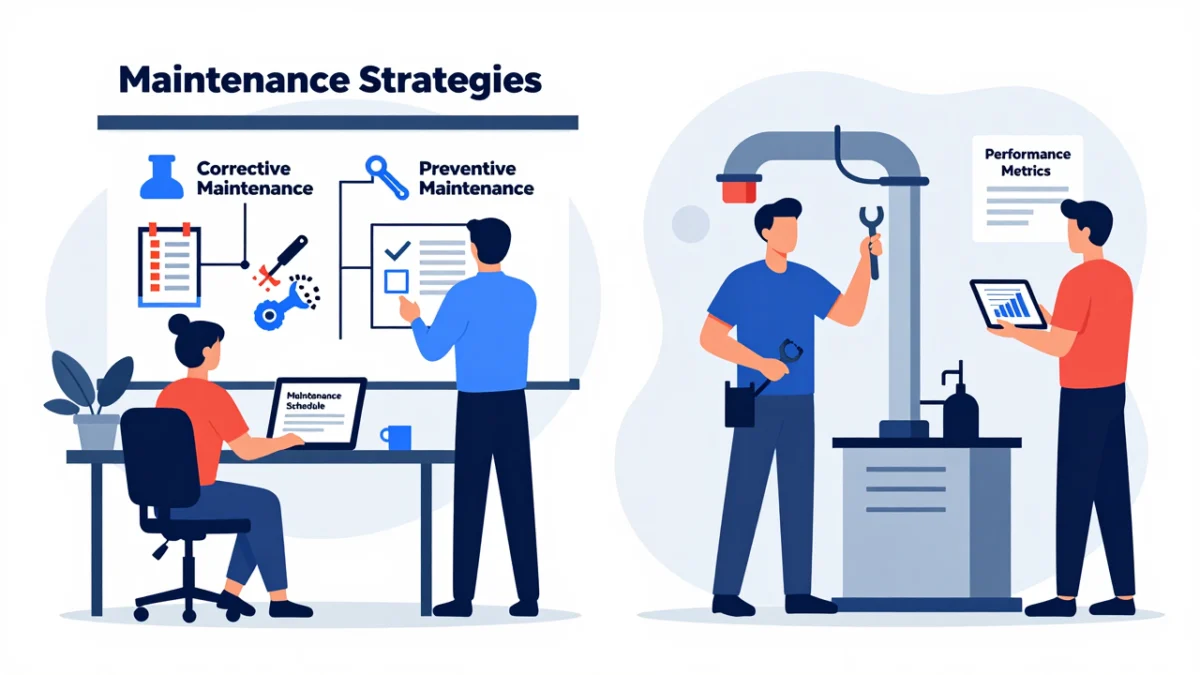
In the modern industrial and business landscape, the efficiency of an organization is often dictated by the reliability of its infrastructure. Whether it is a manufacturing floor, a fleet of delivery vehicles, or a digital server room, the machinery that keeps a business running is its most critical asset. However, a fundamental question persists for operations managers: Should you wait for something to break to fix it, or should you spend resources to ensure it never breaks in the first place?
The dichotomy between corrective maintenance and preventive maintenance represents more than just a scheduling preference; it is a strategic choice that directly impacts the bottom line, employee safety, and operational longevity.
The Core Fundamentals: Defining the Maintenance Spectrum
At its simplest, maintenance strategy is categorized by the timing of the intervention.

Corrective Maintenance: The Reactive Model
Often termed "reactive maintenance" or "run-to-failure," this strategy is defined by its trigger: a system malfunction or total breakdown. In this scenario, maintenance is deferred until the asset can no longer perform its intended function. While it requires minimal upfront planning, it shifts the operational burden to emergency response teams who must troubleshoot and repair under pressure.
Preventive Maintenance: The Proactive Model
Preventive maintenance (PM) is a systematic, time-based, or usage-based strategy. By performing routine inspections, lubrication, part replacements, and system adjustments, organizations aim to mitigate the risk of failure. This approach treats maintenance as an investment in asset health rather than an overhead cost of failure.
Chronology of Maintenance Strategy Development
The evolution of maintenance has mirrored the evolution of industry itself.

- The Era of "Fix It When It Breaks" (Pre-1950s): During the early stages of the industrial revolution, most equipment was simple and mechanical. When a machine stopped, it was fixed on the spot. Complexity was low, and downtime was often viewed as a natural, if inconvenient, part of the production cycle.
- The Rise of Systematic Care (1950s–1980s): As machinery became increasingly complex—integrating hydraulics, early electronics, and sophisticated moving parts—the cost of unplanned downtime began to skyrocket. Industries moved toward scheduled maintenance intervals based on manufacturer recommendations, marking the birth of modern preventive maintenance.
- The Digital Transformation (1990s–Present): With the advent of IoT (Internet of Things), sensors, and advanced data analytics, maintenance shifted again. We are currently in the era of "Predictive Maintenance," where assets "talk" to operators, signaling exactly when they need service before a failure ever occurs.
Supporting Data: The Economic Case for Proactivity
The debate between these two strategies is rarely about which is "easier," but rather which is more fiscally responsible. Data consistently favors a shift toward prevention for critical assets.
- Downtime Reduction: Implementing a robust preventive maintenance schedule can reduce unexpected equipment failures by up to 50%.
- Operational Budgeting: While preventive maintenance may consume approximately 3.66% of a total operating budget, the cost of emergency repairs—which often include expedited shipping for parts, overtime pay for technicians, and lost production time—is consistently higher.
- Asset Longevity: Consistent care can extend the operational life of machinery by up to 25%.
- ROI Potential: Industry studies suggest that transitioning from a purely reactive to a balanced or proactive maintenance strategy can yield an overall cost saving of 20% to 30%.
Comparative Breakdown Table
| Feature | Corrective Maintenance | Preventive Maintenance |
|---|---|---|
| Upfront Cost | Low (No scheduled labor) | Moderate (Labor and parts) |
| Long-Term Cost | High (Due to collateral damage) | Lower (Optimized asset life) |
| Downtime | Unplanned/Disruptive | Planned/Scheduled |
| Resource Needs | Emergency response teams | Scheduled planning/Scheduling |
| Best For | Low-criticality, cheap assets | High-criticality, expensive assets |
Official Industry Perspectives: Why Strategy Matters
Industry leaders, from manufacturing giants to logistics firms, emphasize that there is no "one size fits all" solution. Instead, they advocate for a Balanced Maintenance Strategy.
"Organizations that rely entirely on corrective maintenance are essentially operating in a state of constant crisis," says a lead consultant at a global industrial engineering firm. "However, over-maintaining non-critical assets is just as wasteful. The goal is to apply the right strategy to the right machine."

The consensus among industry regulators is that maintenance is not merely about equipment uptime—it is about compliance and safety. In sectors like healthcare, where a failed HVAC system could jeopardize medical supplies, or in transportation, where a failed brake system is a liability, preventive maintenance is not just a best practice; it is a regulatory requirement.
Implications of Your Maintenance Choices
The decision to lean into one strategy over the other sends ripples throughout the entire organization.
Impact on Workforce
When a company prioritizes corrective maintenance, the workforce must be comprised of "firefighters"—highly skilled at quick, improvised repairs. In contrast, a preventive-focused organization requires staff proficient in documentation, long-term trend analysis, and systematic procedures. Training for the latter is more consistent, whereas training for the former is often reactive and high-stress.

Impact on Productivity
Unplanned downtime is the "silent killer" of productivity. When a critical machine fails without warning, production stops, supply chains are disrupted, and customer deadlines are missed. A preventive strategy allows management to schedule downtime during off-peak hours, ensuring that production remains fluid and reliable.
Impact on Asset Lifecycle
Every time a machine experiences a catastrophic failure, it incurs "wear and tear" that is not easily undone. A component that breaks under load often damages secondary components. Preventive maintenance stops this chain reaction, keeping the equipment within its optimal operating parameters for a longer duration.
How to Choose: A Practical Roadmap
If you are an operations manager looking to optimize your strategy, follow this systematic approach:

1. Conduct an Asset Criticality Analysis
Classify your equipment.
- Critical Assets: If these fail, the whole operation stops. (Apply Preventive Maintenance).
- Non-Critical Assets: If these fail, it is an inconvenience but not a disaster. (Apply Corrective Maintenance).
2. Leverage Technology
Use a Computerized Maintenance Management System (CMMS). These platforms store failure histories, schedule recurring tasks, and help manage parts inventory. If you are not tracking your maintenance, you cannot improve it.
3. Integrate Predictive Elements
Where possible, move from time-based maintenance (e.g., checking a belt every month) to condition-based maintenance (e.g., checking a belt only when a sensor indicates vibration or heat levels are rising). This is the hallmark of a mature maintenance program.

4. Continuous Review
Maintenance is not "set and forget." Review your performance metrics quarterly. Are you over-maintaining? If a machine is inspected every month but never needs adjustment, extend the interval. If a machine keeps failing despite the schedule, investigate the root cause—it might be time for an upgrade.
Conclusion: The Path Toward Operational Excellence
The divide between corrective and preventive maintenance is a bridge that every growing business must cross. While the lure of "no upfront costs" makes reactive maintenance attractive in the short term, the long-term financial, safety, and operational burdens are rarely worth the savings.
By strategically choosing to prevent failure where it matters most, and by accepting a reactive approach only for the most expendable of assets, organizations can achieve a level of efficiency that drives competitive advantage. The goal is to move from a state of being "broken" to a state of being "prepared." Start by auditing your equipment today; the small investment in time will pay significant dividends in the reliability and longevity of your operations tomorrow.
