

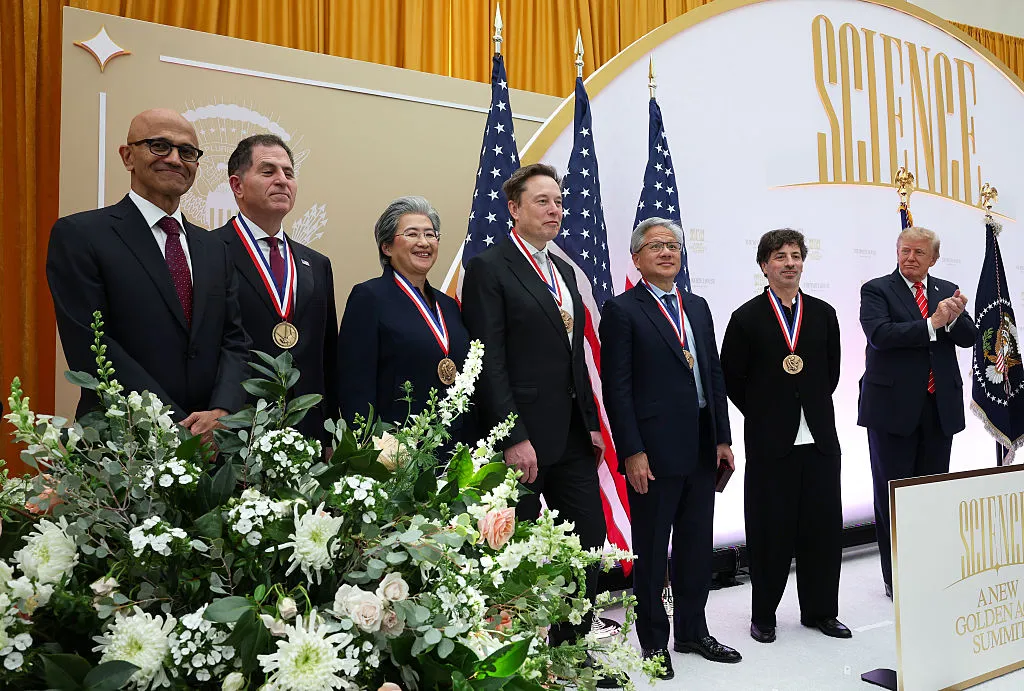
WASHINGTON, D.C. — In a ceremony that underscored the deepening convergence of Silicon Valley’s corporate power and Washington’s political agenda, President Donald Trump hosted the "Golden Age of American Innovation Summit" on Thursday. During the event, the administration bestowed the nation’s highest honors in scientific and technological achievement upon a cohort of the world’s most influential tech leaders.
The ceremony, while framed as a celebration of American ingenuity, has ignited a firestorm of criticism regarding the intersection of government awards and the significant financial contributions made by the recipients to the president’s political causes.
The Honorees: A Who’s Who of the Tech Industry
The recipients of the National Medal of Science included some of the most recognizable names in global technology: Tesla and SpaceX CEO Elon Musk, Nvidia CEO Jensen Huang, Google co-founder Sergey Brin, and AMD CEO Lisa Su. Each was recognized for their contributions to fields ranging from artificial intelligence and advanced computing to aerospace engineering.
Complementing these awards, the National Medal of Technology and Innovation—the highest honor for technological achievement in the United States—was presented to Dell Technologies CEO Michael Dell and Microsoft CEO Satya Nadella.
President Trump, speaking to a room of industry titans and government officials, lauded the group for their collective role in securing American dominance in the 21st century. "These individuals have pioneered an incredible future for America," the President stated. "Because of their vision and their tenacity, we will always be on top. No one else can compete with us."
A Chronology of the Summit and the Awards
The summit, held on October 8, 2026, was the culmination of a months-long effort by the administration to signal a new "pro-innovation" era.
- Morning Sessions: The summit began with a series of closed-door roundtables focusing on deregulation in the AI sector and the strengthening of domestic semiconductor supply chains.
- The Ceremony: By mid-afternoon, the atmosphere shifted to the East Room of the White House, where the medals were presented. The ceremony was marked by a heavy emphasis on the theme of "American Exceptionalism."
- Immediate Backlash: Within hours of the announcement, watchdog groups and political commentators began highlighting the financial connections between the honorees and the Trump administration’s various political vehicles.
- The Microsoft Contrast: The event was particularly notable for the timing regarding Microsoft. On the very day Nadella accepted his medal, the Department of Labor confirmed the administration’s decision to indefinitely suspend Microsoft from the H-1B visa program, a move that complicates the company’s ability to recruit global talent.
Financial Intersections: The "Donation-for-Distinction" Debate
The most controversial aspect of the event involves the substantial financial ties between the recipients and the current administration. According to data compiled by The New Republic, the collective contributions from these individuals and their affiliated entities to causes tied to the president approach $6 billion.
Breakdown of Financial Contributions
Critics argue that the optics of the ceremony are undermined by the sheer scale of the financial support provided by these executives to the administration:

- The Dell Contribution: Michael and Susan Dell have pledged $6.25 billion to the "Trump Accounts," a government-sponsored savings program for children. While the Dells have framed this as a philanthropic endeavor, the scale of the donation and its branding have drawn intense scrutiny from ethics experts.
- Corporate In-Kind Support: Alphabet (Google) and Microsoft were noted for their contributions to the President’s inauguration fund and for financing infrastructure improvements at the White House, including the renovation of the White House ballroom.
- PAC Funding: AMD, led by Lisa Su, has been a significant contributor to pro-Trump Super PACs, fueling debates about the extent to which corporate lobbying and political funding influence executive branch recognition.
Supporters of the administration maintain that the awards are based solely on merit and the economic impact of the companies involved. They argue that these executives are not only innovators but also job creators who have demonstrated a commitment to American economic prosperity.
Official Responses and Administrative Stance
The White House has vehemently rejected the suggestion that the medals were "bought" or that political contributions played any role in the selection process. A spokesperson for the Office of Science and Technology Policy stated, "The National Medal of Science is awarded for outstanding contributions to knowledge in the physical, biological, mathematical, engineering, or social sciences. The administration stands by the immense, measurable impact these leaders have had on our global competitive standing."
Conversely, the recipients themselves have largely remained silent on the political controversy. While some executives released standard press statements thanking their teams and the American workforce for their success, none have directly addressed the reports regarding their donations to the administration’s pet projects.
Implications for the Tech Sector and Federal Policy
The event highlights a shifting dynamic in the relationship between Silicon Valley and Washington. Historically, tech companies have maintained a cautious distance from partisan politics, preferring to lobby for specific policy outcomes. However, the 2026 summit suggests a move toward a more "transactional" relationship.
The H-1B Dilemma
The irony of Satya Nadella receiving a prestigious medal while his company faces a ban from the H-1B program is not lost on industry analysts. This juxtaposition signals that the administration is willing to reward individual corporate leaders for their alignment with the White House while simultaneously enforcing strict, nationalist immigration policies that hurt those same companies’ operational capacities.
Long-term Political Consequences
For the tech industry, this event serves as a bellwether for the remainder of the decade. Companies may now feel increased pressure to align their philanthropic and political spending with the administration’s goals to maintain access and prestige. For the public, the event has raised deeper questions about the integrity of national honors and whether they can ever be truly separated from the influence of deep-pocketed donors.
Future Outlook
As the dust settles from the summit, the long-term impact on the credibility of the National Medal of Science remains to be seen. If these awards are increasingly viewed as political tools rather than scientific accolades, their value as the nation’s highest scientific honor may diminish. Furthermore, the divide between the tech industry’s need for global talent and the administration’s nationalist agenda is likely to continue to create friction, regardless of the awards handed out in the East Room.
In the final analysis, the "Golden Age of American Innovation Summit" served as a powerful, if divisive, demonstration of how the lines between private wealth, corporate influence, and federal authority continue to blur in the modern American political landscape. Whether this convergence leads to the "incredible future" the President promised, or whether it signals a troubling era of crony capitalism, will likely be a central question for voters and industry analysts for years to come.
