

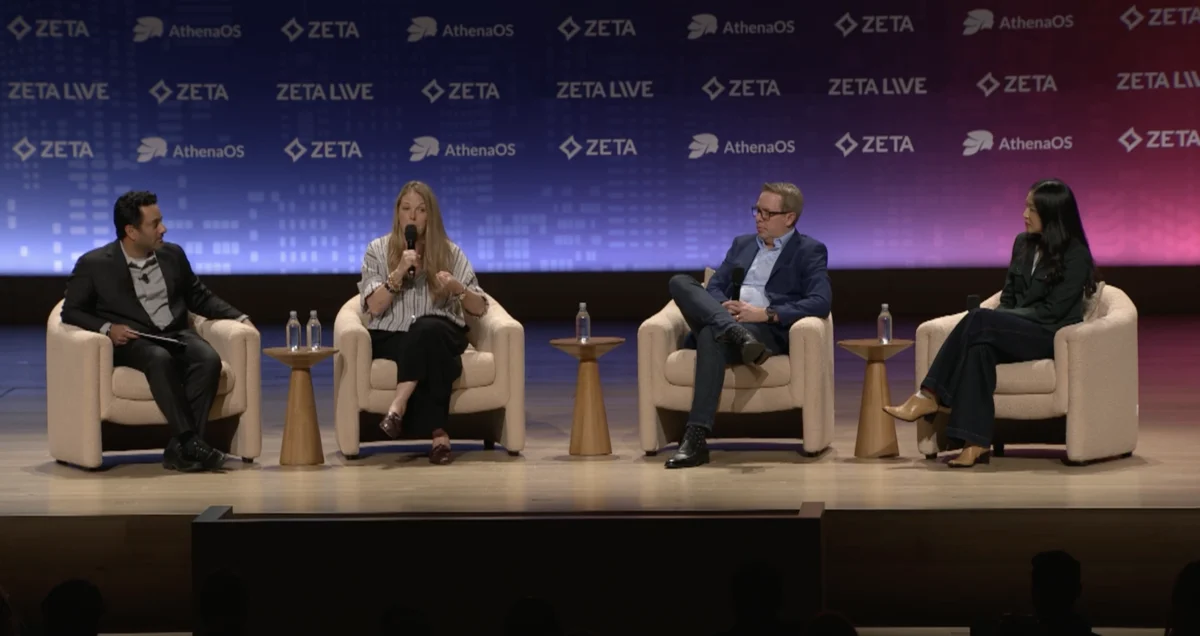
In the rapidly evolving landscape of digital commerce, the promise of Artificial Intelligence has shifted from a futuristic novelty to an operational necessity. At the recent Zeta Live conference held on October 8 in New York City, top marketing executives from Babylist, PepsiCo, and Sharp Electronics gathered to discuss a pivotal transition: the move from using AI as a tool for simple automation to employing it as a core engine for massive scale and strategic insight.
While the data suggests a staggering increase in productivity—exemplified by Babylist’s jump from 5 million to 1 billion annual communications—the conversation among leaders has turned toward a new set of anxieties. As AI takes over the "doing," marketing leaders are grappling with the "being": how to maintain brand authority, ensure discoverability in an AI-governed search landscape, and turn dormant customer data into actionable business intelligence.
Main Facts: The Great Scaling of 2024
The central theme of the Zeta Live panel was the sheer volume of output now possible through AI integration. The most striking figure came from Babylist, the universal baby registry and technology platform. According to Chief Marketing Officer Jill Cress, the company’s email operations have undergone a total metamorphosis. Two years ago, the team was responsible for sending 5 million emails. This year, through the deployment of AI agents and automated workflows, that number is expected to hit 1 billion, including push notifications.
However, this 200-fold increase in output is not without its costs. The primary facts emerging from the executive discussion include:
- Operational Shifts: Marketing roles are being redefined. Instead of "creators" of individual messages, staff are becoming "managers of agents."
- Brand Dilution Risks: High-volume AI output threatens the "edge" and "authority" of brand voices if not managed with a rigorous "context layer."
- The Death of "E-commerce" Distinctions: Much like the term "e-commerce" eventually just became "commerce," AI-powered search is now simply "search."
- Data Activation: Companies like Sharp Electronics are using AI to bridge the gap between field service data and corporate strategy, turning thousands of daily customer touchpoints into real-time reports.
Chronology: From Experimental Tools to Embedded Agents
The timeline of AI adoption in these major corporations reveals a shift from skeptical experimentation to deep structural integration over the last 24 months.
2022-2023: The Automation Phase
During this period, AI was primarily used for discrete tasks. At Babylist, the focus was on efficiency—writing subject lines or conducting basic A/B testing. At PepsiCo, the technology was being explored for its ability to speed up the "animatics" process—creating rough sketches or animations of commercials to test concepts before spending millions on production.
Early 2024: The Agentic Shift
By the beginning of this year, the philosophy shifted toward "agentic" workflows. Rather than a human using a tool to write an email, "agents" (specialized AI programs) began handling the end-to-end process of message construction, quality assurance, and distribution. This allowed Babylist to scale from millions to billions of touchpoints.
Late 2024 and Beyond: The Strategic Re-evaluation
As of the October 8 panel, the focus has moved to the "human-in-the-loop" necessity. Leaders are realizing that while AI can handle the volume, it cannot yet handle the "moat"—the unique trust and authority that keeps a customer loyal. The current phase involves building "context layers" to feed the AI better data about brand tone and ensuring that high-stakes content, such as product reviews, remains strictly human-authored.
Supporting Data: Metrics of Efficiency and Engagement
The transition to AI-driven marketing is supported by significant, albeit sometimes cautious, data points shared by the executives.
Babylist’s Volume and Performance
The most quantifiable data comes from Babylist’s communication department. The jump to 1 billion communications is not just a vanity metric; it is accompanied by improved engagement. Jill Cress noted that despite the massive increase in volume, the company has seen:
- Higher open rates.
- Increased click-through rates (CTR).
- Better overall impact on the bottom line.
- The successful replacement of traditional photography with AI-generated imagery, which Cress noted is actually "outperforming" the company’s previous high-cost photo shoots.
Sharp’s Operational Footprint
Grace Dolan, President of Sharp Electronics’ U.S. Consumer Division, provided a glimpse into the scale of data being processed. Sharp maintains:
- A nationwide repair service team of 550 people.
- A call center staffed by 35 employees.
- Thousands of daily data points regarding product failures, customer frustrations, and feature requests.
AI now synthesizes this data into daily reports, a task that was previously impossible to perform manually at that speed.
PepsiCo’s Discoverability Challenge
Mark Kirkham, CMO of PepsiCo Beverages U.S., highlighted a more concerning data trend: generative AI platforms (like ChatGPT or Google’s Gemini) tend to recommend only a "handful of brands" when prompted by users. This creates a "winner-takes-all" environment where discoverability becomes the most critical metric for legacy brands like Gatorade.
Official Responses: Insights from the C-Suite
The panel featured a candid exchange regarding the emotional and strategic realities of leading through the AI revolution.
Jill Cress (CMO, Babylist) on Brand Voice
Cress was vocal about the dangers of "unsupervised" AI scaling. "We are now starting to see that our tone, our edge, our authority is getting a little bit diluted because we’re not necessarily doing the work of feeding back into the context layer," she warned. For Babylist, the "moat" is trust. While AI can generate an image of a nursery, Cress insisted that independent product reviews must be written by humans to maintain the integrity of the brand.
Mark Kirkham (CMO, PepsiCo) on the Evolution of Search
Kirkham challenged the industry to stop compartmentalizing AI. "I think we need to just stop talking about search and agentic search. It’s just search," he said, drawing a parallel to how "e-commerce" eventually lost its prefix. He emphasized that for a brand like Gatorade, which relies on scientific credibility, the goal is to ensure that when a consumer asks an AI for hydration advice on Reddit or Gemini, the brand’s scientific benefits are accurately represented.
Grace Dolan (President, Sharp Electronics) on Internal Culture
Dolan took a pragmatic approach, viewing AI as a way to make better use of "information that always existed." She also highlighted the importance of grassroots enthusiasm. Rather than hiring a "Chief AI Officer," she empowered a passionate team member to lead an internal newsletter and develop case studies. However, she remained humble about the company’s progress: "We’re learning, and we talk about it a lot, and we always feel behind."
Implications: The Future of the Marketing Profession
The insights shared at Zeta Live suggest several profound implications for the future of the industry.
1. The Rise of the "Marketing Architect"
The role of the entry-level marketer is changing. At Babylist, marketers are no longer "copywriters"; they are "agent managers" embedded in product squads. This suggests that future marketing talent will need to be as comfortable with prompt engineering and data architecture as they are with creative storytelling.
2. The Context Layer as the New Brand Bible
As AI generates more content, the "Brand Guidelines" document of the past is being replaced by the "Context Layer." This is a dynamic, machine-readable set of instructions that ensures an AI agent understands the specific "edge" and "authority" of a brand. Companies that fail to build robust context layers will see their brand identity "diluted" into a generic, AI-average mush.
3. The "Human Moat" in an Automated World
As AI-generated content becomes ubiquitous, human-generated content will command a premium. Babylist’s insistence on human-written reviews highlights a burgeoning trend: "Human-Made" may soon become a badge of quality and trust, much like "Organic" or "Handcrafted" in the physical world.
4. Generative Engine Optimization (GEO)
PepsiCo’s focus on discoverability in Gemini and Reddit suggests that SEO is evolving into GEO. Marketers will no longer just optimize for keywords on a results page; they will optimize for "recommendability" within an AI’s latent space. This requires a deeper understanding of how AI models ingest and weigh information.
5. The Perpetual State of "Feeling Behind"
Perhaps the most relatable implication came from Sharp’s Grace Dolan. Despite successful implementations, the speed of AI development ensures that even the most advanced companies feel they are struggling to keep up. This "perpetual lag" is becoming the new normal in corporate leadership, requiring a culture of continuous learning rather than a "set-it-and-forget-it" implementation strategy.
In conclusion, the Zeta Live panel made it clear that the AI revolution is no longer about "if" or "when," but about "how much" and "at what cost." For Babylist, PepsiCo, and Sharp, the goal is to harness the 200x scale of AI without losing the 1-to-1 human connection that defines their brands. As Jill Cress aptly noted, the challenge is no longer just producing the content—it is providing the oversight to ensure that content actually sounds like the brand it represents.
