

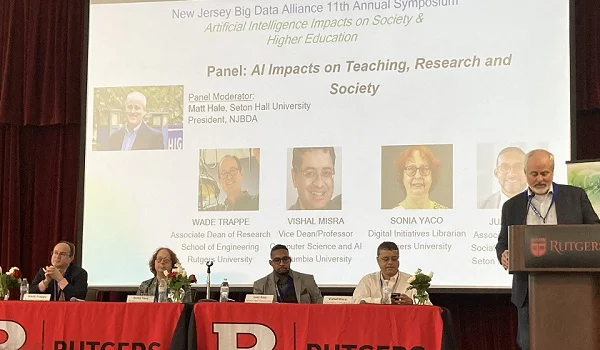
The integration of Artificial Intelligence (AI) into the fabric of higher education is no longer a speculative future; it is an immediate, transformative reality. During the 2024 New Jersey Big Data Alliance (NJBDA) Symposium, hosted at Rutgers University–New Brunswick, leading academics, technologists, and administrators converged to dissect how generative AI and advanced machine learning are fundamentally reshaping the university experience—from the admissions office to the archives.
As the symposium’s sessions underscored, the scope of this transformation is total. Whether it is the streamlining of administrative logistics, the democratization of historical archives, or the radical evolution of research methodologies, AI is acting as a catalyst for a new era in collegiate life.
The Scope of the Shift: A Comprehensive Transformation
The symposium’s central panel, "AI Impacts on Teaching and Research," moderated by Matthew Hale of Seton Hall University, set a bold tone. The consensus was clear: the traditional ivory tower is being renovated from the ground up. Panelists noted that AI will eventually influence every facet of university operations, including grading, lecture delivery, data management, and the fundamental ways in which faculty engage with grant-funded research.
This transition is not merely about adopting new software; it is about rethinking the infrastructure of higher education. Institutions are currently grappling with how to integrate these tools without sacrificing academic rigor or the essential human elements of teaching and mentorship.
Chronology of AI Integration in Higher Education
The adoption of AI in academia has followed a rapid, non-linear path. While universities have utilized data analytics for years, the advent of Large Language Models (LLMs) like ChatGPT-3 marked a pivotal shift in 2022 and 2023.
- Early Adoption (2010–2020): Universities utilized basic predictive modeling and software like Tableau for enrollment management and basic administrative reporting.
- The Generative Surge (2022–2023): The public release of generative AI tools forced universities to move from reactive policy-making—often focused on plagiarism—to proactive implementation.
- Strategic Integration (2024): Universities began establishing formal "AI Task Forces," as seen at Columbia University, moving beyond individual experimentation to institutional-wide adoption across dining, research, and licensing departments.
- The Current Horizon: As identified at the NJBDA Symposium, the focus is now shifting toward "guardrails"—teaching students the ethical and critical literacy skills required to navigate an AI-augmented world.
Operational Efficiency and Administrative Oversight
Wade Trappe, associate dean for research and development at the Rutgers School of Engineering, highlighted how AI is moving beyond the classroom to enhance administrative agility.
Data-Driven Admissions
One of the most immediate impacts of AI is in student recruitment. Admissions administrators are often tasked with the complex puzzle of crafting a balanced student cohort. AI tools can now analyze vast datasets to help administrators identify gaps in incoming classes—balancing athletic rosters, academic concentrations, and demographic representation with unprecedented speed.
Research Productivity
Trappe also pointed to the role of AI in monitoring and facilitating faculty output. By utilizing advanced analytics software like Tableau, universities can identify trends in grant applications. For instance, the software can highlight faculty who have not submitted grant proposals in over two years, providing deans with the necessary data to offer targeted support and mentorship to reignite research productivity.
The Archive Reimagined: Digital Humanities and AI
Perhaps the most profound example of AI’s utility came from Sonia Yaco, a digital initiatives librarian at Rutgers. Her work with special collections illustrates how technology can bridge the gap between historical preservation and modern accessibility.
Overcoming Literacy and Accessibility Barriers
A significant challenge in modern archives is the decline in cursive literacy among students. Historical manuscripts, often handwritten, have historically been difficult for students to interpret. AI transcription tools are now effectively translating these documents into machine-readable text, making them accessible to a wider student body.
Linking the Unlinked
Yaco highlighted the "multimedia potential" of AI in cataloging. In collections containing tens of thousands of unlabeled photographs, AI can analyze visual content to generate descriptive metadata. By creating "MARC" (Machine-Readable Cataloging) records automatically, AI can link disparate photographs to historical documents, allowing researchers to piece together narratives that were previously lost to time.
Implications for Research: From Months to Seconds
Matthew Hale, chair of the Master of Public Administration at Seton Hall, provided a vivid comparison of the pre-AI and post-AI research landscape. Recalling his earlier career in political science, Hale described the painstaking, labor-intensive process of tracking local news coverage of elections.
"In the 2000 election, we had to hire people across 50 television markets to manually record VHS tapes, ship them to the University of Southern California, and have teams of people watch and code them," Hale noted. "That process took us almost a year to complete. Today, that same analysis could be performed in seconds using AI-driven automated content analysis."
This shift suggests that researchers will no longer be limited by the logistics of data collection. Instead, the bottleneck in research is moving toward the development of more complex questions and the interpretation of the vast datasets now available.
Official Responses and Institutional Strategies
The symposium highlighted that the challenge for top-tier universities is not just adopting AI, but managing it. Vishal Misra, professor of computer science and the first dean of AI at Columbia University, shared that his institution has identified over 70 distinct use cases for generative AI.
Columbia’s strategy involves a centralized task force that evaluates these use cases—ranging from dining services to research teaming—based on their potential for institutional impact. By prioritizing these initiatives, universities are attempting to standardize the AI experience, ensuring that innovation is both secure and equitable.
The Pedagogy of Guardrails: Teaching in the Age of AI
As AI becomes an ubiquitous classroom tool, the role of the professor is shifting from information gatekeeper to critical guide.
Combatting Hallucinations
Wade Trappe emphasized the urgency of teaching "guardrails." Because 18-year-old students are often already proficient users of tools like ChatGPT, the academic focus must shift to AI literacy. "Just because a tool provides an answer doesn’t mean it’s true," Trappe noted. Students must be taught to identify hallucinations, verify data sources, and understand the biases inherent in the training data of LLMs.
Encouraging Divergent Thinking
Juan Rios, an associate professor in the Master of Social Work program at Seton Hall, argued that AI can actually be used to expand, rather than limit, human creativity. In his social policy courses, he uses generative AI to help students simulate the outcomes of social interventions.
"We use AI to create scenarios of the future—what does a community look like if homelessness is eradicated?" Rios explained. By asking students to visualize these futures and then "localize" them to the specific context of cities like Newark, he forces students to move beyond rote learning and into the realm of complex, systemic thinking.
Looking Ahead: The Community Impact
The overarching message from the 2024 NJBDA Symposium is that the AI revolution in higher education is fundamentally a question of service. As institutions integrate these powerful tools, the ultimate goal remains the betterment of society.
Whether it is improving grant-funded medical research, preserving the cultural history of the 19th century through digital cataloging, or preparing social workers to envision more equitable urban futures, AI is being positioned as a partner in the university’s mission. The challenge remains for institutions to maintain their human-centric values while embracing the efficiency of the machine, ensuring that the next generation of students is not just technologically savvy, but ethically grounded in their use of these transformative tools.
As the symposium concluded, it was evident that while the tools of the trade are changing, the fundamental goal of the university—to think critically, to preserve knowledge, and to solve the most pressing challenges of our time—remains as vital as ever.
