

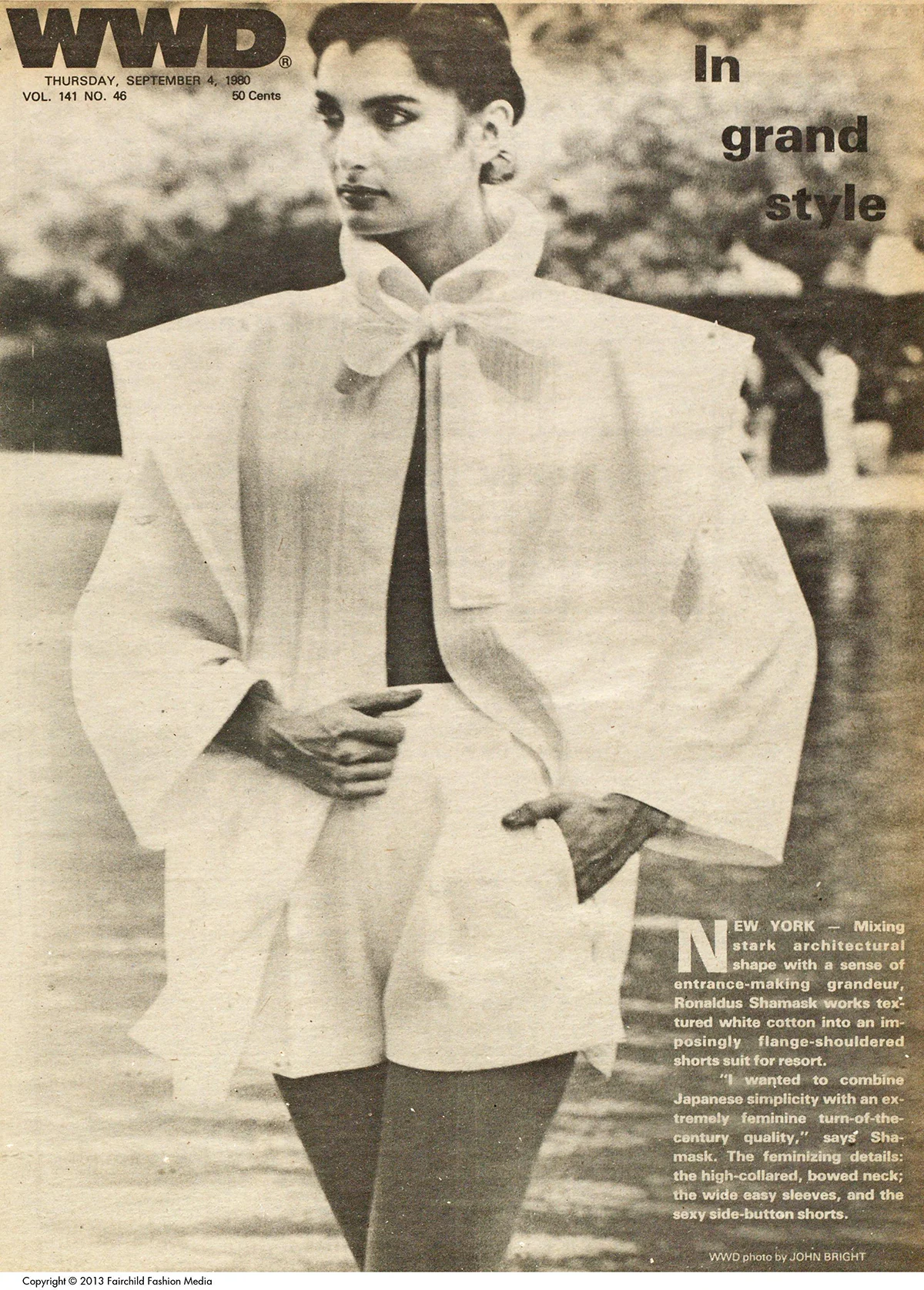
In the lexicon of summer fashion, color is rarely a mere aesthetic choice; it is a psychological response to the environment. As temperatures rise, the industry’s perennial search for "cool" often leads back to a singular, monochromatic sanctuary: pristine white. While the 1980s are frequently remembered for the neon-drenched excesses of power suits and maximalist glamour, a parallel movement of cerebral minimalism was taking root in New York. At the center of this movement was Ronaldus Shamask, a designer whose work transformed the humble materials of linen and cotton into architectural statements of "simplexity."
Through the lens of the Women’s Wear Daily (WWD) archives, we revisit a pivotal moment in American fashion history when Shamask redefined the relationship between the garment and the wearer. His philosophy, rooted in postmodern thought and Japanese precision, continues to inform the contemporary landscape of "quiet luxury" and minimalist design.
Main Facts: Defining the Shamask Aesthetic
Ronaldus Shamask, a Dutch-born designer who made his mark in the United States, was never interested in the ephemeral whims of trend-driven fashion. Instead, his work was an exploration of form, line, and the inherent properties of fabric. His contribution to the 1980s fashion scene was characterized by a rigorous devotion to "simplexity"—a term he coined to describe the marriage of complex construction with a deceptively simple appearance.
The Philosophy of Simplexity
The core of Shamask’s work lies in the paradox of the "easy" look. In a 1989 interview with WWD for the "Designers on Designing" series, Shamask articulated a philosophy that remains a blueprint for high-end minimalism. He argued that true success in design is achieved when a garment appears effortless, hiding the "complex labor" required to create it.
"Something that is simple is often successful because it appears that there aren’t problems involved," Shamask noted. This approach was not about laziness; it was about the mastery of tailoring. The "facile and spontaneous" surface of his white linen jackets and cotton dresses was the result of meticulous pattern-making and an intimate understanding of how fabric interacts with the human body in motion.
The Palette of Summer
While other designers used color to shout, Shamask used white to whisper—and in doing so, he commanded the room. For Shamask, white was not a void but a canvas that highlighted the geometry of his silhouettes. In the sweltering heat of a New York summer, his choice of crisp linens and textured cottons offered more than just physical cooling; they provided an emotional state of ease and clarity.
Chronology: The Evolution of a Minimalist Master
To understand Shamask’s impact, one must trace his journey through the 1980s, a decade where he stood as a counterpoint to the era’s more flamboyant tendencies.
1981: The Architectural Breakthrough
The spring 1981 collection served as a manifesto for Shamask’s vision. Photographed for WWD, the collection featured model Margaret Donahue in a look that would become iconic: a kimono-inspired jacket in textured white cotton, paired with elevated dress shorts.
This ensemble was a masterclass in cross-cultural synthesis. By merging the traditional Japanese kimono silhouette with the Western concept of the "dress short," Shamask created a garment that felt both ancient and futuristic. The bow-neck detail added a touch of softness to an otherwise rigid architectural form, signaling the designer’s ability to balance postmodern thinking with wearable contemporary style.
The Mid-1980s: Critical Acclaim
Throughout the mid-80s, Shamask’s reputation grew as a "designer’s designer." He was often mentioned alongside Zoran Ladicorbic (known simply as Zoran), another master of minimalist luxury. While Zoran focused on the ultimate "gap-less" wardrobe of five or six pieces, Shamask delved deeper into the structural possibilities of tailoring.
In 1987, Shamask was honored with a Coty Award, followed by recognition from the Council of Fashion Designers of America (CFDA). These accolades solidified his position as a leader in American couture-level ready-to-wear, proving that there was a significant market for intellectual, understated clothing.
1989: The ‘Designers on Designing’ Interview
By 1989, Shamask was reflective. His interview with WWD served as a summation of a decade’s worth of experimentation. It was during this conversation that he formally introduced the concept of "simplexity" to the public. He referenced postmodernist thinkers like Roland Barthes, suggesting that fashion was a semiotic system where the "signifier" (the simple white dress) was far less complicated than the "signified" (the hours of labor and structural engineering beneath the surface).
Supporting Data: The Mechanics of Construction and Materiality
The enduring appeal of Shamask’s work is supported by his technical innovations and his uncompromising choice of materials.

Material Selection: Linen and Cotton
Shamask’s preference for natural fibers was both a functional and an aesthetic choice.
- Linen: Known for its breathability and its tendency to wrinkle, linen was often viewed as a "difficult" fabric in the 1980s. Shamask embraced these wrinkles as a sign of authenticity and lived-in luxury.
- Textured Cotton: By using piqué and other textured weaves, he added depth to his monochromatic white looks. This ensured that even without color, the garments possessed a tactile richness that caught the light and emphasized the architectural shadows of the folds.
The Influence of Japanese Silhouette
Shamask was one of the few Western designers of his era who successfully integrated Japanese design principles without descending into caricature. Data from fashion historians suggests that Shamask’s work bridged the gap between the avant-garde "Anti-Fashion" movement coming out of Tokyo (led by Rei Kawakubo and Yohji Yamamoto) and the clean, sportswear-driven heritage of American fashion.
His patterns often avoided traditional darts and seams, opting instead for origami-like folds that allowed the fabric to drape naturally. This reduced the "friction" between the garment and the body, a key component of the "simplexity" he sought to achieve.
Official Responses and Critical Reception
The industry’s response to Shamask was one of profound respect, though he was often categorized as a "niche" or "intellectual" designer.
The WWD Perspective
WWD has historically served as the primary chronicler of Shamask’s career. Their archives describe his 1981 collection as "thoughtfully tying postmodern thinking with contemporary style." Critics praised his ability to elevate casual items—like shorts—into the realm of high fashion through the use of sophisticated tailoring and premium fabrics.
Peer Recognition
Shamask’s contemporaries often viewed him as a purist. While the 1980s were dominated by the "Big Three" (Ralph Lauren, Calvin Klein, and Donna Karan), Shamask occupied a space similar to Geoffrey Beene—a designer focused on the technical "how" of clothing rather than just the "what."
His work was frequently cited in academic circles for its relationship to the "Deconstructivist" movement in architecture. Just as Frank Gehry or Zaha Hadid were reimagining the boundaries of buildings, Shamask was reimagining the boundaries of the coat and the dress.
Implications: The Legacy of Simplexity in Modern Fashion
The influence of Ronaldus Shamask extends far beyond the 1980s. His philosophy of "simplexity" and his mastery of the white, architectural silhouette have several lasting implications for the industry today.
The Rise of Quiet Luxury
The current "Quiet Luxury" movement, championed by brands like The Row, Lemaire, and Jil Sander, owes a significant debt to Shamask. The idea that a garment’s value lies in its construction and the quality of its materials—rather than visible branding—is the direct descendant of Shamask’s 1980s output. When we see a $2,000 white linen shirt today that looks "simple," we are seeing the modern application of simplexity.
Sustainability and Materiality
As the fashion industry grapples with its environmental impact, Shamask’s reliance on natural, long-lasting fibers like linen and cotton feels increasingly prescient. His designs were built to last, both physically and aesthetically. By creating clothes that were "emotional states of being" rather than seasonal trends, he advocated for a slower, more intentional form of consumption.
The Minimalist Blueprint
Shamask proved that minimalism does not have to be boring. By incorporating Japanese-inspired silhouettes and postmodern philosophy, he showed that a white dress could be as complex and intellectually stimulating as a tailored tuxedo. He taught the industry that "simple" is the hardest thing to achieve because it leaves no room for error.
Conclusion: The Enduring Power of White
As we look back at the 1981 WWD photograph of Margaret Donahue in Shamask’s kimono-inspired jacket, we see a vision of summer that remains untouched by time. The "cool and ease" of white linen continues to be the ultimate sartorial antidote to the summer heat. Ronaldus Shamask’s genius lay in his ability to take that universal truth and elevate it into an art form. His "simplexity" remains a guiding light for any designer who believes that the most profound statements are often the ones made with the fewest lines.
