

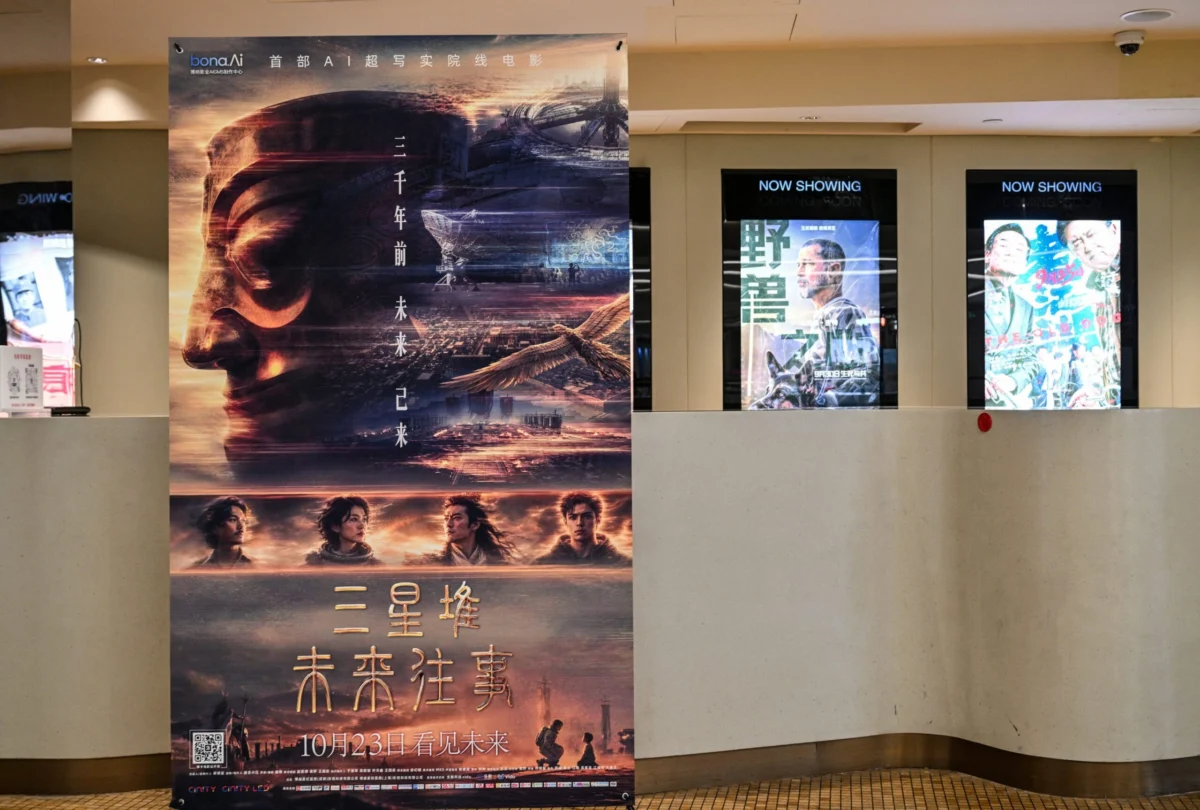
The promise of artificial intelligence in cinema has long been a dual-edged sword: a beacon for creative democratization and a looming threat to the sanctity of human artistry. While global audiences have watched the rapid integration of generative AI into the creative pipeline—from background textures to complex visual effects—a recent milestone in China has highlighted a critical disconnect between technological capability and consumer appetite.
Sanxingdui: Future Past, touted as China’s first fully AI-generated feature film, recently made its theatrical debut. Produced by the industry heavyweight Bona Film Group, the sci-fi thriller was intended to signal a new epoch in filmmaking. Instead, it became a cautionary tale. With a production budget of $1.5 million, the film has struggled to gain traction, pulling in a meager $180,000 as of early this week, according to data from the Chinese ticketing platform Maoyan.
This performance raises a pressing question for the global entertainment industry: While audiences are increasingly comfortable with AI-assisted short-form content, are they prepared to surrender the two-hour feature film experience to the machine?
The Genesis of an Experiment: A Chronology of the Project
The road to Sanxingdui: Future Past began with a desire to push the boundaries of what is possible within the constraints of modern production budgets. The film centers on an archaeologist tasked with saving a future society enslaved by an all-powerful AI—a meta-narrative that reflects the very technology used to build it.
The Timeline of Production
- Late 2025 – Early 2026: Bona Film Group shifts resources toward exploring generative AI’s capacity to handle full-length narrative arcs. The project is greenlit as an experiment in workflow efficiency.
- Mid-2026: Development intensifies as the production team utilizes proprietary and third-party generative models to craft everything from character models and environmental textures to script refinement.
- September 2026: Sanxingdui secures its theatrical release permit—a major regulatory hurdle that acknowledged the film’s unique status as a piece of "AI-authored" intellectual property.
- October 2026: The film hits Chinese cinemas. Early indicators suggest a sharp divide between the tech-enthusiast community and the traditional movie-going public.
- Present Day: Following a dismal box office run, industry analysts are re-evaluating the commercial viability of AI-only features.
Data and Disparity: The Tale of Two Formats
To understand why Sanxingdui failed, one must look at the landscape of Chinese media consumption. The irony of the film’s failure is that it occurred in a market that has already been completely transformed by AI in other sectors.
The Microdrama Explosion
According to data from Caixin, the first quarter of 2026 saw a staggering shift in the digital content landscape. Over 120,000 microdramas—snackable, narrative-driven content optimized for TikTok-style platforms—were released. Of these, more than 95% were generated using AI.
The economic shift here is seismic:
- Cost Reduction: The price to produce a high-engagement microdrama has dropped to as low as $3,000.
- Volume: A year prior, AI-generated content in this sector was virtually non-existent.
- Audience Reception: These short-form dramas are highly successful, indicating that for low-stakes, high-frequency entertainment, audiences are not only accepting of AI—they prefer the cost-efficiency and rapid iteration it provides.
The Feature Film Chasm
However, the leap from a 60-second clip to a 100-minute feature film is not merely a matter of duration; it is a matter of emotional investment. While Sanxingdui boasted a modest budget of $1.5 million, it was marketed as a theatrical experience. In the world of high-budget cinema, where films like Avatar or domestic hits like Nezha 2 set the standard, audiences expect a level of emotional resonance and technical polish that current AI models have yet to consistently replicate.
Official Responses and Industry Reflexion
The lukewarm reception of Sanxingdui has not gone unnoticed by its creators. Jiang Defu, the Chief Operating Officer of Bona Film Group, addressed the controversy in an interview with the Chinese film outlet Yuli. His tone was one of defensive pragmatism rather than celebratory victory.
"We are the first to try it, the first to get a theatrical release permit, and the first to be tested by the audience," Jiang stated. "I think that is not easy at all."
Jiang’s comments reflect the sentiment that Sanxingdui was never meant to be the "perfect" film, but rather a "proof of concept." By acting as a pioneer, Bona Film Group has effectively absorbed the reputational and financial costs of being the industry’s "guinea pig." The company has yet to release a follow-up statement regarding whether this experience will alter their long-term production strategy.
The Social Media Verdict
On Xiaohongshu, the feedback has been polarized. Some users expressed visceral discomfort, with one post stating, "China’s first AI movie totally traumatized me." Others, however, saw the potential for democratization. A more positive user noted, "My biggest takeaway? AI movies are super low-cost and let you tell stories with complete freedom."
Implications for Global Cinema
The failure of Sanxingdui serves as a global bellwether. The conversation around AI in film is no longer a theoretical debate about the future; it is a live, contentious issue involving labor unions, creative directors, and streaming giants.
The Hollywood Context
In the United States, the tension is palpable. The 2023 strikes by screenwriters and actors were, in significant part, a fight for the future of human labor in the age of generative models. Hollywood is currently walking a tightrope, utilizing AI for technical tasks while attempting to maintain the illusion of human-centric storytelling.
A notable example is the recent release of the Netflix crime thriller Animals, directed by Ben Affleck. Affleck admitted to using AI in the film, yet he was notoriously cagey about which elements were AI-generated. His reasoning is telling: "I used [AI] for lots of things… I’m a little bit hesitant to point out what they are." He argued that the purpose of filmmaking is to "foster the illusion of reality." If the audience knows a scene is "fake" or machine-generated, that illusion of reality is shattered.
The Expert Perspective
Stanley Rosen, a professor at the University of Southern California and an expert on Chinese film, suggests that the market has a "bifurcated" attitude toward AI.
"The public is highly skeptical about AI use in major feature films, despite their general acceptance of short-form films," Rosen explains. He posits that until AI can match the visual fidelity and narrative depth of blockbuster epics, its home is on streaming platforms rather than in the multiplex.
"The financial loss of Sanxingdui: Future Past will compel others contemplating using AI for feature films to tread more carefully," Rosen adds.
Conclusion: A Future in Flux
The experiment of Sanxingdui: Future Past proves that while AI is an incredibly powerful tool for reducing costs and increasing output, it has yet to conquer the "theatrical threshold." Cinema, at its core, is a communal experience defined by the connection between human creators and human viewers.
For the time being, the role of AI in film appears to be that of an invisible assistant—a silent partner in post-production, visual effects, and logistics. When it is pushed to the forefront as the sole author of a feature-length narrative, the lack of "human soul" becomes a tangible absence that audiences are quick to notice and slow to forgive.
Bona Film Group’s experiment may have flopped, but it has provided the industry with a vital piece of data: audiences are not yet ready to watch a machine talk to itself for two hours. Whether that changes as generative models evolve remains the defining question of the next decade of cinema. For now, the theater remains a human domain.
