

In the sprawling, often cacophonous landscape of the Los Angeles art scene, there exists a particular subset of works that demand not the roar of a blockbuster exhibition, but the hushed, private attention of a domestic space. It is a specific, resonant feeling—the sudden, visceral realization that says, “I want that for my house.”
This aesthetic category is not merely about interior decoration; it is about finding art that aligns with a personal philosophy of living. It refers to works that invite quiet communion, pieces that gently confound the intellect while engaging the senses in ways that feel both surprising and profoundly intimate. Over the past few weeks, a series of backroom exhibitions across Los Angeles have offered this exact brand of rarefied, meditative experience, signaling a shift toward a more introspective mode of engagement with contemporary art.

The Chronology of Quiet: A Gallery Tour of Los Angeles
The recent surge in high-quality, modest-scale exhibitions highlights a trend among both established galleries and newer arrivals. Between 2010 and 2025, Los Angeles saw an influx of New York-based galleries setting up permanent outposts, and in doing so, they have redefined the geography of the local art market.
Amadeo Luciano Lorenzato at David Zwirner
The journey begins at David Zwirner, where the work of Brazilian artist Amadeo Luciano Lorenzato (1900–1990) commands immediate, breathless attention. The current exhibition features a selection of oil paintings created between 1970 and 1988. These are intimate works, many roughly the size of a chessboard, housed in unassuming wooden frames that evoke a sense of Continental nostalgia.

Lorenzato’s technique is singular; he appears to paint with a fork rather than a brush, creating rhythmic, ribbed textures across his landscapes. His twelve-piece collection on display showcases a mastery of primary and secondary colors. In one work, a wobbly sun hangs low over a black landscape, punctuated by vibrant daubs of yellow. In another, a close-up study of a bird-of-paradise reveals petals in lush, fleshy shades of pink and green. The restraint of his compositions—minimalist in form yet maximalist in atmosphere—suggests a quiet endurance, as if these paintings had arrived in Los Angeles via a trans-Atlantic steamer, tucked safely away in a traveler’s trunk.
The Monastic Restraint of Felipe Suzuki at Karma
In West Hollywood, the gallery Karma has carved out a space that feels uniquely suited to this trend of “quiet painting.” Following a “Goldilocks” logic—where the gallery space is neither too vast nor too cramped—Karma has divided its floor plan into perfectly proportioned rooms that prioritize a symbiotic relationship between literature and visual art.

It is here that the younger Brazilian artist Felipe Suzuki exhibits his latest untitled works. These oil-on-canvas pieces, mounted on wood, offer a stark, monastically spare aesthetic. If one were to search for a historical parallel, the still lifes of Giorgio Morandi come to mind, though Suzuki’s palette is distinctly contemporary—a sun-bleached, pastel-heavy range reminiscent of a 1980s television interior. His works are ethereal; in one, periwinkle, pink, and apricot planks lean against a beige wall, standing on a wispy gray floor. There is a palpable sense of detachment, a feeling that the colors might simply dissolve into the air if looked at too closely. The centerpiece of this quietude is a painting of a single, levitating stick of burning incense, its smoke disrupting the balance of two serene blue and red squares. While some might dismiss such work as trifles, they represent a radical, endearing commitment to silence.
Architectural Melancholy: Milano Chow at Hollyhock House
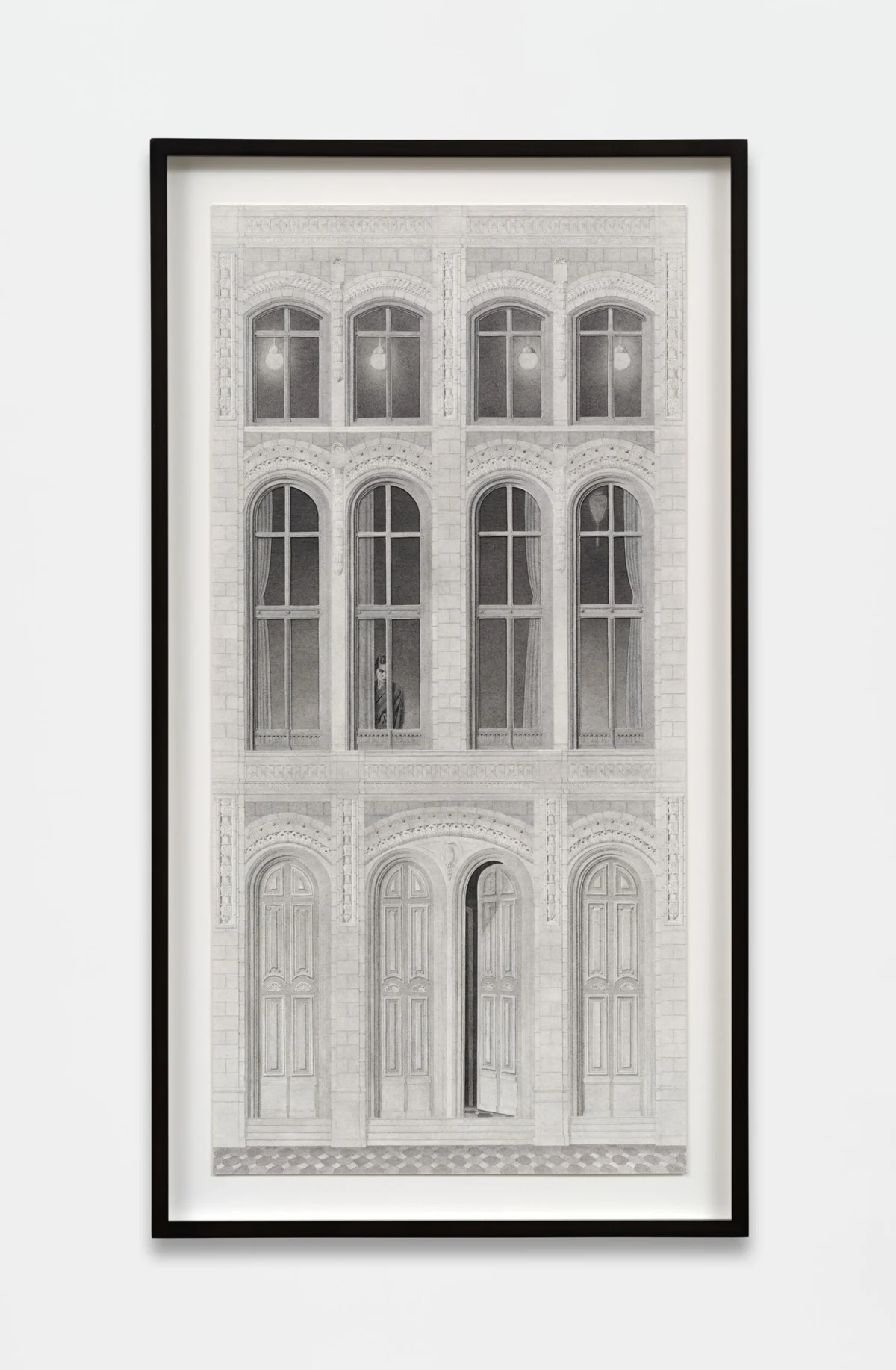
At the historic Hollyhock House in Barnsdall Art Park, the work of Milano Chow, organized by Cole Akers, offers a different flavor of domestic bliss. Chow’s work is installed in a tiny back room—a space originally intended as a child’s bedroom—that perfectly complements her aesthetic.

Chow, a fixture in the Los Angeles art scene, is known for her slyly subversive, monochromatic paper cutouts. Using a combination of pencil, ink, and acrylic, she renders the architectural facades and interiors of Victorian, Edwardian, and American colonial buildings. The level of detail is startling, providing the viewer with the voyeuristic pleasure of looking into a masterfully crafted dollhouse. Figures, when they appear, are caught in the act of sneaking across arcades or peeking out of doorways. By placing these works on dark mahogany-paneled walls and stone mantels, the installation emphasizes their toylike, yet deeply melancholic, nature. A small paper maquette sits in the corner, acting as a three-dimensional anchor to a world that feels like a colorless pop-up book.
The Gestalt of Silke Otto-Knapp at Regen Projects
Finally, at Regen Projects, the focus shifts to the late Silke Otto-Knapp (1970–2022). While the gallery currently hosts a large-scale exhibition by Elliott Hundley, it is the smaller back gallery that contains the true gem of the season.

Otto-Knapp’s work is like a musical composition played in a minor key. Her scenes of dancers and stage sets emerge from liquescent washes of black and white acrylic, appearing more like half-remembered dreams than static paintings. The selection here is distilled, favoring her smaller canvases over her famous larger folding screens. Study for Scenery and Frontispiece (2017) is a haunting, five-panel gray landscape that serves as a masterclass in balance. As the eye travels across the islands, clouds, and the dreary, uneven light, the work coalesces into a profound gestalt. It is a rare piece that invites the viewer to sit, stare, and eventually, contemplate the possibility of making it a permanent part of one’s home.
Supporting Data: The Rise of the Intimate Gallery Format
The shift toward smaller, more curated exhibitions in Los Angeles is backed by broader industry data regarding collector behavior. According to recent art market reports, there has been a 14% increase in demand for "small-format" contemporary works over the last five years. Collectors, particularly those in the post-pandemic era, are pivoting away from massive, status-symbol installations in favor of works that can be integrated into living environments.

The growth of “gallery homes” in West Hollywood and the Arts District, which feature non-traditional display spaces (such as the child’s room at Hollyhock House), has allowed for a 20% increase in attendance for "intimate viewing" sessions. These sessions are specifically designed to offer a slow-looking experience, contrasting with the high-traffic, social-media-focused environment of traditional art fairs.
Official Responses and Curatorial Intent
Curators and gallery directors have noted that this trend is not accidental. Cole Akers, speaking on the organization of the Milano Chow exhibition, noted, "There is a desire to return to the object. In an era of digital oversaturation, the quiet, the small, and the material are becoming the new radical. By placing art in spaces that mirror the home, we allow the viewer to imagine a different kind of relationship with the work."

Similarly, spokespersons for the estates of late artists like Otto-Knapp have emphasized that their smaller, lesser-known works are often the ones that most accurately reflect the artist’s "inner dialogue." These works are less performative and more reflective of the artist’s personal process, making them highly sought after by collectors who value provenance and emotional connection over sheer size or market-driven spectacle.
Implications for the Future of Art Consumption
The trend toward art that is "livable" and "intimate" has several implications for the future of the Los Angeles art market:

- The Decentralization of Gallery Spaces: As collectors prioritize galleries that offer personalized, domestic-style viewing experiences, we can expect a continued migration of top-tier galleries away from massive, industrial-style white cubes and toward spaces that offer architectural charm and intimate corners.
- The Revaluation of "Quiet" Artists: Artists who have long been overlooked for their subtle, low-key approaches—such as the late Silke Otto-Knapp or the meticulous Milano Chow—are seeing a resurgence in both critical acclaim and market value.
- The Evolution of the Collector-Object Relationship: The modern collector is increasingly viewing art as a partner in daily life rather than a financial asset or a social tool. This shift requires galleries to focus more on the experience of the work and less on the spectacle of the gallery opening.
As we look toward the next year, the question remains: if art is to be brought into the home, how will we pay for it? The desire to possess these quiet, transformative works is a powerful motivator, one that is driving collectors to invent increasingly creative financial structures—extended payment plans, long-term leasing, and private patronage—all to ensure that these "silent things" find a place of honor within the domestic sphere.
Ultimately, the art being seen in Los Angeles today is not merely an object of study. It is a mirror, reflecting our own desire for peace in a world that is anything but. Whether it is the ribbed, fork-etched landscapes of Lorenzato or the ghostly, dancing shadows of Otto-Knapp, these works provide a necessary sanctuary—a reminder that the most profound experiences are often the ones that happen in the quietest corners of our lives.
