

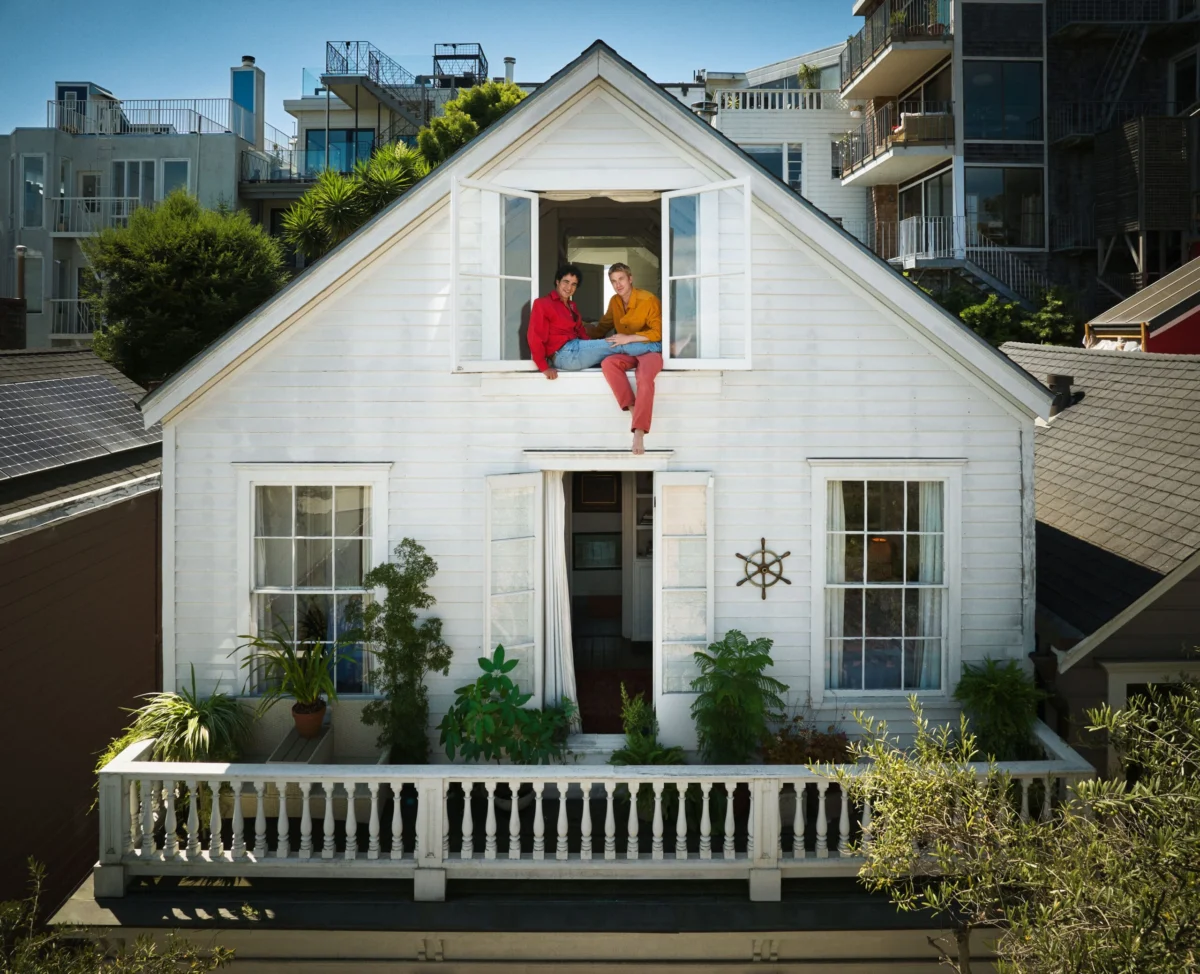
In the high-stakes world of fashion and performance art, where "curated" is the operative word and "perfection" is the baseline expectation, a historic 1850s cottage on San Francisco’s Telegraph Hill offers a refreshing, rebellious alternative. For fashion designer Zac Posen and his partner, actor and former New York City Ballet principal Harrison Ball, the journey to their West Coast home was less about finding a pristine property and more about embracing the spirit of discovery.
The result is an interior landscape that feels less like a page from a design magazine and more like a collection of memories—a "junk shop" aesthetic that manages to be both deeply personal and profoundly chic. With the collaborative touch of legendary AD100 designer Ken Fulk, the couple has turned a "tired" rental into a bohemian masterpiece that defies the polished trends of the modern era.

A Journey West: The Origins of a New Chapter
The narrative began roughly two and a half years ago, when Posen—a titan of American fashion—stepped into his dual roles as executive vice president and creative director at Gap Inc. and chief creative officer at Old Navy. This career shift necessitated a bicoastal life, forcing the couple to trade their New York rhythm for the fog-swept charm of San Francisco.
For Ball, the transition was a physical manifestation of a pioneer’s spirit. Along with his father and their two miniature poodles, Tsuki and Bizet, Ball drove across the country, carrying little more than a handful of suitcases and a striking painting of a man on a horse, discovered in the quiet hills of Bucks County, Pennsylvania.

"This move was in the spirit of the pioneers," Posen reflects from his office in New York. "It was definitely this feeling of going West, discovering the unknown." For Ball, the move marked a significant career pivot as well. Having recently retired from a storied career as a principal dancer at the New York City Ballet, he was embarking on a new path in acting, most notably appearing in Brokeback Mountain at the Chicago Shakespeare Theater earlier this year.
The Search: Finding the Captain’s Cottage
The process of finding a home was, by Ball’s own admission, an obsessive one. A self-confessed "Zillow queen," Ball was on the verge of signing a lease on a different property when he stumbled upon the 1850s captain’s cottage. Nestled against the backdrop of the bay, the house spoke to him immediately.

"I knew before I saw it that this was it," Ball recalls. "It had that metropolitan New York feeling, but on island time. I grew up going to Robin Hood’s Bay in Yorkshire, so this was like finding my old family house again."
The house, however, carried more than just personal resonance; it held a storied place in San Francisco lore. Its history reads like a velvet-rope guest list: it has been home to a Russian aristocrat, a Prohibition-era club, and, according to local legend, a temporary residence for the likes of Joan Baez and a frequent haunt for Martha Stewart. Armistead Maupin, the literary chronicler of San Francisco life, lived on the very same street while penning Tales of the City.

Despite its illustrious past, the house felt stagnant when the couple first arrived. "It was furnished, but it had an Airbnb vibe," says Ball. "The garden was dead. Moss everywhere."
The "Anti-Decorator" Approach: Enter Ken Fulk
The transformation of the space truly began after a chance encounter at a dinner party shortly after the couple moved in. They ran into Ken Fulk, the quintessential San Francisco-based designer whose work is synonymous with maximalist whimsy and high-drama interiors.

"I’d met Ken on my first trip to San Francisco, when I had a trunk show at Neiman’s at 22," Posen says. After seeing the state of their new home, Fulk didn’t offer a corporate pitch or a formal proposal. Instead, he simply offered to help.
Fulk’s approach to the project was strikingly unorthodox. There were no mood boards, no endless committee meetings, and no rigid concepts. Speaking from his own beach house in Provincetown, Fulk explains his philosophy for the project: "The cottage is delightfully imperfect. There is this great bohemian quality to the place—when you go over there, you really feel like you’ve run away and joined the circus."

Fulk’s intervention was designed to feel invisible, like a slow accumulation of time rather than a sudden injection of capital. "It’s the anti-decorator’s decorator’s house," Fulk says. "Everyone is so bored of perfection. This house is meant to look like someone actually lives there. Like they’ve been there forever already."
The Anatomy of the Interior: A Curated Chaos
The resulting aesthetic is a thoughtful, if chaotic, layering of history and personal artifacts. The living room serves as the heart of the home, featuring a bold scarlet velvet sofa—sourced from a Banana Republic furniture line—flanked by blue velvet armchairs from Les Trois Garçons. A vintage burl-wood coffee table sits at the center, while a commanding piece of art by Posen’s father, Stephen Posen, anchors the room.

The office, which the couple refers to as their "tented office," features draped walls created from leftover canvas that Posen and Fulk were testing for a retail pop-up. It is a perfect example of the project’s accidental genius: high-concept design born from scraps.
In the kitchen, the couple resisted the urge to renovate, opting instead to preserve the vintage cabinetry and the 1950s O’Keefe & Merritt stove. A crimson stripe painted at the cornice line provides a subtle nod to Posen’s sartorial sensibilities, while the "crow’s nest" attic guest room, with its whitewashed beams and sloping ceilings, evokes the feeling of a long-abandoned Montauk beach shack.

The dressing room represents the couple’s willingness to lean into the "wrong" aesthetic to achieve "cool." With an old Persian rug and a mahogany desk that defies modern trends, the room serves as a sanctuary for their eclectic collection of campaign desks and ornate, local-vintage finds.
Implications: The New Zeitgeist of Home Design
The success of the Posen-Ball cottage highlights a shifting trend in high-end residential design. As digital platforms continue to promote a homogenized, "Instagram-ready" aesthetic, there is a growing movement toward "lived-in" imperfection.

By avoiding the trap of over-curation, the couple has managed to create a space that feels honest. The inclusion of the "mistakes"—like the paint color in the kitchen or the remnants of fabric from a pop-up store—adds a layer of humanity that is often stripped away by professional designers.
"The cottage is not, like, particularly fancy," Ball notes. "I don’t really love overdone stuff. It’s a rental, so there’s only so much we can do."

This pragmatism is the core of their design success. In a world where luxury is often defined by the cost of the materials, Posen, Ball, and Fulk have defined luxury by the authenticity of the experience. They have treated the house as a living, breathing entity, one that will continue to evolve as they gather more "treasures" from their travels and local scavenger hunts.
A Garden Sanctuary
The transformation wasn’t limited to the interior. Ball, taking the lead on the outdoor space, has turned the once-mossy, neglected backyard into a lush sanctuary. Using a variety of plants—including pink begonia, Brugmansia, Ligularia, and coyote mint—the garden now serves as an extension of the living space.

Equipped with a Winged Victory-inspired sculpture from Fulk and vintage rattan chairs adorned with custom Perennials fabrics, the backyard is where the couple—and their poodles—find their respite. It is, perhaps, the most accurate reflection of their life together: a mix of classical inspiration, practical comfort, and a refusal to be anything other than themselves.
Conclusion: The Art of Living
Zac Posen and Harrison Ball have successfully navigated the pressures of their respective careers to create a home that feels like a refuge rather than a trophy. Through their collaboration with Ken Fulk, they have proved that the most sophisticated homes are not those that are perfectly styled, but those that tell a story—even if that story is a little "higgledy-piggledy."

As Posen continues to shape the future of American retail and Ball explores his burgeoning career in the arts, their cottage on Telegraph Hill remains a testament to the idea that home is not about the permanence of architecture, but the layers of life you choose to place within it. It is, as Ball says, exactly what it is: a beautiful, imperfect, and entirely unique expression of a life lived well.
