

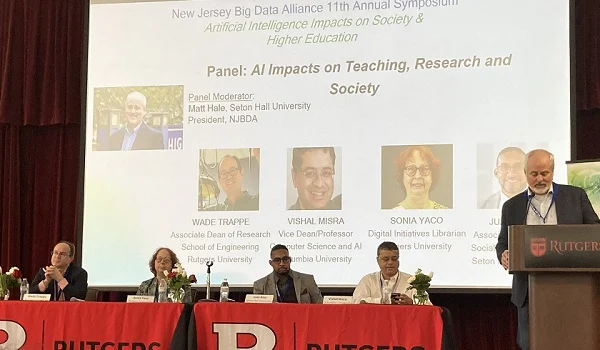
The landscape of higher education is undergoing its most radical transformation since the advent of the internet. At the 2024 New Jersey Big Data Alliance (NJBDA) Symposium, hosted at Rutgers University–New Brunswick, leading academics and technology experts gathered to dissect the profound impacts of artificial intelligence (AI) on society and the academy. The consensus among the experts was clear: AI is not merely a tool for efficiency; it is a fundamental shift in how universities will conduct research, manage student cohorts, curate history, and facilitate classroom learning.
The Symposium Overview: A New Era for Academia
The 2024 NJBDA Symposium served as a crucible for ideas regarding the future of higher education. Throughout the event, a recurring theme emerged: the integration of generative AI is poised to touch every facet of the university experience, from the mundane administrative tasks of course scheduling to the complex, creative processes of social science research.
The panel session, “AI Impacts on Teaching and Research,” featured a diverse cross-section of academic leadership. Moderated by Matthew Hale, chair of the Master of Public Administration program at Seton Hall University, the discussion featured:
- Vishal Misra: Professor of Computer Science and Vice Dean of Computing and AI at Columbia University.
- Juan Rios: Associate Professor, Master of Social Work program at Seton Hall University.
- Wade Trappe: Associate Dean for Research and Development at the Rutgers School of Engineering.
- Sonia Yaco: Digital Initiatives Librarian at Rutgers University.
The Mechanics of Transformation: Administrative and Research Efficiency
Streamlining Admissions and Faculty Oversight
Wade Trappe of Rutgers opened the discussion by highlighting the logistical power of AI in administrative roles. Universities often struggle with the "cohort effect"—the challenge of building a balanced, diverse incoming class of students. Trappe argued that AI can accelerate this process, allowing administrators to identify gaps in incoming profiles—such as the need for more artistic talent in a pool heavily weighted toward athletes—thereby creating a more cohesive campus environment.
Beyond admissions, Trappe touched on faculty support. He pointed to tools like Tableau, which are increasingly being integrated into university systems to identify faculty members who have not submitted grant applications in recent cycles. By using data analytics to flag these gaps, deans can proactively reach out to faculty, offering resources and support to increase research output.
The Institutional Strategy: Columbia’s 70-Use-Case Roadmap
Vishal Misra provided an institutional perspective from Columbia University, where he serves as the first-ever Dean of AI. Following his experience starting a company that utilized ChatGPT-3, Misra helped establish a presidential task force at Columbia to map the university’s AI integration.
“We have identified 70 different use cases across the university,” Misra noted, ranging from dining services and technology ventures to the licensing office and, crucially, research teaming. By prioritizing these use cases, Columbia aims to assist researchers with the burdensome pre-grant and post-grant processing tasks that currently consume significant administrative time, allowing scholars to focus on the science rather than the paperwork.
Preserving the Past: AI as a Digital Archivist
Perhaps the most compelling intersection of humanities and technology was presented by Sonia Yaco, a digital initiatives librarian. Yaco highlighted a critical cultural challenge: the decline of cursive literacy among modern students. This has made vast swaths of historical archives inaccessible to the average researcher.
Yaco is leveraging AI to bridge this gap. Her work involves using machine learning to transcribe handwritten manuscripts into searchable, digital text. Beyond transcription, the AI is capable of analyzing and cataloging tens of thousands of unlabeled photographs within special collections. By generating MARC (MAchine-Readable Cataloging) records, AI can provide context—identifying a 19th-century rural scene in Korea, for example—and link it to previously unassociated documents. This capability, Yaco noted, transforms static, silent archives into vibrant, multimedia collections that are accessible to students with diverse learning styles.
Chronology of Change: From VHS Tapes to Instant Analytics
The pace of progress was underscored by moderator Matthew Hale, who provided a historical anchor for the discussion. Reflecting on his early research on television news coverage of national elections, Hale recounted a process that was once agonizingly slow.
In the year 2000, his team hired individuals across 50 television markets to manually record news segments on VHS tapes, mail them to the University of Southern California, and then employ researchers to sit and watch the tapes to code data. The process for a single election cycle took nearly a year. “I think it would be done in 37 seconds today,” Hale quipped, emphasizing that the era of manual data collection is effectively over. This acceleration allows for more longitudinal studies and a faster feedback loop between hypothesis and publication.
The Pedagogical Shift: Guardrails and Creative Scenarios
Teaching the "Guardrails"
As AI becomes ubiquitous, the role of the professor must evolve from a source of knowledge to a navigator of information. Wade Trappe noted that the current generation of 18-year-olds is already intimately familiar with ChatGPT, but they lack the critical framework to use it safely.
"We need to teach them the guardrails," Trappe asserted. He emphasized the necessity of teaching students about "hallucinations"—instances where AI generates plausible-sounding but entirely false information. The central lesson of the modern classroom, he argued, is to foster a healthy skepticism. "Just because a wonderful new tool tells you an answer doesn’t mean you should believe it," Trappe warned.
AI for Social Empathy
Juan Rios provided a unique perspective from the field of social work. Rather than viewing AI as a replacement for human thought, Rios uses it to help students expand their cognitive horizons. In his social policy courses, he uses generative AI to help students construct future scenarios.
If a student is studying homelessness or substance abuse, they use AI to create a visual and narrative model of a community where those problems have been addressed. This exercise forces students to "stretch their minds" and localize their policy solutions to the specific needs of cities like Newark, where Seton Hall conducts much of its community service work. The goal is to move from theoretical study to community-centered problem solving, using AI as a bridge between data and empathy.
Implications for the Future of Higher Education
The symposium concluded with a look toward the broader societal implications of these advancements. The integration of AI into higher education is not simply an "IT upgrade." It is a fundamental alteration of the academic mission.
Ethical and Institutional Challenges
While the potential for efficiency is high, the panel acknowledged the ethical weight of these tools. As universities move toward automated admissions, data-driven faculty oversight, and AI-assisted research, they must grapple with:
- Data Integrity: The risk of relying on "fake data" or biased algorithms.
- Accessibility: Ensuring that AI tools are used to enhance, not hinder, the learning experiences of students with different cognitive styles.
- Human Agency: Maintaining the vital role of the professor in a world where answers are instantaneous.
The Road Ahead
The 2024 NJBDA Symposium made it clear that the "AI University" is already here. The successful institutions will be those that view AI as a partner in the research process and a tool for pedagogical innovation rather than a threat to academic integrity. By focusing on critical thinking, ethical guardrails, and community-centered applications, universities can harness the power of AI to not only accelerate their work but to deepen their connection to the history they preserve and the societies they serve.
As the panelists demonstrated, the transition is not just about adopting the latest software—it is about reimagining what a university can do when it is no longer limited by the speed of manual labor or the constraints of analog archives.
