

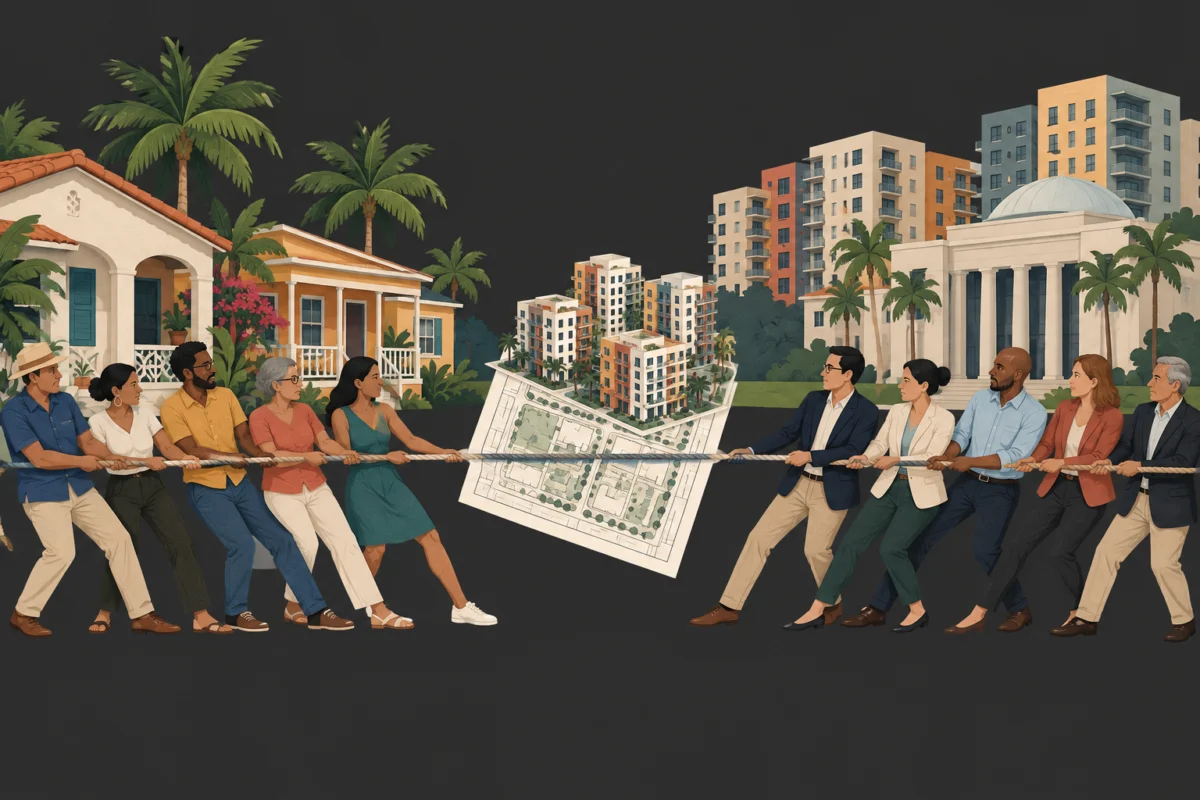
Little Havana, the historic heart of Miami’s Cuban-American community, is bracing for a transformation that could redefine its architectural silhouette and social fabric. As city planners push forward with aggressive zoning proposals designed to unlock housing capacity, the neighborhood finds itself at the epicenter of a national debate: how to solve a chronic housing affordability crisis without sacrificing the character and infrastructure that make a neighborhood livable.
The Main Facts: A New Frontier for Development
Proposed zoning changes in Little Havana and portions of the Miami River District aim to move away from the status quo, which some officials argue has stifled the growth of essential housing. Under the new framework, certain properties could be up-zoned to accommodate up to 150 residential units per acre, with building heights reaching up to eight stories.
This is not merely a local initiative; it is a response to the shifting landscape of Florida’s housing policy. The planning effort is navigating the complexities of the Florida 2023 Live Local Act—a piece of legislation that has undergone three revisions this year alone. While the Act provides a pathway for developers to gain significant density bonuses in exchange for reserving 40% of units as affordable rentals for at least 30 years, the city’s broader zoning proposal carries no such mandate.
The potential for market-rate, high-density development has sparked a "tug-of-war" between proponents, who see supply as the primary cure for rising rents, and long-term residents, who fear that unchecked growth will strain infrastructure, overwhelm public schools, and erode the cultural identity of a district defined by its historic low-rise charm.
A Decade of Planning: From "Me Importa" to Modernization
The current zoning debate is the culmination of a decade-long odyssey in urban planning. In 2015, the planning and design firm Plusurbia spearheaded an initiative to revitalize the iconic Calle Ocho corridor. This was followed in 2019 by the "Me Importa" Revitalization Master Plan, a collaborative effort backed by the National Trust for Historic Preservation that synthesized input from over 2,700 stakeholders.
The goal of these earlier efforts was to balance progress with preservation. Megan McLaughlin, director of preservation projects at Plusurbia, emphasizes that the strategy was never about stagnation but about "incremental development." The firm advocated for "inverse density"—a planning philosophy that grants greater density allowances to smaller lots to discourage the assembly of massive, block-wide parcels that often lead to sterile, high-rise developments.
"It’s like coding," says McLaughlin. "You’re documenting the DNA of the place and integrating it into the code." By measuring existing setbacks, building heights, and sidewalk widths, planners hoped to create a set of rules that would allow for infill construction that feels organic to the neighborhood rather than imposed upon it.
Chronology: The Road to the Commission
The legislative process has been marked by tentative timelines and ongoing public skepticism.
- 2015-2019: Conceptual planning phases, including the Plusurbia revitalization efforts and the National Trust’s "Me Importa" master plan.
- September 2, 2024: The Planning, Zoning, and Appeals Board recommended approval of the current zoning proposal, signaling a shift toward more aggressive density.
- September 2024: Public hearings revealed significant pushback, particularly regarding the impact on single-family homes south of Calle Ocho. In response, city planners removed several properties from the proposal to create a more gradual transition.
- October–December 2024 (Projected): City Commission review, additional community outreach, and potential second readings.
The timeline remains fluid. Because the proposal involves a significant acreage of future land-use changes, state-level review is mandatory. While state law suggests a 30-day review period, city staff acknowledge that inquiries from state reviewers regarding environmental, traffic, and infrastructure impact could stretch the entire process to six months or longer.
Supporting Data: Infrastructure and Capacity Concerns
The central tension of the proposal lies in the disconnect between mathematical "capacity" and physical reality. Proponents of the rezoning point to a need for more housing stock near transit corridors and employment hubs like Brickell and Downtown Miami.
However, critics, including property owners and local advocates, cite a 2016 city study on "Maximum Density Potential," which suggested that even under existing zoning, the city could accommodate eight times the number of units recorded in 2010. Critics argue that the current push for more density ignores the lack of underlying infrastructure.
Key data points currently under review include:
- School Capacity: A preliminary review by the local school district identified that six out of the nine schools serving the impacted area are already operating at or near capacity.
- Utility Infrastructure: Questions regarding sewage, drinking-water supply, and hurricane evacuation routes remain unanswered, with opponents noting that the "Miami 21" code was originally designed to ensure a "gradual transition" in density—a principle they claim this proposal violates.
- Affordability vs. Market Rate: While the Brisas del Sol project—a $53.3 million development with 146 income-restricted units—shows what is possible with federal subsidies, the proposed zoning changes rely on the private market to naturally suppress costs through supply. Economists remain divided on whether this approach will provide relief to the lowest-income households or merely accelerate gentrification.
Official Responses and the "Gentle Density" Alternative
City planners have attempted to soften the impact of the proposal by coupling it with a "neighborhood revitalization district." This tool is intended to mandate public benefits and establish strict design guidelines. The city is also moving to fund $7 million in sanitation and security upgrades for Calle Ocho, a move that local construction leaders like Zion Mass, CEO of Mass Construction, view as a necessary step in acknowledging the corridor’s evolving role.
"It’s a great opportunity for the neighborhood to change and become a new hub for younger crowds," says Mass. "But it’s the responsibility of the citizens and the community leaders to ensure we preserve the history."
Juan Mullerat of Plusurbia suggests that the city should look toward "gentle density"—the integration of accessory dwelling units, triplexes, and four-unit buildings—rather than relying solely on large-scale apartment complexes. Mullerat argues that density is only a benefit if it is paired with mobility. "Transportation is critical," he notes, citing his work in the West Grove, where proximity to a train station was rendered useless by the physical barrier of six lanes of traffic on U.S. 1.
Implications: The Future of Little Havana
The implications of these zoning changes extend far beyond the borders of Little Havana. If successful, the model could be replicated across Miami, fundamentally altering the character of historic neighborhoods in favor of urban density. If the proposal fails or is watered down, it could signal a broader rejection of the "supply-first" housing strategy currently favored by state legislators.
For now, the residents of Little Havana are caught in a waiting game. They are watching to see if the city’s promises of design guidelines and revitalization districts will offer meaningful protections, or if they are merely administrative placeholders for a development boom that will leave the neighborhood’s "DNA" behind.
As the City Commission prepares for its upcoming debates, the fundamental question remains: Can a neighborhood evolve to house the future without losing the history that defines its past? The answer will likely dictate the housing trajectory of Miami for decades to come. The process is not just about concrete and permits; it is a test of whether a city can grow efficiently while maintaining the human-scale connections that make a neighborhood a home.
