

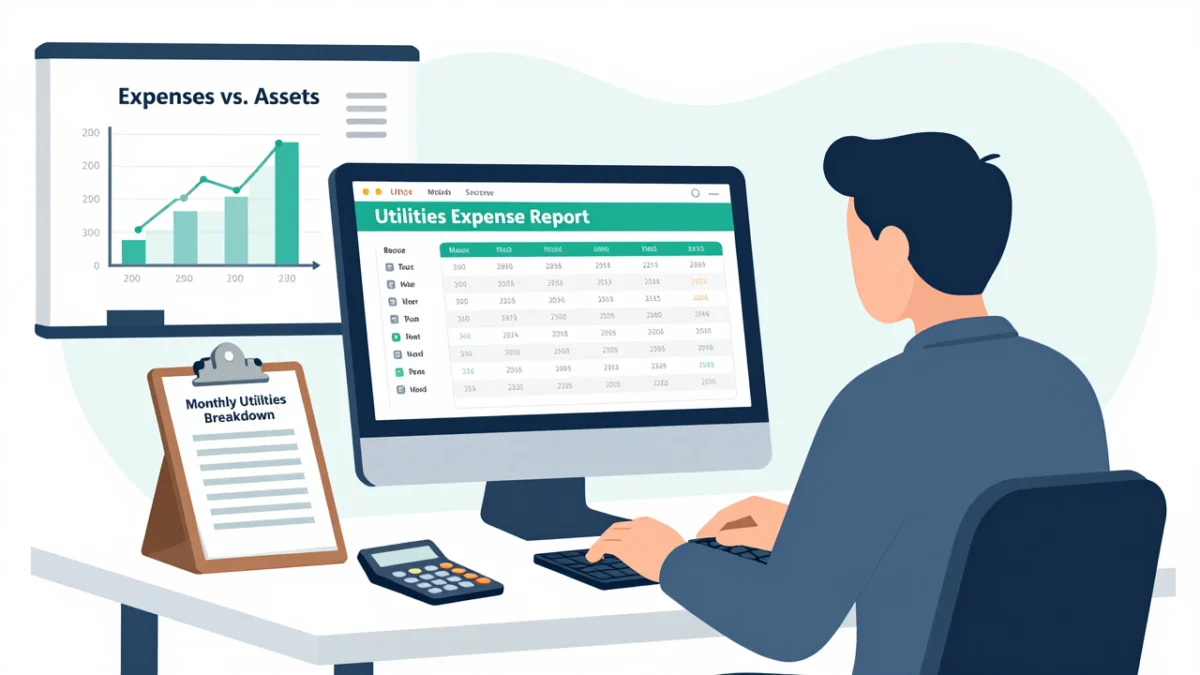
In the complex ecosystem of business accounting, few distinctions are as fundamental—yet as frequently misunderstood—as the classification of operational costs. For small business owners and financial managers alike, the question of whether a utility payment qualifies as an asset is a recurring point of confusion. To maintain the integrity of financial reporting and ensure tax compliance, it is critical to understand that utilities, such as electricity, water, and heating, are strictly operational expenses, not assets.
The Core Definition: Why Utilities Fail the Asset Test
At its heart, accounting is the language of value. An asset is defined as a resource with economic value that an entity owns or controls with the expectation that it will provide a future benefit. Conversely, an expense represents the cost of operations that a company incurs to generate revenue.

Utilities fall squarely into the latter category. When your business consumes electricity to power machinery or water to facilitate production, those resources are "consumed" the moment they are used. They do not hold residual value, nor can they be sold or leveraged for future economic gain beyond the immediate operation of the business. Because they lack the capacity to provide future benefits, they are recorded on the income statement as a deduction from revenue, rather than on the balance sheet as an asset.
Chronology of Financial Recognition
The timing of how these costs appear in your ledger depends largely on the accounting method your business employs. However, the lifecycle of a utility expense typically follows a standard progression:

- Incurrence of Service: The business utilizes the utility provider’s service (e.g., electricity usage throughout the month of October).
- Receipt of Obligation: The utility company issues a statement. Under accrual accounting, this is the moment the expense must be recognized, regardless of when the cash actually leaves your bank account.
- Liability Creation: If the bill is not paid immediately, the amount is recorded as an Accounts Payable entry. This is a crucial distinction: the unpaid bill is a liability, not a shift in asset classification.
- Settlement: The payment is made, reducing the cash asset account and simultaneously clearing the liability.
Accrual vs. Cash Basis Accounting
For many small businesses, the choice between accrual and cash basis accounting significantly changes the "view" of these expenses. In cash basis accounting, the expense is recognized only when the payment is physically made. While this is simpler, it often fails to match expenses with the revenue they helped generate, potentially distorting the financial health of the business in any given month. Accrual accounting, by contrast, provides a more accurate, albeit complex, picture of true operational costs.
Supporting Data: The Anatomy of the Financial Statement
To better grasp the impact of these costs, we must look at how they interact with the primary financial statements:

| Financial Element | Role in Utility Accounting |
|---|---|
| Income Statement | Acts as the home for utility expenses; reduces net income. |
| Balance Sheet | Records the unpaid portion of bills as a current liability. |
| Cash Flow Statement | Reflects the actual outflow of cash used to settle utility accounts. |
Misclassifying a utility bill as an asset—perhaps by amortizing it or listing it as a long-term resource—leads to an artificial inflation of your company’s book value. This is not merely a technical error; it is a distortion that can mislead investors, complicate tax filings, and result in poor strategic decision-making.
Official Accounting Standards and Principles
The Generally Accepted Accounting Principles (GAAP) provide clear guidelines regarding asset recognition. According to the Financial Accounting Standards Board (FASB), for an item to be recognized as an asset, it must satisfy three criteria:

- It must be a probable future economic benefit.
- The entity must have obtained control over the benefit.
- The transaction or event giving rise to the entity’s right to the benefit must have already occurred.
Utility expenses fail the first criterion. Because the electricity is used to light a room or power a computer for a single, ephemeral moment, there is no "future" benefit remaining to be harvested.
The Implications of Misclassification
The consequences of failing to correctly categorize these costs can be severe. When a business treats an expense as an asset, it creates a "phantom" balance sheet.

1. Distorted Financial Ratios
Lenders and investors use metrics like the Current Ratio (Current Assets / Current Liabilities) to assess risk. If you are reporting utility bills as assets, you are skewing your liquidity ratios. This could lead to a false sense of security or, worse, inaccurate borrowing capacity calculations.
2. Tax and Audit Risks
Tax authorities require that businesses accurately categorize their expenses to determine taxable income. If your business is deducting costs as assets and then attempting to depreciate them, you are effectively creating a false tax shelter. This is a major red flag during an audit and can lead to penalties and forced restatements of earnings.

3. Operational Inefficiency
If a department head misallocates utility costs, the company loses the ability to perform accurate cost-benefit analysis. For instance, if you cannot see the true, immediate cost of powering a particular production line, you cannot accurately determine its profitability.
Strategic Management: Moving Beyond Classification
Knowing that utilities are expenses is only the first step. Effective business owners use this knowledge to drive operational efficiency.

Granular Allocation
Rather than treating "Utilities" as a single, massive line item, forward-thinking managers allocate these costs by department. By assigning electricity usage to specific cost centers, you can identify which teams or production processes are the most energy-intensive. This data is vital for setting departmental budgets and incentivizing energy-saving behaviors.
Automation and Oversight
With modern accounting software, the manual entry of utility bills is becoming obsolete. Automated integrations with utility providers allow for real-time tracking of expenses. This ensures that the moment a bill is incurred, the liability is recorded, and the expense is mapped to the correct period.

The "Prepaid" Exception
There is one specific scenario where a utility-related item can be an asset: Prepaid Utilities. If you pay a utility provider a deposit or pay for a year of service in advance, that prepayment represents a future economic benefit (a credit against future consumption). This amount should be recorded as a "Prepaid Expense" (a current asset) and then moved to the income statement as an expense on a monthly basis as the service is actually used. This is the only legitimate way to bridge the gap between "Asset" and "Utility."
Conclusion: Clarity as a Business Imperative
In the high-stakes environment of business finance, precision is not a luxury; it is a necessity. By stripping away the misconception that utility costs are assets, you empower your organization to see its true financial position.

Remember: assets provide long-term, compounding value; expenses provide the fuel for current, daily operations. By accurately capturing these costs as they are incurred, managing them through departmental allocation, and ensuring they are never erroneously placed on your balance sheet, you establish a solid foundation for sustainable growth.
Ultimately, the goal of accounting is to provide a clear, honest, and accurate narrative of your business’s performance. By respecting the distinction between an expense and an asset, you are ensuring that the story your financial statements tell is one of accuracy, integrity, and operational success.

Frequently Asked Questions (FAQ)
Q: If I pay a security deposit for my office utilities, is that an asset?
A: Yes. Because a security deposit is refundable or will be applied to future bills, it represents a future economic benefit. It should be recorded as a "Deposit" or "Other Asset" on your balance sheet.
Q: Can I capitalize utility costs during the construction of a new building?
A: Under certain accounting standards, costs that are directly attributable to bringing an asset to its intended state of use—including specific utility costs incurred during construction—may sometimes be capitalized as part of the asset’s cost. However, this is a specialized exception and should be handled under the guidance of a CPA.

Q: Why does it matter if I record the expense when I pay it vs. when I receive the bill?
A: Recording it when you receive the bill (accrual) matches the cost to the period in which you actually used the resources. Recording it only when you pay it (cash) can hide the true volume of your expenses during busy months, leading to potentially inaccurate profitability assessments.
