

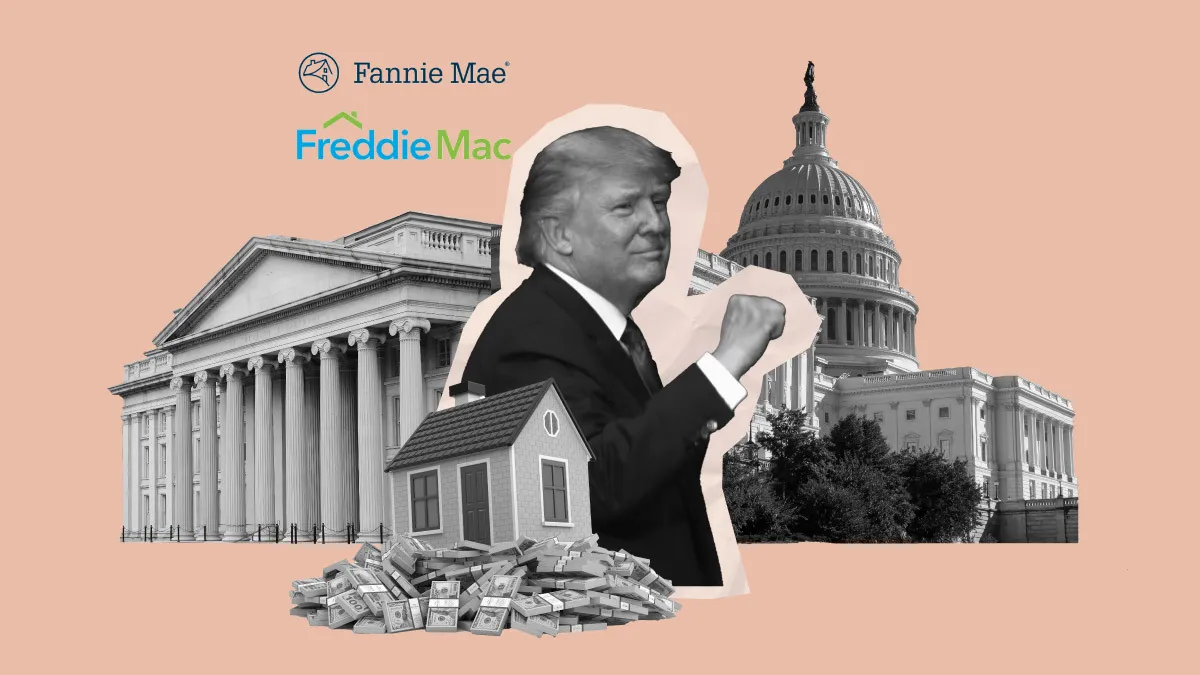
Executive Summary: The Persistence of Privatization Plans
President Donald Trump has firmly dismissed speculation that his administration is abandoning the proposed initial public offering (IPO) for mortgage finance giants Fannie Mae and Freddie Mac. Speaking to journalists aboard Air Force One this past Friday, the President clarified that despite the recent administrative pivot involving Federal Housing Finance Agency (FHFA) Director Bill Pulte, the plan to return the mortgage giants to the private market remains a live, albeit non-urgent, policy objective.
Fannie Mae and Freddie Mac, the twin pillars of the U.S. housing market, have remained under government conservatorship since the 2008 financial crisis. Together, they back approximately 70% of the nation’s mortgage debt. The prospect of an IPO has been a cornerstone of the President’s second-term economic agenda, representing a potential multi-billion dollar shift in the structure of American housing finance.
A Chronology of the GSE Privatization Effort
The path toward potential privatization has been marked by sporadic momentum and significant regulatory hurdles. To understand the current climate, one must look at the timeline of the administration’s strategy:
- May 2025: President Trump signals "serious consideration" for ending the decade-long conservatorship, explicitly mentioning the possibility of an IPO while retaining a government-backed implicit guarantee.
- August 2025: The administration formally signals its intent to pursue an IPO, sparking a temporary rally in GSE-related securities.
- November 2025: FHFA Director Bill Pulte outlines a roadmap during a New York City conference, suggesting the government may explore the sale of a 5% stake in the entities while maintaining federal oversight.
- January–June 2026: Throughout the current year, the administration conducts high-level consultations with financial titans, including JPMorgan Chase CEO Jamie Dimon, Goldman Sachs CEO David Solomon, and Bank of America CEO Brian Moynihan.
- June 2026: Amidst growing doubts regarding the feasibility of the IPO, stocks for both Fannie and Freddie face downward pressure, shedding over 30% of their value year-to-date.
The Pulte Factor: A Dual-Role Dilemma
The central point of confusion regarding the IPO’s status stems from the appointment of FHFA Director Bill Pulte to lead the nation’s intelligence apparatus on an acting basis. Critics and investors alike questioned whether Pulte’s shift in focus to the Office of the Director of National Intelligence (ODNI) signaled an abandonment of his housing finance duties.
However, the President’s comments suggest that the administration sees no conflict between Pulte’s dual assignments. Pulte, who is scheduled to begin his intelligence role on June 30, has been tasked by the President with an ambitious mandate: downsizing the intelligence community, which the President has publicly described as "too big" and "unnecessary."
The appointment has, however, ignited a firestorm on Capitol Hill. The selection of a housing regulator to oversee national security has drawn sharp bipartisan criticism. Concerns regarding Pulte’s lack of traditional national security experience have led to an organized pushback from the Senate. Sens. Bill Cassidy (R-La.), Susan Collins (R-Maine), and Lisa Murkowski (R-Alaska) have joined Democratic colleagues in backing an amendment specifically designed to bar Pulte from simultaneously holding the FHFA directorship and the acting DNI position.
Supporting Data: Market Volatility and Investor Sentiment
The market’s reaction to the President’s comments highlights the high-stakes nature of the GSE reform. Investor enthusiasm, which reached a fever pitch in late 2025, has been replaced by a cautious "wait-and-see" approach.
- Share Price Performance: As of the close of business this past Friday, Fannie Mae’s stock (FNMA) was down 0.74%, while Freddie Mac’s (FMCC) slipped 1.07%. These figures contribute to a broader annual decline exceeding 30%.
- Market Share: With the GSEs supporting 70% of the U.S. mortgage market, any structural change carries systemic risk. Financial analysts note that the current "implicit" guarantee—where investors believe the government will not allow the entities to fail—is what maintains the liquidity of the Mortgage-Backed Securities (MBS) market.
- Institutional Engagement: The administration’s engagement with Wall Street leadership suggests a desire to ensure that any IPO would be supported by the nation’s largest liquidity providers. However, the lack of a formal legislative framework has stalled concrete institutional investment.
Official Responses and Political Implications
The President’s stance remains clear: "We’re thinking about an IPO for that. It’s not a rush." This statement is designed to temper market expectations while maintaining the threat—or promise—of privatization as a tool to reduce the federal footprint in the economy.
The administration has been equally firm regarding the duration of Pulte’s intelligence role. The President has explicitly stated that the appointment is not meant to be permanent, citing the belief that Pulte would not desire a long-term tenure in the intelligence community. This temporary nature is intended to pacify critics who argue that the ODNI requires a dedicated, experienced professional, while still allowing the President to utilize Pulte to execute a specific administrative downsizing agenda.
However, the political math remains difficult. With the Senate actively moving to block the "double-duty" arrangement, the administration faces a potential constitutional and administrative standoff. If the Senate successfully passes the amendment to decouple the roles, the President will be forced to choose between his agenda for the intelligence community and his long-term plan for the reform of Fannie Mae and Freddie Mac.
Economic and Strategic Implications
The Future of the Housing Market
The privatization of Fannie Mae and Freddie Mac is not merely a financial transaction; it is a fundamental reordering of the American dream of homeownership. Should an IPO proceed, the primary challenge for the administration will be balancing private investor interests with the mandate to keep mortgage rates affordable and accessible.
If the government fully divests, the "implicit guarantee" would likely have to be formalized or explicitly removed. A removal of that guarantee could lead to a significant increase in mortgage interest rates, as investors would demand a higher risk premium for holding mortgage-backed assets. Conversely, a formalization of the guarantee would require a massive legislative lift, likely requiring a comprehensive "Housing Act" that has yet to be introduced in Congress.
The Intelligence Community Mandate
The selection of Pulte—a figure deeply embedded in the housing sector—to lead the intelligence community is being viewed by political analysts as a signal that the President prioritizes "disruptor" figures over institutional insiders. The move suggests a desire to force efficiency and consolidation through outsiders who are not beholden to the traditional bureaucracies of the agencies they are meant to lead.
The failure or success of this strategy will likely set the tone for the remainder of the second term. If the President can successfully navigate the Senate’s resistance and push forward with both his housing reforms and his administrative downsizing, it will represent a significant consolidation of executive power. If, however, the Senate succeeds in blocking the appointment, it will serve as a stark reminder of the limits of executive authority in a divided government.
Conclusion: The Road Ahead
As the nation moves toward the latter half of 2026, the status of Fannie Mae and Freddie Mac remains a litmus test for the President’s economic philosophy. While the rhetoric surrounding an IPO remains steady, the tangible steps toward privatization have slowed, hampered by a combination of political opposition and the logistical complexities of reforming the world’s largest mortgage financiers.
Investors, policymakers, and homeowners alike will be watching the next few months with heightened scrutiny. Whether the administration eventually moves to IPO the GSEs or decides to settle for incremental reforms remains to be seen. What is certain, however, is that the future of the American housing market is currently in a state of suspended animation, waiting for the political dust to settle on the President’s broader agenda.
