

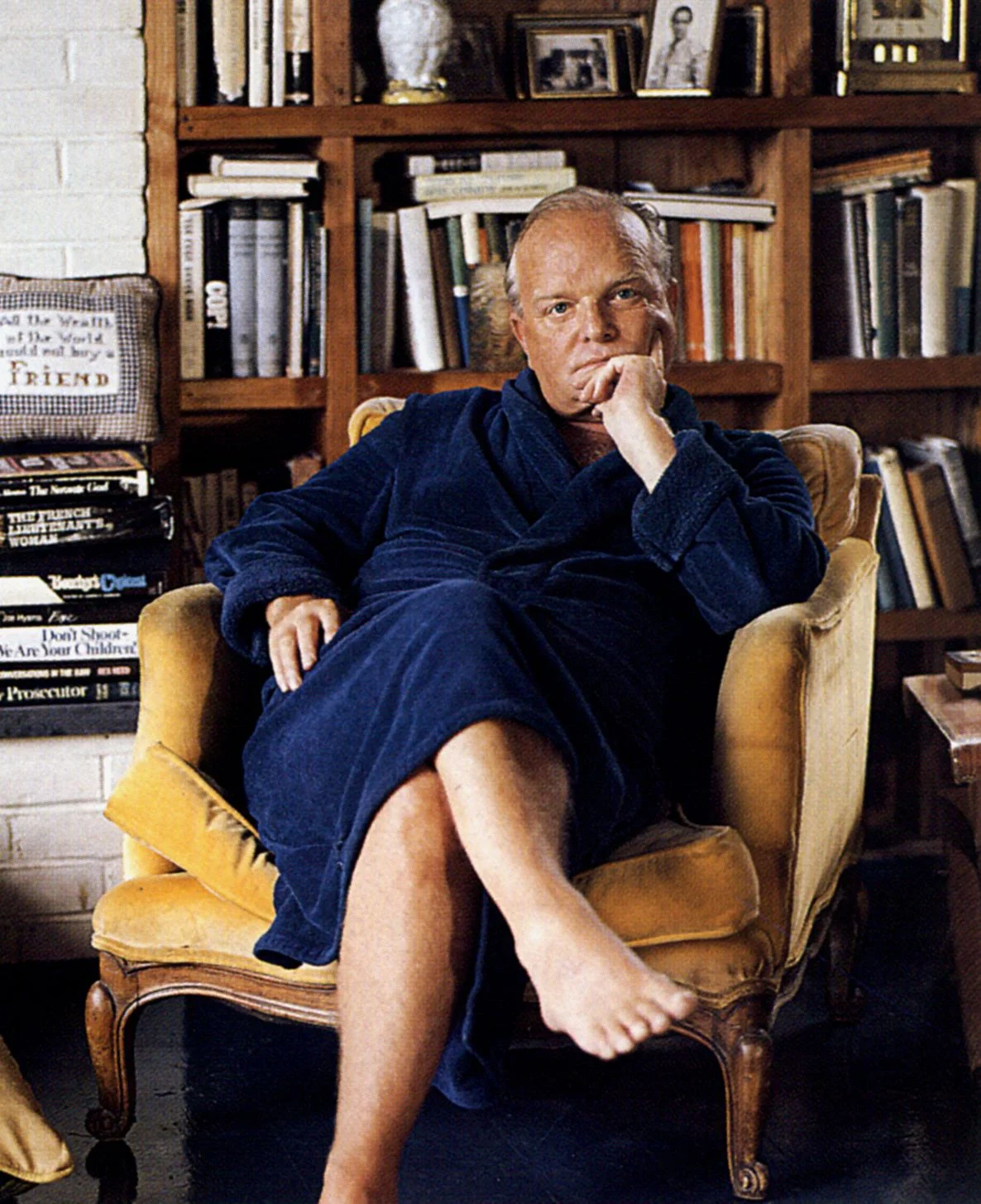
For decades, the name Truman Capote has conjured images of mid-century high society, the chilling precision of true-crime reportage, and the enigmatic, high-pitched wit of an American literary icon. Now, fans and collectors alike have a rare, tangible opportunity to peer into the private life of the In Cold Blood author. Gerald Clarke, the acclaimed biographer and close confidant of Capote, has announced that he is downsizing his collection, offering nearly 400 personal lots from the writer’s estate for public auction.
This historic sale, managed by the Cornell Auction house, serves as a poignant epilogue to the life of a man whose personal spaces were as curated and complex as his prose.
The Auction: A Portal into the Past
The Cornell Auction sale is officially scheduled for November 21, with an online preview and bidding window opening on October 26. While the full catalogue remains under wraps, the auction house has confirmed that many of the items reflect the aesthetic and personal history documented in a landmark 1976 Architectural Digest feature on Capote’s Sagaponack, Long Island home.

The collection is not merely a hoard of curios; it is a curated archive of a life lived at the intersection of literary genius and social performance. Among the most anticipated items are pieces from Capote’s extensive collection of paperweights—an obsession he pursued with fervor. Some of these objects were crafted by the author himself, utilizing flowers preserved in resin, while others contain geologic fragments from the Kansas farm that became the setting for his masterpiece, In Cold Blood.
Beyond the curiosities, the sale features deeply personal artifacts, including a signed copy of Harper Lee’s To Kill a Mockingbird, a bronze frog inkwell, and even the very house keys that once granted access to his secluded Hamptons sanctuary.
A Chronology of a Literary Life
To understand the significance of these items, one must look at the trajectory of the man who collected them:

- 1924: Truman Streckfus Persons is born in New Orleans, Louisiana.
- 1962: Capote commissions a custom-built home in Sagaponack, Long Island, describing the location as "Kansas with a sea breeze."
- 1966: The publication of In Cold Blood cements his status as a titan of American literature.
- 1976: Capote opens his Sagaponack home to Architectural Digest, revealing a space defined by "run-down comfort" and a collection of personal talismans.
- 1984: Truman Capote passes away at the age of 59.
- 1988: Gerald Clarke publishes his definitive biography, Capote, cementing the journalist’s role as the primary custodian of the writer’s legacy.
- 2024: The cultural fascination with Capote is reignited by the miniseries Feud: Capote vs. the Swans.
- 2026: At 89 years old, Gerald Clarke announces the auction of 400 personal lots, sharing the treasures of his long-time friend with the public.
Supporting Data: The Anatomy of a Home
The items up for auction are inseparable from the architecture of Capote’s life. His Sagaponack home, which he built to his own specifications, was a study in contradictions. It was a place he claimed to be "hide-and-seek" architecture—hidden behind scrub pine and privet hedges to ensure his privacy.
The home was a reflection of his internal world: a "raincoat" of a building with exposed studs and rafters, designed to look intentionally unfinished. Inside, the decor was not the work of a professional decorator but an expression of his own eclectic sensibilities. He eschewed the "Don’t Touch" mentality, preferring a home that felt lived-in and comfortable.
The auction will likely feature elements from his "witchcraft altar"—a collection of curiosities he maintained on his living room steps. This included an antique wood cat, a bronze bell, and needlepoint pillows gifted by friends. These were not mere decorations; they were the props of his daily life, surrounding him as he worked at his round, claw-footed wicker table, writing by hand on his signature yellow Sphinx paper.

Official Perspectives and Personal Reflections
The transition of these items from private ownership to public auction has been handled with a mix of pragmatism and reverence. For Gerald Clarke, who has lived with these objects since Capote’s passing, the decision to downsize is a natural progression of time.
"I’m here to work," Capote once told Architectural Digest, reflecting on his solitude in Sagaponack. He was a man who knew the world—from the prisoners he interviewed in Kansas to the socialites he entertained at the U.N. Plaza—yet he found his greatest comfort in the company of his own possessions.
The auction house has noted that the items are being sold not as static museum pieces, but as artifacts of a vibrant, albeit melancholic, life. By offering them for auction, the legacy of Capote’s unique, "run-down comfort" aesthetic is being decentralized, allowing fans to incorporate a fragment of his world into their own.

Implications: The Market for Literary Provenance
The upcoming auction represents a significant moment in the market for literary memorabilia. In an era where digital archives are becoming the norm, the physical materiality of a writer’s life—the keys they held, the books they gifted, the paperweights they arranged—holds an increasingly potent allure.
The high level of interest surrounding the auction is compounded by the recent media depictions of Capote, such as the 2005 film Capote and the 2024 miniseries Feud: Capote vs. the Swans. These works have introduced a new generation to his complex persona, transforming him from a historical figure into a contemporary cultural touchstone.
For the serious collector, these 400 lots represent a chance to own a piece of the "Kansas with a sea breeze" philosophy that defined the latter half of Capote’s life. For the casual fan, it is a rare window into the habits of a man who, despite being a legendary socialite, ultimately preferred to spend his evenings in bed by 9:30 p.m. with a good book and his English bulldog, Maggie.

As the date of the auction approaches, the narrative surrounding the sale remains clear: these objects are more than just merchandise. They are the remnants of a life that was constantly in motion, yet deeply tethered to the physical things that made a house feel like a home. Whether it is a bronze inkwell or a signed first edition, each item tells a story of a man who sought to capture the truth of the world, only to retreat into his own carefully constructed, sea-breezed sanctuary.
The auction of the Truman Capote estate is a rare opportunity to bridge the gap between the myth of the man and the reality of his existence. As the gavel falls in November, these fragments of his life will find new homes, ensuring that the legacy of one of America’s most singular voices continues to be cherished, touched, and held.
