

In the asphalt-dominated geography of the modern American city, where the rhythm of life is dictated by the relentless flow of commuters and the static permanence of concrete infrastructure, Bonnie Ora Sherk (1945–2021) stood as a profound, disruptive outlier. A visionary artist, landscape architect, and educator, Sherk spent over four decades challenging the fundamental assumptions of how we inhabit the world.
Her life’s work is currently the subject of a poignant and essential retrospective, Life Frames since 1970, hosted at the University of California, Santa Barbara’s Museum of Art, Design, and Architecture. The exhibition serves as both an archive and a manifesto, documenting a career that bridged the gap between avant-garde performance art and practical, ecological urban planning. Through drawings, posters, evocative Kodachrome projections, and moving images, the exhibition invites visitors to reconsider the "business of everyday life" and the social relations that underpin it.
The Cultural Trickster: A Theoretical Framework
To understand Sherk, one must first understand her roots in the conceptual ferment of the late 1960s. Mentored by Fluxus luminaries Robert Watts and Mel Henderson, Sherk adopted the mantle of the "cultural trickster." In the tradition of post-Dadaist performance art, she utilized irony, absurdity, and physical presence to act as a "proactive spoiler."
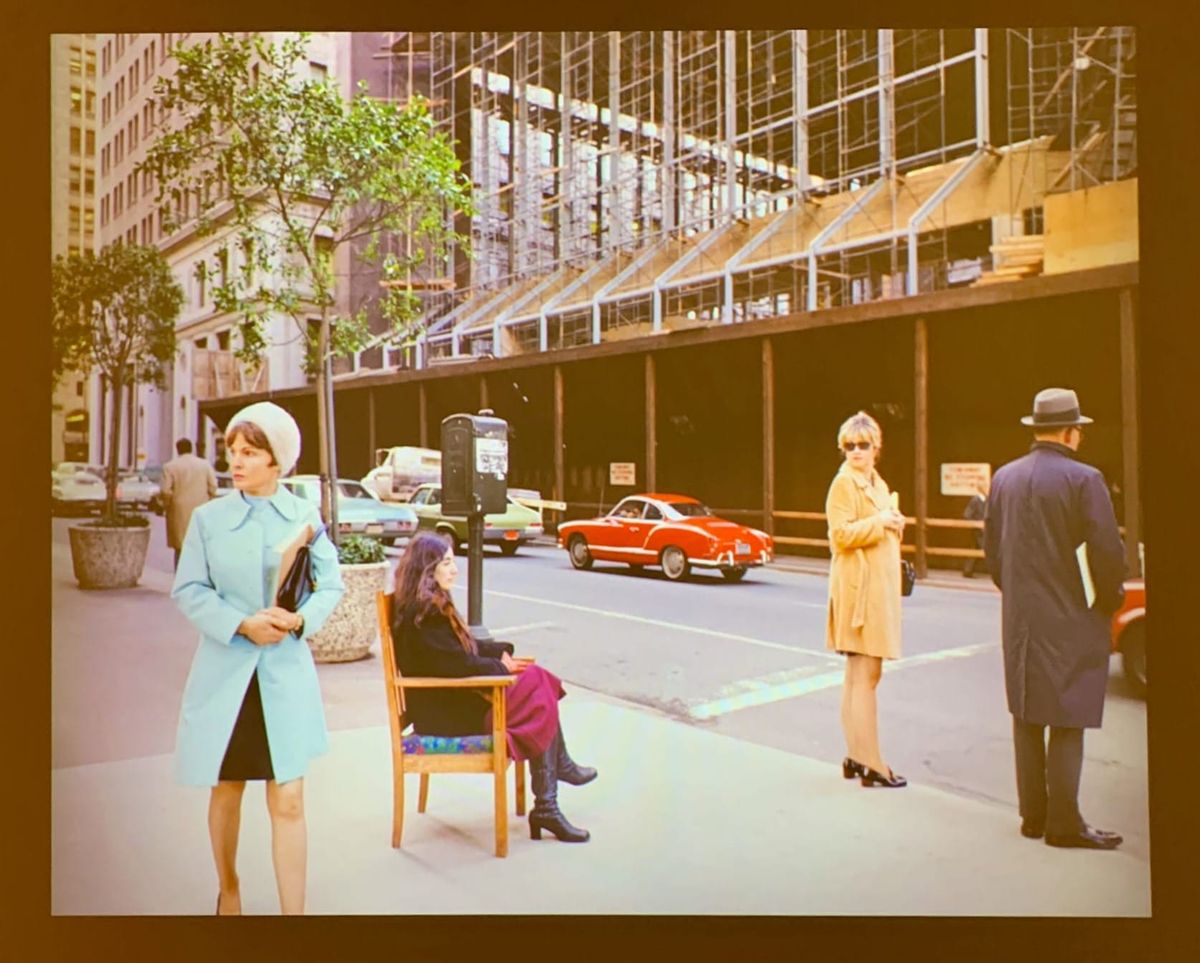
She did not merely observe the city; she intervened in it. By inserting herself into mundane environments—sitting in a chair in the middle of a bustling street or cage-sharing with zoo animals—she forced passersby to confront the arbitrary nature of urban zoning and social behavior. Her work was never about destruction; it was about exposing the invisible boundaries that dictate human and animal movement, effectively "spoiling" the predictability of the status quo to make room for new, mindful encounters.
Chronology: From Performance to "Life Frames"
1970: The Aesthetics of Stillness
The exhibition highlights Sitting Still (1970), a series of interventions that serve as the bedrock of Sherk’s artistic philosophy. In these works, Sherk placed herself in ordinary chairs amidst the chaotic transit of San Francisco. The photographs—presented at UCSB as large-scale projections—capture a surreal, quiet defiance. By remaining motionless while the world accelerated around her, she transformed the street from a mere conduit of commerce into a theater of human behavior.
1971: The Lion’s Den
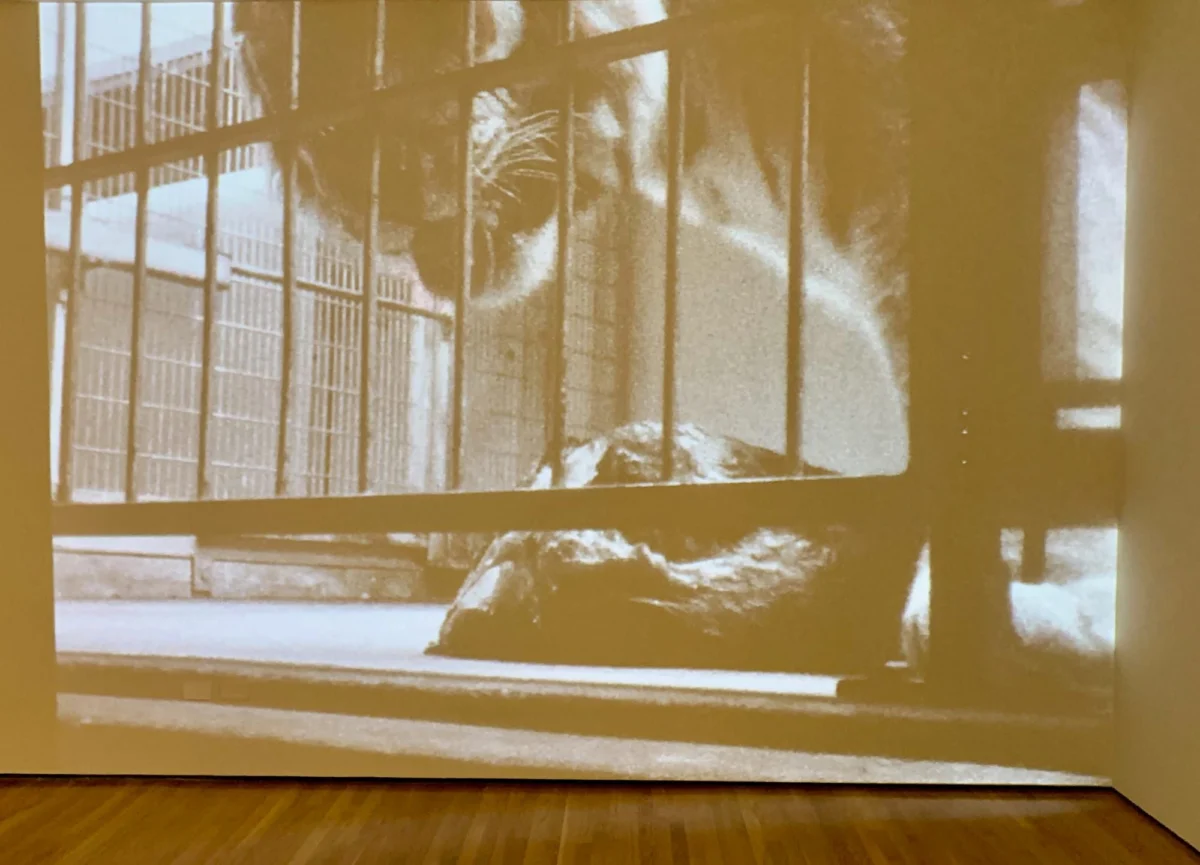
Perhaps her most provocative work, Public Lunch (1971), remains a haunting centerpiece of the exhibition. In a stark, black-and-white film transfer, the viewer witnesses Sherk caged inside the San Francisco Zoo’s Lion House. Situated directly adjacent to the big cats, she mirrored their movements—pacing, resting, and eating—while the public gawked. This performance was a visceral commentary on the prison-like architecture of zoos and the dehumanizing nature of surveillance, collapsing the distinction between "civilized" human and "wild" animal.
1978–1980s: The Crossroads Community
As the 1970s progressed, Sherk’s practice shifted from temporary performance to sustained environmental intervention. She became a pivotal figure in the creation of the Crossroads Community (the "Farm"), an ambitious project that converted a derelict freeway embankment in San Francisco into a thriving agricultural and educational site. This marked her transition into "Life Frames," a concept she would champion for the rest of her career. The Farm was not just an art installation; it was an attempt to reclaim the "wasteland" of urban infrastructure for community sustenance.
Supporting Data: The Architecture of Sustainability
The exhibition at UCSB provides critical insight into the evolution of Sherk’s "Life Frames." While her early work was ephemeral, her later work was systemic. Sherk believed that the built environment—the highways, the overpasses, and the concrete dividers—could be repurposed to support biodiversity and human connection.
Data from the exhibition archives suggest that Sherk’s projects were not mere flights of fancy. Her designs for "The Farm" incorporated:
- Urban Agriculture: Providing local produce to underserved communities, effectively challenging food deserts.
- Educational Programming: Creating a space where children and adults could interact with nature, shifting the pedagogical model from classroom-based learning to experiential engagement.
- Infrastructure Reclamation: Proposing that the space beneath urban transit arteries should be treated as a valuable public asset rather than a dead zone.
Sherk’s work effectively anticipated the modern "green city" movement, proving that artistic intervention could be the catalyst for meaningful urban planning reform.
Official Responses and Critical Reception
The retrospective at the Museum of Art, Design, and Architecture has been met with quiet, contemplative acclaim. Critics note that while the exhibition is modest in physical scale, its intellectual weight is immense. By focusing on the documentary aspects of her life, the curators allow the work to speak for itself, resisting the urge to over-interpret her actions.
"Sherk was a pioneer of the social practice movement before it had a name," notes one museum official in the exhibition pamphlet. "She viewed the city as a malleable organism. Her legacy is not found in objects, but in the shift in perception she forced upon her audience."
Despite her significant influence on ecological art, some scholars argue that Sherk’s work was often overlooked by the mainstream art establishment because it refused to be commodified. Unlike paintings or sculptures, her interventions were temporal, geographic, and deeply tied to the land, making them difficult to categorize within the traditional art market.
Implications: The Legacy of "Life Frames"
The implications of Sherk’s work resonate with startling relevance in the 21st century. As cities struggle with the consequences of climate change, food insecurity, and social alienation, her "Life Frames" offer a roadmap for future urbanism.

1. The De-commodification of Space
Sherk’s legacy challenges us to view urban space not as a commodity to be developed for profit, but as a framework for living. Her insistence on "Sitting Still" in the middle of a busy city serves as a reminder that we have the agency to disrupt the flow of consumption and reclaim space for human connection.
2. Radical Inclusivity
By inviting the public to participate in her art—whether as observers of Public Lunch or laborers at The Farm—Sherk dismantled the barrier between the artist and the audience. Her work implies that everyone is a participant in the "performance" of the city. We are all "proactive spoilers" if we choose to challenge the status quo.
3. Ecological Responsibility
Sherk’s career underscores the necessity of integrating nature into the urban core. Her work at the freeway embankment proved that even the most "unnatural" spaces could be transformed into sites of growth. As we face the challenges of the Anthropocene, her vision of "Life Frames" serves as a blueprint for creating resilient, self-sustaining communities that prioritize life over infrastructure.
Conclusion: The Artist as Architect of Consciousness
Bonnie Ora Sherk was never just an artist; she was an architect of human consciousness. Her work was a continuous, life-long effort to strip away the artifice of modern urban existence and expose the raw, living potential of the spaces we inhabit.
The Life Frames since 1970 exhibition at UCSB is more than a retrospective; it is a call to action. It asks us to look at the concrete and the asphalt of our own cities and imagine what might happen if we, like Sherk, chose to sit still, observe, and eventually, transform. Her legacy remains a vibrant, necessary disruption in the business of everyday life—a reminder that the most profound change often begins when we refuse to move with the crowd and instead, begin to frame our own lives.
