

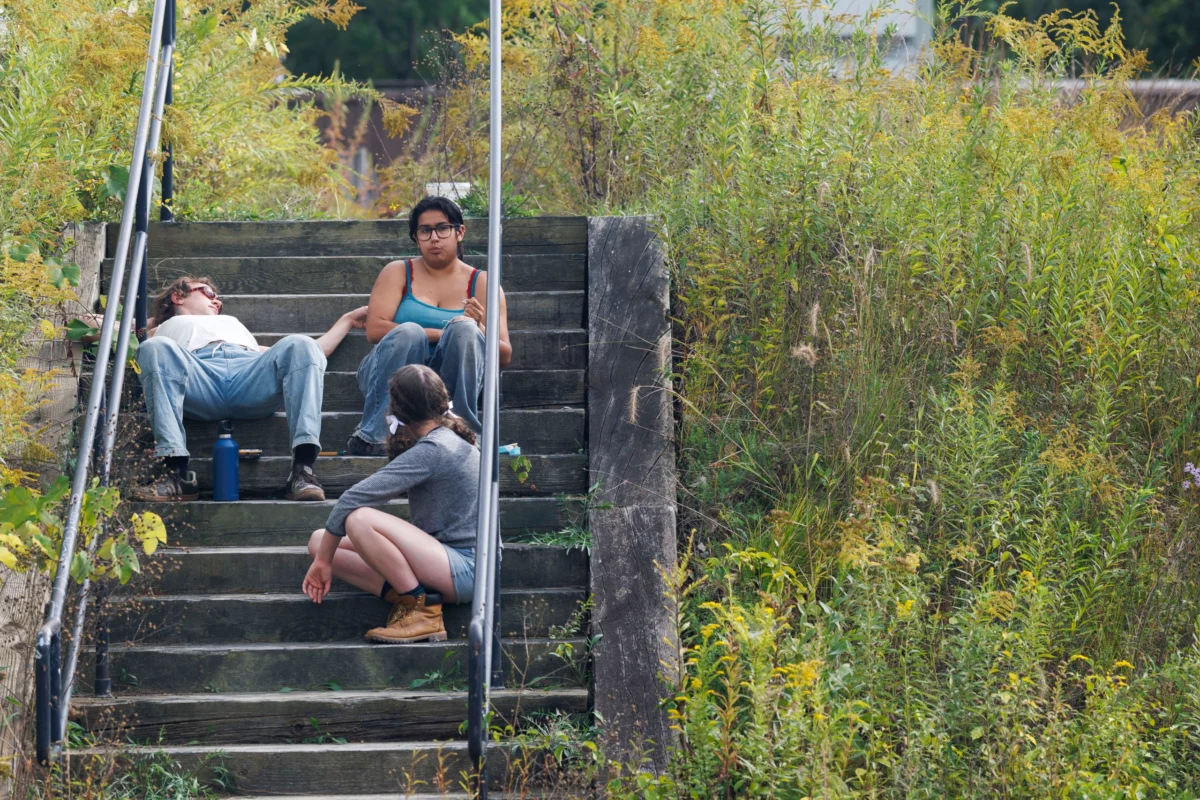
AMHERST, Mass. — The parking lots at Hampshire College are eerily vacant, a vast expanse of asphalt reclaimed by the silence of an autumn afternoon. Inside the campus buildings, the air is stale, and the once-vibrant common areas now house only dying plants in dust-covered pots. The only sign of life is a solitary, white-bearded man on a riding mower, methodically trimming an empty lawn—a rhythmic, habitual act performed in the shadow of a dying institution.
By December, Hampshire College, a once-celebrated bastion of progressive, self-directed liberal arts education, will shutter its doors permanently. It is not an anomaly, but rather the latest casualty in a gathering storm that is reshaping the American landscape. Across the United States, private and public colleges are closing or merging at a staggering rate—last year, the pace reached the equivalent of one institution every three weeks.

As the sun sets on these campuses, experts warn that the higher education sector has entered a period of crisis as profound and disruptive as the industrial decline that gutted the American auto and steel sectors decades ago.
The Chronology of a Slow-Motion Collapse
For over 60 years, American higher education experienced an era of uninterrupted, seemingly limitless expansion. Universities were built, campuses were expanded, and the assumption was that the supply of students would perpetually grow.

However, the tide began to turn around 2011. Data from the Western Interstate Commission for Higher Education (WICHE) and other analysts indicate that this was the starting point of a thirty-year period of projected decline in the college-aged population. This demographic cliff, coupled with shifting economic realities and a crisis of public confidence, has left the industry in a precarious position.
- 2011: National college enrollment reaches its historic peak.
- 2016: Roughly 70 percent of high school graduates choose to pursue post-secondary education.
- 2021–2024: The number of students enrolling in college drops by 2 million from the 2011 high.
- 2024: The Bureau of Labor Statistics reports that the proportion of high school graduates choosing to attend college has plummeted to 63 percent.
- 2025-2026: A wave of closures hits small private, non-profit institutions, with nearly 150 schools shuttering their doors over the preceding decade.
Supporting Data: The Anatomy of the Crisis
The crisis is not evenly distributed, yet it is systemic. According to Peter Stokes, a managing director at Huron Consulting Group, the industry is bracing for a total transformation. Stokes projects that approximately 442 of the nation’s 1,700 remaining private, non-profit universities are currently at risk of closure or merger within the next decade.

"Everyone is shocked to hear that more than a quarter of our private colleges could be gone in the next decade," Stokes said. "We are now talking about hundreds of other institutions being in a similar, dire situation."
The enrollment shortfall is compounded by several factors:

- Demographic Decline: The number of 18-year-olds in the U.S. is shrinking, a trend forecasted to continue through at least 2041.
- International Hurdles: The flow of international students—a critical revenue stream for many schools—has slowed significantly due to visa delays, geopolitical tensions, and restrictive immigration policies.
- Public Skepticism: Gallup surveys reveal a sharp decline in public confidence in higher education, falling from 57 percent in 2015 to just 38 percent today.
- Financial Instability: Many institutions have relied on "tuition discounting"—offering deep, unsustainable price cuts—to lure students, effectively cannibalizing their own bottom lines.
The "Sink-or-Swim" Environment
Not every school is failing. The "top-tier" institutions—highly selective private universities and large, well-endowed public flagships—remain insulated by their reputations and massive endowments. According to the National Student Clearinghouse Research Center, these institutions are actually seeing increased demand.
The victims of this new era are almost exclusively small, regional, or niche private colleges—institutions that lack the financial buffer to weather a drop in enrollment. Often located in rural areas or towns where the college was the primary economic engine, these schools are now saddled with debt taken on during the "growth years" to build facilities that no longer serve a purpose.

Kevin McElrath, director of the College Crisis Initiative at Davidson College, describes the current environment as a "sink-or-swim" landscape. "It’s been brewing for quite some time, and it is being magnified by recent policy changes," he said.
Official Responses and Institutional Voices
The human cost of these closures is immense. At Hampshire College, student Chloe De Lisle, one of fewer than 170 remaining students on a campus designed for 1,500, speaks of the surreal nature of the final semester. "It feels like we’re still waiting for the student body to arrive," she says.

Hampshire President Jen Chrisler admits that the college simply ran out of time. "What is happening here is something I think other institutions are likely to be facing," she noted. "And that is going to be bad for us as a country."
Faculty members are equally disheartened. Jim Wald, an associate professor of history, remembers when Hampshire was the "hot place" for innovation. Now, he and his colleagues are tasked with managing the dissolution of an institution that was once a beacon for students who didn’t fit into the "huge sea of people in a lecture hall."

For students like Mars Richman, who transferred to the University of Massachusetts (enrollment: 31,000+), the transition is jarring. "At Hampshire, everything was underfunded, but we all knew who to go to for what," Richman said. "That’s not an environment I’m comfortable in [at a massive university]."
The Collateral Damage: A National Economic Threat
The closure of a college goes far beyond the loss of an academic institution; it is a profound blow to the surrounding community.

- Local Economic Decay: When a college shuts down, a town loses its primary employer, its source of foot traffic for local businesses, and the influx of young talent that often remains after graduation.
- Student Disruption: A 2022 study by the State Higher Education Executive Officers Association found that fewer than half of students at closed colleges successfully transfer to another institution, and of those who do, less than half go on to earn a degree.
- Workforce Gaps: Experts warn of a "skills vacuum." As baby boomers retire in record numbers, the nation relies on a steady stream of graduates to fill essential roles. The closure of smaller, accessible colleges limits the pipeline of skilled labor, particularly in rural regions.
The Future of the "College Town"
John Thelin, an emeritus professor at the University of Kentucky and author of A History of American Higher Education, points out that in the 19th and 20th centuries, founding a college was a symbol of civic legitimacy. "Before they had clean water, before they had public schools, they would build a college," he said.
Now, the collapse of these schools is creating a new geographic inequality. "You’re going to have some regions with a shortage of colleges and others where the campuses begin to look like ghost towns," Thelin predicted.

As maintenance crews at Hampshire begin to erase the graffiti left by the last class—messages like "Hampshire will live forever"—the reality is far more somber. The buildings may remain, but the intellectual ecosystem that once thrived within them is being dismantled.
For the remaining students, like Madeline Keating, the future is uncertain. They are already planning reunions for a school that will no longer exist, clinging to the social ties they forged in the final, quiet days of their campus.

"We’ll throw a Frisbee or something," Keating said, attempting to encapsulate the legacy of a place that, despite its impending closure, defined their development.
The crisis in higher education is, at its core, a crisis of relevance and sustainability. As the sector continues to consolidate, the question remains: what will replace the "hippie paradises" and small, rural colleges that once provided a path to higher education for millions? For now, the answer is silence, empty classrooms, and a national realization that the era of universal campus expansion has definitively, and perhaps permanently, come to an end.
