

The automotive landscape is currently dominated by high-tech, screen-heavy, and software-defined vehicles. While Ford’s modern Bronco revival has been a resounding commercial and critical success—effectively challenging the Jeep Wrangler’s decades-long hegemony—there remains an intangible, visceral appeal to the original 1960s architecture that no amount of digital integration can replicate.
A prime example of this enduring fascination is a stunning 1969 Ford Bronco restomod currently slated for auction through Mecum. It serves as a masterclass in restraint, proving that when it comes to classic iron, sometimes the most sophisticated upgrade is one that respects the original silhouette while hiding modern performance beneath the surface.
Main Facts: A Coyote-Powered Time Capsule
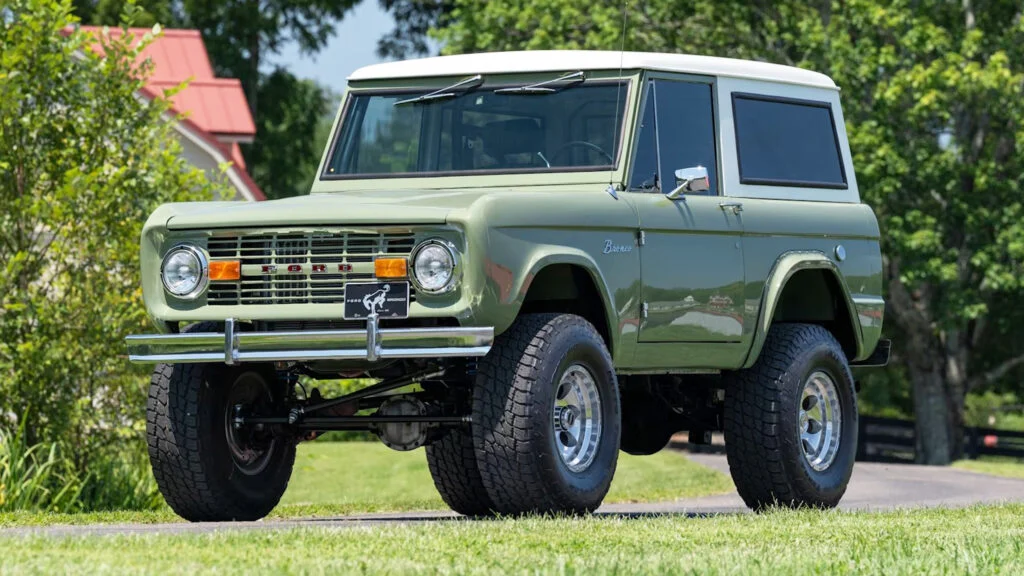
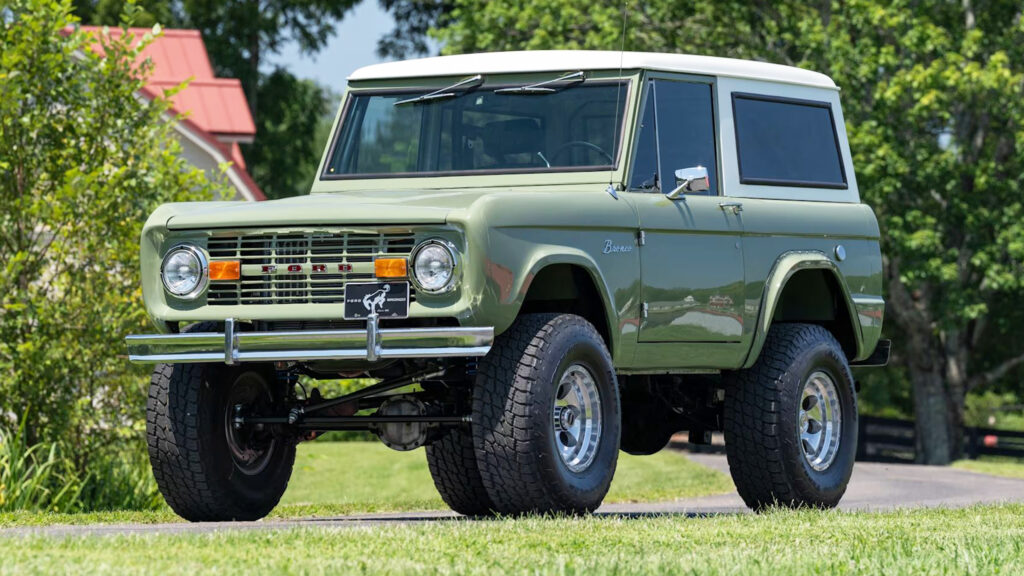
At first glance, this 1969 Bronco presents itself as a beautifully preserved classic. Dressed in a dignified, understated shade of green—a color that pays homage to the era’s earthy palette—it is topped with a clean white roof that highlights its iconic upright, boxy stance. However, the veneer of nostalgia is shattered the moment the engine bay is opened.
The centerpiece of this build is a 5.0-liter Coyote V8 engine. By transplanting one of Ford’s most successful modern modular engines into the lightweight 1969 chassis, the builder has created a machine with a power-to-weight ratio that would leave the factory-original 1969 Bronco struggling in its wake. With a custom air intake and a bespoke exhaust system, this Bronco doesn’t just sound like a modern performance vehicle; it delivers the kind of linear, naturally aspirated torque that defines the modern Mustang GT, all within a vintage footprint.
Beyond the powertrain, the vehicle features:
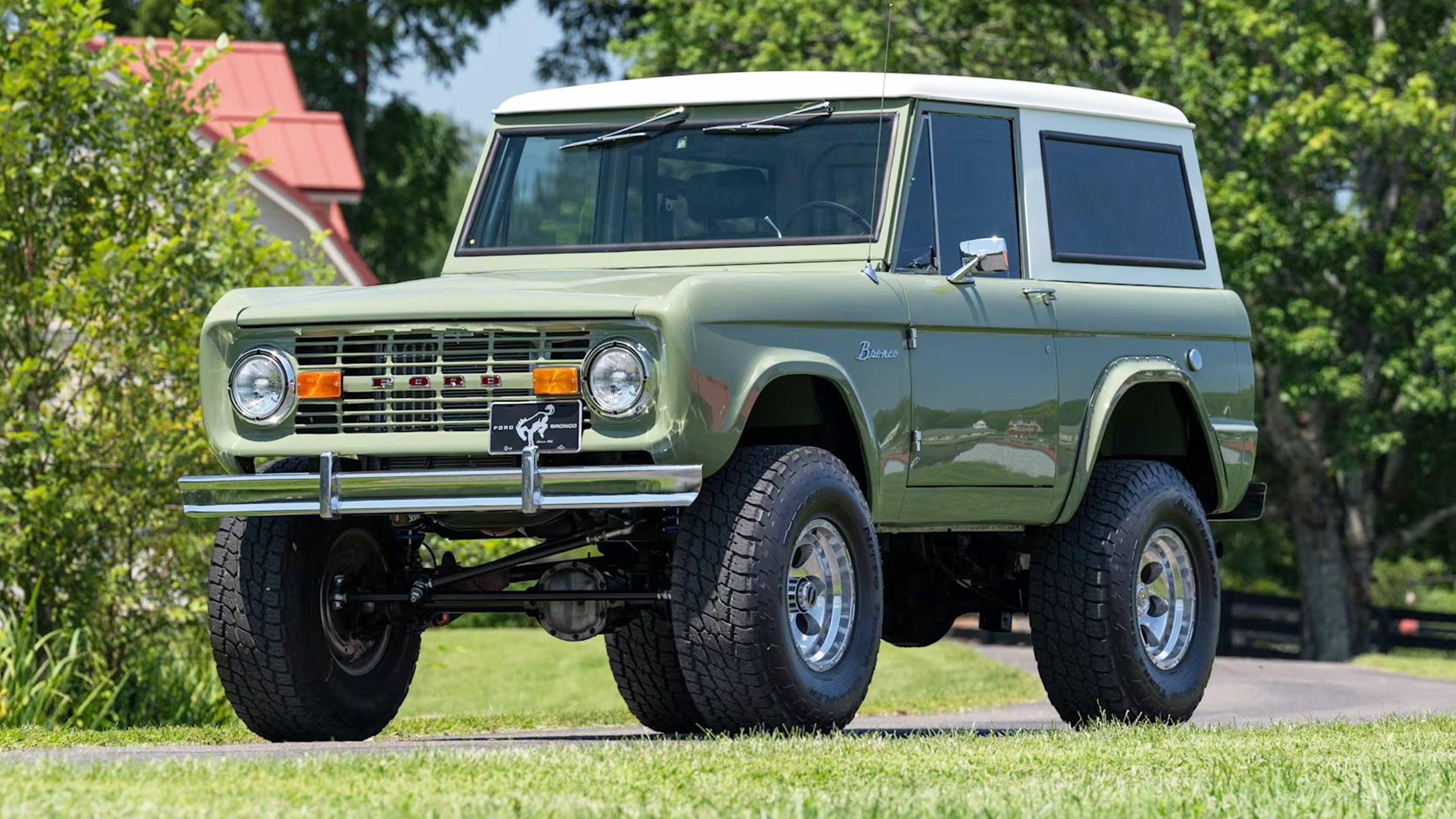
- A Revised Chassis: While technical specifications remain sparse, the visual evidence shows a significant upgrade to the suspension, including modern shocks and high-performance control arms.
- Off-Road Readiness: The truck sits on a set of aluminum beadlock wheels wrapped in aggressive all-terrain tires, bolstered by a functional lift kit.
- Aesthetic Purity: The exterior retains the classic chrome front and rear bumpers, maintaining the authentic look of the late 60s while providing the durability required for contemporary driving.
Chronology: The Evolution of the Bronco Legend
The Ford Bronco’s history is a story of three distinct eras, each reflecting the needs of the American consumer at the time.
1966–1977: The Original Trailblazer
The first-generation Bronco was introduced in 1966 as a direct response to the Jeep CJ-5 and the International Harvester Scout. It was designed by Donald Frey and Lee Iacocca as a "Sport Utility" vehicle, a term that was revolutionary at the time. It was compact, maneuverable, and featured a unique chassis that provided a tight turning radius, making it an instant hit with ranchers and off-road enthusiasts alike.
1978–1996: The Era of Size and Sophistication
As the market shifted, so did the Bronco. It grew significantly in size, becoming a full-size SUV based on the F-Series platform. This era saw the Bronco become a cultural icon, appearing in movies, television, and eventually becoming the centerpiece of one of the most televised moments in American history in 1994.
2021–Present: The Modern Renaissance
After a 25-year hiatus, Ford brought the Bronco back to the assembly line. The modern sixth-generation Bronco is a technological marvel, utilizing advanced terrain management systems, independent front suspension, and a design language that leans heavily into retro-futurism. It is, by all metrics, a better daily driver and a more capable crawler than its predecessors.
Supporting Data: The Restomod Market Boom
The "restomod" (restoration and modification) market has seen an exponential rise in value over the last decade. Data from major auction houses like Mecum and Barrett-Jackson suggests that classic Broncos are among the most liquid assets in the collector car world.

While a bone-stock 1969 Bronco in mint condition holds significant value, a professional restomod that swaps out the aging drivetrain for a crate Coyote engine often commands a premium. The reason is simple: reliability and usability. Owners of these vehicles often want the aesthetic of 1969 with the ignition-turn reliability of 2026.
When comparing this specific 1969 model to a modern Bronco Raptor, the data highlights a clear distinction in philosophy. The Raptor is a factory-tuned Baja racer designed to absorb massive impacts at high speeds. The 1969 restomod, conversely, is a bespoke experience. It offers a "driver-in-the-loop" connection that is increasingly rare. With two extra cylinders compared to some of the entry-level modern Broncos, and the lack of complex driver-assistance software, this vehicle appeals to the enthusiast who wants to feel the machine, not just operate it.
Official Perspectives: The Philosophy of Minimalism
In the world of custom car builds, there is often a temptation to "over-build." Many restomods suffer from cluttered dashboards, oversized touchscreens, and over-engineered interiors that clash with the rugged, simplistic lines of a 1969 truck.
This specific Bronco avoids those pitfalls. The interior is a masterclass in purposeful minimalism. The dashboard is almost entirely bare, save for a small, integrated display for modern telemetry and a series of classic, tactile toggle switches. The three-spoke, wood-rimmed steering wheel provides a focal point that screams mid-century automotive elegance.
Design experts note that the decision to carry the exterior green paint onto the dashboard and door panels is a hallmark of high-end, thoughtful craftsmanship. It creates a seamless transition between the "outside" and the "inside," a design choice that is often lost in mass-produced modern vehicles. The inclusion of a full roll cage—subtly integrated into the cabin—ensures safety without obstructing the driver’s view, a necessity for a vehicle with this much power under the hood.
Implications: The Future of Classic Ownership
What does a build like this tell us about the future of the automotive hobby?
First, it suggests that the "Internal Combustion Engine" (ICE) will live on through heritage platforms long after mass-market manufacturers shift to electrification. As long as there are enthusiasts who appreciate the sound, vibration, and mechanical complexity of a V8 engine, vehicles like this Bronco will remain in demand.
Second, it highlights a generational shift in how we value vehicles. Younger buyers, who may have grown up in an era of touchscreens and quiet electric motors, are increasingly drawn to the "analog" experience. They are seeking out the tactile feedback of a physical gear shifter, the smell of leather and fuel, and the raw, unrefined sound of a high-displacement engine.
Finally, the success of this Bronco at auction will serve as a bellwether for the restomod industry. If it fetches a price commensurate with its build quality, it will signal that the market is valuing "subtle, high-performance, and period-correct" over "loud, flashy, and over-digitized."
Conclusion
Whether or not this 1969 Bronco is "cooler" than a modern Raptor is a subjective debate, but the argument for the restomod is compelling. It is a bridge between two worlds: the rugged, utilitarian charm of the 1960s and the reliable, high-performance capability of the 21st century.

While the modern Bronco is undoubtedly a more capable tool for the average driver, this restomod is a piece of art that happens to be an exceptional vehicle. It is a reminder that in our rush toward the future, there is immense value in looking back, refining the past, and keeping the spirit of the original American off-roader alive on the open road. As it heads to the auction block, one thing is certain: the new owner isn’t just buying a truck; they are buying a legacy of power, style, and the pure joy of driving.
