

By [Your Name/Journalistic Desk]
Note: This article draws upon reporting originally published by Greater Greater Washington, a nonprofit dedicated to advancing equitable land use and transportation policy. This is part one of an ongoing series examining the Washington Metropolitan Area Transit Authority’s (WMATA) looming fiscal cliff.
The holiday season is traditionally a time for reflection and planning, but for the Washington Metropolitan Area Transit Authority (WMATA), the final weeks of 2023 were defined by a grim, existential ultimatum. As the region prepared to celebrate, the transit agency released what has been colloquially dubbed a “doomsday budget.” The document outlines a staggering $750 million funding shortfall for the 2025 fiscal year—a deficit that, if left unaddressed, could force the agency to implement service cuts so profound they would fundamentally alter the character of the nation’s capital.
For a region home to five of the ten wealthiest counties in the United States, the crisis is not a lack of regional wealth, but a failure of institutional architecture. The impending shortfall is the culmination of decades of structural neglect, exacerbated by the permanent shift in post-pandemic commuting patterns. As of mid-January 2024, the clock is ticking: the agency faces a July deadline to secure funding or begin the process of dismantling a transit network that serves millions.
The Anatomy of the Deficit: A Structural Flaw
To understand why Metro is teetering on the edge, one must look at its origins. Founded in 1976, WMATA was envisioned as a premier transit system, joining the ranks of BART in San Francisco and MARTA in Atlanta. Yet, uniquely among its peers, WMATA was established without a dedicated, permanent source of operating funding.
While capital projects—new trains, track repairs, and station upgrades—have occasionally received earmarked support, the day-to-day operations (salaries, electricity, maintenance, and administrative costs) have long relied on a precarious blend of farebox revenue and annual, discretionary subsidies from the District of Columbia, Maryland, and Virginia. This model requires a perpetual, politically fraught scramble for cash. Unlike peer systems in London or the planned structure for New York City’s congestion pricing, Metro lacks a regional sales tax or road-pricing mechanism to buffer against economic volatility.
The Myth of the "Return to Office"
Since the onset of COVID-19, the traditional “commuter-in-chief” model—where suburban professionals flood downtown offices via Metro—has evaporated. As of late 2023, Metrorail ridership hovered at roughly 56% of 2019 levels. While off-peak and weekend ridership have shown remarkable resilience, recovering to 90% of pre-pandemic figures, the core weekday commute remains depressed at 55%.
With roughly one in four DMV residents now working remotely, the capital region faces a post-pandemic reality that is significantly more disconnected from transit than the national average. Despite pressure from political figures like Virginia Governor Glenn Youngkin, who has urged a full return to the office, data suggests that even a complete reversal of remote work policies would fail to resolve the crisis. Estimates indicate that such a move would only cover a fraction of the budget hole, leaving more than 75% of the annual deficit intact. The fiscal cliff is not merely a temporary dip in ridership; it is a permanent structural mismatch.
Chronology of a Crisis: From 2018 to the Present
The current instability can be traced back to the last major attempt to stabilize the agency.
- 2018: The region reached a historic deal to provide WMATA with dedicated capital funding. Each jurisdiction agreed to contribute $167 million annually, totaling $500 million.
- The Compromise: In exchange for this capital stability, the jurisdictions imposed a 3% cap on the growth of operating assistance payments. While intended to prevent "budget bloat," the cap was not indexed to inflation.
- 2020–2023: Federal pandemic relief funds acted as a vital, albeit temporary, bridge. These dollars successfully prevented a total service collapse during the years of social distancing.
- Late 2023: The federal well finally ran dry. WMATA management identified $100 million in internal cost-savings and maintenance efficiencies, but this left a gaping $650 million void for the upcoming fiscal year.
- The Present: WMATA is legally obligated to pass a balanced budget. Without legislative intervention from the three jurisdictions, the agency must present a plan that slashes service to meet its revenue reality.
The "Death Spiral": A Mathematical Reality
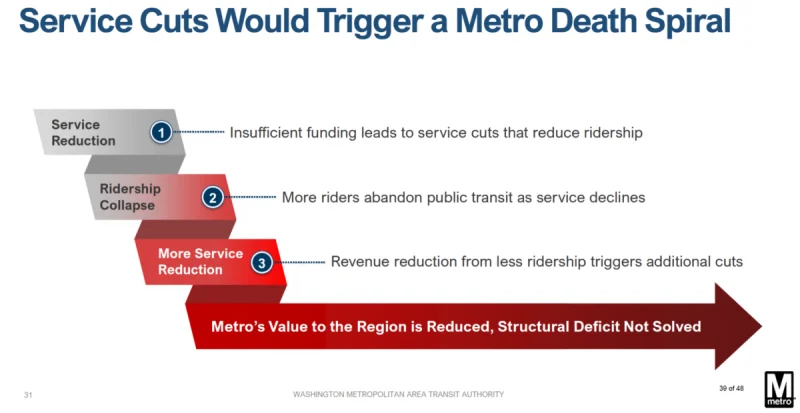
The logic of the doomsday budget is rooted in a terrifying feedback loop known as the "transit death spiral." Because the vast majority of Metro’s operating costs are fixed—tied to staffing and essential safety protocols—the only way to significantly reduce spending is to cut service.
However, service cuts lead to diminished reliability, which causes ridership to drop further, leading to even lower fare revenue. Consequently, the agency would need to cut $947 million to realize a $650 million gain, as the cuts themselves would trigger a loss of an additional $197 million in farebox revenue. The resulting service reductions would be cataclysmic:
- Frequency: Trips occurring every six minutes or less would plummet from 81% of total service to a mere 10%.
- Operating Hours: All stations would shutter at 10:00 PM, seven days a week.
- Bus Infrastructure: 67 of the 135 Metrobus routes would be eliminated entirely, with 41 more facing frequency reductions.
- Accessibility: MetroAccess, a lifeline for the region’s disabled and elderly populations, would be stripped to the absolute legal minimum required by federal law.
- Fare Hikes: Standard fares would see a 20% increase, pricing out working-class commuters.
- Station Closures: The ten lowest-ridership stations, including newer stops on the $6.8 billion Silver Line and the recently opened Potomac Yard station, face potential mothballing.
Official Perspectives and Political Hurdles
The political landscape is fractured. DC, Maryland, and Virginia are grappling with their own fiscal constraints. The District is managing internal budgetary disputes, Maryland is navigating a $3.3 billion state-level transportation shortfall, and Virginia’s involvement is currently tied to a contentious, high-stakes proposal to build a $2 billion sports arena in Alexandria.

Dr. Tracy Hadden Loh, a WMATA board member, has characterized the situation as a defining moment for the region. "The DC region is at a precipice," she noted. "We could emerge stronger… or we could choose stagnation and decline. If that happens, it won’t just be because the money isn’t there. It will be a policy choice."
John Hillegass, representing the Greater Washington Partnership, echoes this sentiment, emphasizing that the region has failed to establish a sustainable long-term funding mechanism. "We’ve never really figured out how to pay for WMATA as a region and create the funding stability that a world-class transit agency needs," Hillegass said.
Implications: The High Cost of Inaction
The implications of allowing the "doomsday budget" to take effect go beyond transit. The Washington metropolitan area relies on the seamless movement of people to fuel its economy. A massive contraction of Metro service would increase road congestion, degrade air quality, and deepen economic inequality by limiting job access for those who cannot afford private vehicles.
Furthermore, the optics of closing the Silver Line—a project only recently completed—would signal a failure of long-term regional planning that could haunt the area’s ability to attract business and federal investment for decades.
As the July deadline approaches, the question for the leaders of DC, Maryland, and Virginia is no longer just about balancing a spreadsheet. It is about defining the future of the nation’s capital. Will they continue to treat the region’s primary artery as an optional expense, or will they finally commit to the governance and funding structures necessary to maintain a world-class, functional transit system? The answers provided in the coming months will likely dictate the economic and social trajectory of the region for a generation.
