

Every year, the K-12 school system in the United States generates an astonishing 530,000 tons of food waste. This staggering figure represents up to 40 percent of all food served in cafeterias nationwide, creating a massive environmental footprint that contributes approximately 1.9 million metric tons of greenhouse gas emissions annually.
However, amidst the grim statistics, a quiet revolution is taking place in Gwinnett County, Georgia. Lovin Elementary School, guided by the World Wildlife Fund’s (WWF) "Food Waste Warriors" program and the local "Green & Healthy Schools" initiative, has successfully slashed its food waste by 70 percent. By transforming the cafeteria from a site of disposal into a "living laboratory," the school is not only mitigating environmental damage but also providing students with hands-on lessons in mathematics, biology, and civic responsibility.
The Magnitude of the Problem: Beyond the Trash Can
The issue of food waste in schools is not merely a matter of discarded calories; it is a complex systemic failure. When students throw away unopened milk cartons, sealed bags of carrots, or untouched apples, they are effectively discarding the water, energy, and labor required to produce, process, and transport those goods. When this organic matter ends up in a landfill, it decomposes anaerobically, releasing methane—a greenhouse gas significantly more potent than carbon dioxide in the short term.
For many administrators, the problem has felt insurmountable due to tight budgets, labor shortages, and the inherent challenges of managing the palates of thousands of children. Yet, as the case of Lovin Elementary demonstrates, the path forward begins with a fundamental shift in perspective: viewing food waste not as trash, but as data.
A Chronology of Change: From Audits to Action
The transformation at Lovin Elementary did not happen overnight. It began in late 2018 with a rigorous, data-driven diagnostic tool: the food audit.
Phase 1: The Audit (2018)
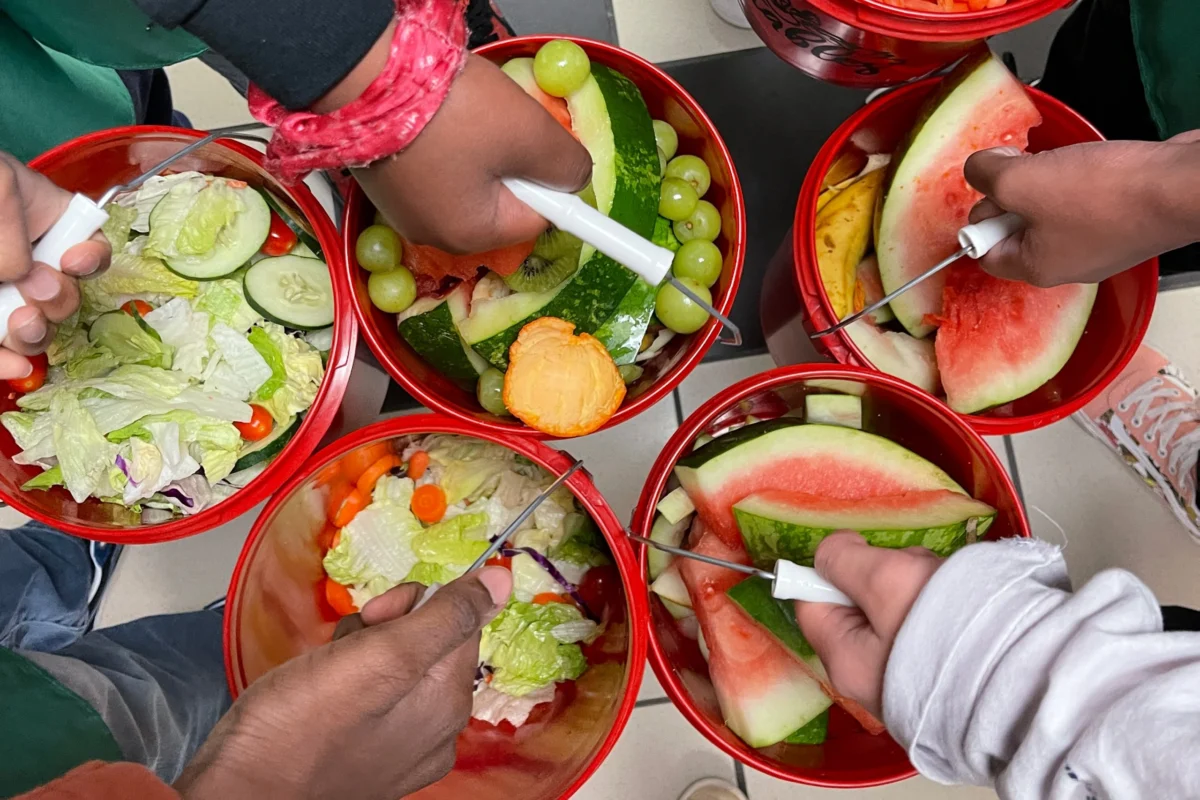
Gerin Hennebaul, a STEM content specialist at Lovin, realized that to solve the problem, the school first had to quantify it. Partnering with Green & Healthy Schools, the staff organized an assembly line of third and fifth graders to weigh and categorize every item left on student trays.
The results were eye-opening. During a single "Taco Day" audit, the school collected 589 pounds of waste. Of that, 120 pounds consisted of "recoverable" items—perfectly edible food that had never been touched. The visual impact of these numbers on the students was immediate, sparking a genuine desire to find solutions.
Phase 2: Implementation and Innovation (2019–2021)
Armed with data, students became the architects of their own solutions. They began by launching public awareness campaigns, using posters and school-wide announcements to educate peers on the benefits of "taking only what you eat."
The most significant early innovation was the "share table." By creating a designated space for students to place unopened, pre-packaged items they didn’t want, the school ensured that perfectly good food was redistributed rather than discarded. Simultaneously, they began diverting vegetable scraps from the teachers’ salad bar to a small flock of chickens kept on school grounds, creating a closed-loop system for organic waste. By March 2019, the school had reduced its lunch waste to 435 pounds, with over 100 pounds diverted to the share table alone.
Phase 3: Scaling the Impact (2022–Present)
In the fall of 2021, a grant from the Food Well Alliance allowed for the installation of a full-scale composting bin. Under the guidance of Hennebaul, the school began a systematic rollout of composting education, starting with fifth graders and eventually encompassing almost every grade level.
By the 2023–2024 academic year, the school was collecting a massive 5,489 pounds of food waste annually. The program became so successful that the school’s own bin reached capacity, necessitating a partnership with a local church that now utilizes the school’s compost for its community garden.
Cafeterias as Classrooms: Integrating STEM and Sustainability
One of the most profound aspects of Lovin Elementary’s success is the integration of food waste management into the standard curriculum. The cafeteria has effectively become an extension of the classroom.
- Mathematics: Fourth graders rotate weekly to weigh waste, record the data in binders, and perform calculations using decimals to track the school’s progress.
- Biological Sciences: Students engage in "vermicomposting" (worm composting) in classrooms and participate in temperature monitoring of outdoor compost piles to understand the decomposition process.
- Civic Engagement: The "Eco Heroes" club, comprised of second and third graders, manages the garden, while third graders develop skits, original songs, and PowerPoint presentations to teach kindergartners about waste reduction. This peer-to-peer mentoring ensures that the culture of sustainability is passed down, rather than imposed from above.
The Role of Technology: Raccoon Eyes AI
In early 2025, the school took a leap into the future by piloting "Raccoon Eyes AI." Developed by a Georgia Tech student, this system used computer vision to scan student trays as they were disposed of, providing granular data on which items were being rejected. This allowed the school to make informed decisions—such as adjusting the seasoning of a particular side dish—to align cafeteria offerings with student preferences. While the technology is currently in a state of transition due to an acquisition, the pilot proved that data-driven menu adjustments can significantly reduce waste at the source.
Challenges and Official Perspectives
Despite the successes at Lovin Elementary, scaling these initiatives across the country remains difficult. The primary hurdles, according to educators, include:
- Administrative Buy-in: Success requires a unified front from the cafeteria manager, head custodian, and the school’s administration. Without this support, the logistical hurdles—such as cleaning, sorting, and storage—become impossible to manage.
- The "Fully Released" Teacher Model: Hennebaul emphasizes that her role as a "fully released" teacher (someone without a dedicated homeroom) provides the flexibility needed to manage the program. In schools where staff are stretched thin with standard classroom duties, the consistency required for these programs can be difficult to maintain.
- External Constraints: Schools are often bound by rigid district-level vendor contracts. Even when data shows that students dislike a specific brand of nuggets or a particular roll, individual schools often lack the autonomy to switch suppliers or change core menu items.
- Logistics and Weather: Composting is an outdoor activity that can be interrupted by inclement weather, requiring schools to have backup plans to ensure waste is still managed during rainy or cold seasons.
Implications for the Future
The model established at Lovin Elementary offers a blueprint for educational institutions nationwide. The environmental implications are clear: if thousands of schools adopted similar "Food Waste Warrior" practices, the collective reduction in methane emissions would be substantial.
However, the educational implications are arguably even more important. By participating in these programs, students are learning that their actions have measurable consequences and that they possess the agency to solve real-world problems. As Hennebaul noted, when students realize their teachers don’t have all the answers, they become researchers, problem-solvers, and advocates.
For schools looking to follow in Lovin’s footsteps, the advice is simple: start with data. By conducting a food audit and involving students in every step of the process, schools can transform a daily chore into a powerful learning experience that benefits the planet and the next generation of environmental stewards.
As the World Wildlife Fund’s report concludes, the goal is not just to reduce waste, but to foster a culture where such waste is viewed as unacceptable—a lesson that these students will likely carry with them long after they graduate.
