

By Sarah Lewis
Small Business News
Published: October 26, 2026
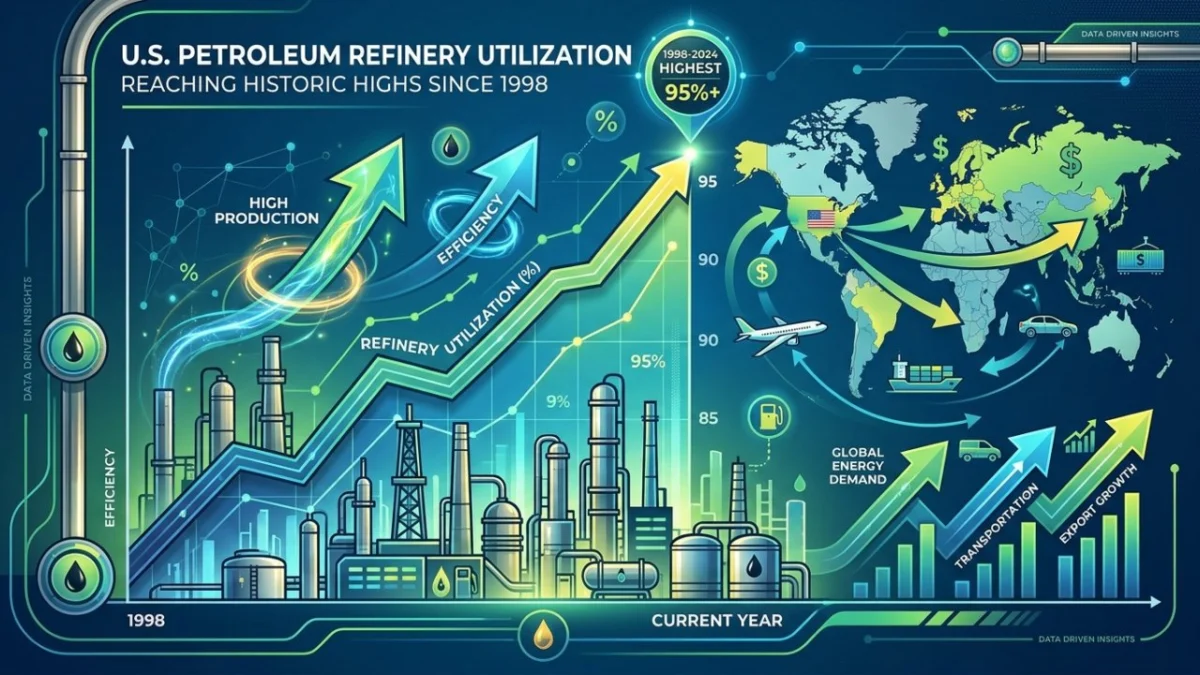
In an era defined by volatile energy markets and shifting global trade patterns, the American refining sector has reached a defining milestone. Between May and September 2026, U.S. refineries operated at an average utilization rate exceeding 95%—a level of intensity not witnessed in nearly three decades. For the small business community, this surge is far from a mere statistical curiosity; it represents a critical juncture that impacts the cost of doing business, supply chain reliability, and long-term strategic planning for thousands of enterprises across the country.
The Main Facts: A 1998 Benchmark Revisited
The data, recently highlighted by the U.S. Energy Information Administration (EIA), underscores the massive effort refineries have undertaken to keep pace with an insatiable international appetite for petroleum products. While the summer months are historically characterized by seasonal maintenance and a ramp-up in production to meet domestic gasoline demand, the 2026 season defied expectations.
By maintaining utilization rates above 95% for five consecutive months, the U.S. refining sector has effectively maximized its existing hardware. This performance is largely attributed to a global supply crunch, which has widened the margins for refined petroleum products, incentivizing operators to push their infrastructure to the limit. However, as business owners digest this news, it is imperative to distinguish between utilization rates and total output. While the efficiency of these plants is at a 28-year high, total production capacity has seen a contraction of approximately 4% since 2019. This means that while individual refineries are working harder than ever, the industry as a whole is operating with a smaller total "ceiling" than it did half a decade ago.
Chronology: The Path to Maximum Output
The 2026 refining cycle did not happen in a vacuum. It was the result of a deliberate, market-driven response to global economic pressures that began early in the year.
- Q1 2026: Market analysts noted a tightening in global distillate stocks. With geopolitical instability and shifts in international energy trade, the demand for diesel and jet fuel began to outpace supply.
- May 2026: As the traditional summer driving season approached, U.S. refineries entered a high-gear production phase. Unlike previous years where the focus remained heavily on gasoline, the industry began pivoting to prioritize distillates to capture lucrative export opportunities.
- June–August 2026: Utilization rates held steady above the 95% threshold. Refineries minimized downtime, deferring non-essential maintenance to keep units running at capacity.
- September 2026: Despite the usual seasonal taper, demand for exports remained resilient, allowing utilization to persist at historic levels through the end of the month.
- October 2026: The industry experienced a marginal cooling off. While rates dipped slightly below the summer highs, they remain significantly above the five-year seasonal average, suggesting that the "new normal" for energy supply is one of sustained, high-intensity operations.
Supporting Data: Understanding the Capacity Constraint
To navigate the current market, small business owners must look beyond the headline-grabbing utilization percentages. The "Capacity Paradox" is perhaps the most vital takeaway from the 2026 report.
Refinery utilization is a measure of how much of a plant’s operational capacity is being used. Running at 95% suggests that refineries are essentially "redlining"—operating with very little room for error. When combined with the 4% reduction in total capacity mentioned earlier, it becomes clear why the market remains so sensitive.

If an unexpected outage occurs at a major facility, the sector lacks the "slack" or spare capacity that existed in previous decades to absorb the shock. For a logistics company or an agricultural producer, this means that even minor disruptions in the Gulf Coast—the heart of U.S. refining—can lead to immediate, outsized spikes in fuel prices. The data suggests that while we are producing enough to meet current needs, the margin for error in the supply chain is razor-thin.
Official Responses: The EIA’s Perspective
Jimmy Troderman, a principal contributor for the U.S. Energy Information Administration, summarized the drivers of this phenomenon during a recent briefing. "High international demand for U.S. distillate fuel oil exports has kept refinery outputs elevated," Troderman noted.
The official stance from the EIA highlights that the U.S. is increasingly functioning as a global energy stabilizer. By exporting distillate fuels, U.S. refineries are not just feeding the domestic economy but are also balancing international markets. However, the EIA’s reports also implicitly warn of the risks associated with this export-heavy strategy. When global prices spike, domestic supply can be pulled toward those international markets, potentially tightening local availability for U.S. businesses.
Implications for Small Business Operations
For the average small business owner, the implications of these trends are multifaceted. Whether you operate a fleet of delivery trucks, run an HVAC installation company, or manage a manufacturing facility, the refinery landscape is a direct influence on your bottom line.
1. Strategic Inventory Management
With refinery utilization at peak levels, the supply chain is vulnerable. Businesses that rely heavily on diesel and heating oil should consider "strategic stockpiling." Rather than relying on just-in-time delivery, which assumes a stable and abundant supply, it may be prudent to increase on-site storage capacity where possible. This can serve as a buffer against the price volatility that typically accompanies minor supply chain hiccups.
2. The Shift to Distillate Forecasting
The 2026 trend shows a clear prioritization of distillates over gasoline. Small business owners should adjust their forecasting models to reflect this. Energy costs for diesel-dependent sectors may not mirror the price trends seen at the local gas station. Utilizing professional energy forecasting tools—or subscribing to industry-specific newsletters—can provide a "leading indicator" of when to lock in fuel contracts.
3. Hedging and Price Mitigation
In a market where production is at capacity, price spikes are often a reaction to external events. Businesses should explore hedging strategies, such as fuel surcharge clauses in client contracts. By incorporating a dynamic fuel surcharge, businesses can protect their margins against unexpected jumps in the cost of diesel, ensuring that the burden of energy inflation is not borne solely by the entrepreneur.

4. Operational Efficiency
High utilization rates generally correlate with high energy costs. As refineries pass on the costs of their own high-intensity operations, businesses must look inward. Investing in fuel-efficient fleet management software, optimizing delivery routes, or upgrading to more energy-efficient machinery is no longer just a "green" initiative—it is a financial imperative to maintain competitiveness in an era of high-cost energy.
Navigating the Road Ahead
The record-breaking utilization of U.S. refineries is a testament to the resilience and productivity of the American energy sector. Yet, for the entrepreneur, it is a signal to remain vigilant. We are living in a period where the global demand for energy is placing unprecedented pressure on our infrastructure.
While the immediate concern of a fuel shortage seems mitigated by this high-output trend, the reality is that the market remains tight. Small business leaders who take the time to understand these trends—who watch the EIA data, monitor export demand, and proactively manage their energy procurement—will find themselves in a much stronger position than those who are caught off-guard by the next market shift.
The takeaway for the remainder of 2026 and heading into 2027 is clear: the energy market is not returning to the "low-stress" environments of the past. It is a high-demand, high-utilization, and high-sensitivity ecosystem. By planning for volatility, diversifying fuel procurement, and staying informed, small business owners can not only survive these energy shifts but thrive by out-maneuvering the competition in a challenging economic landscape.
For further details and detailed data analysis, visit the official U.S. Energy Information Administration report.
