

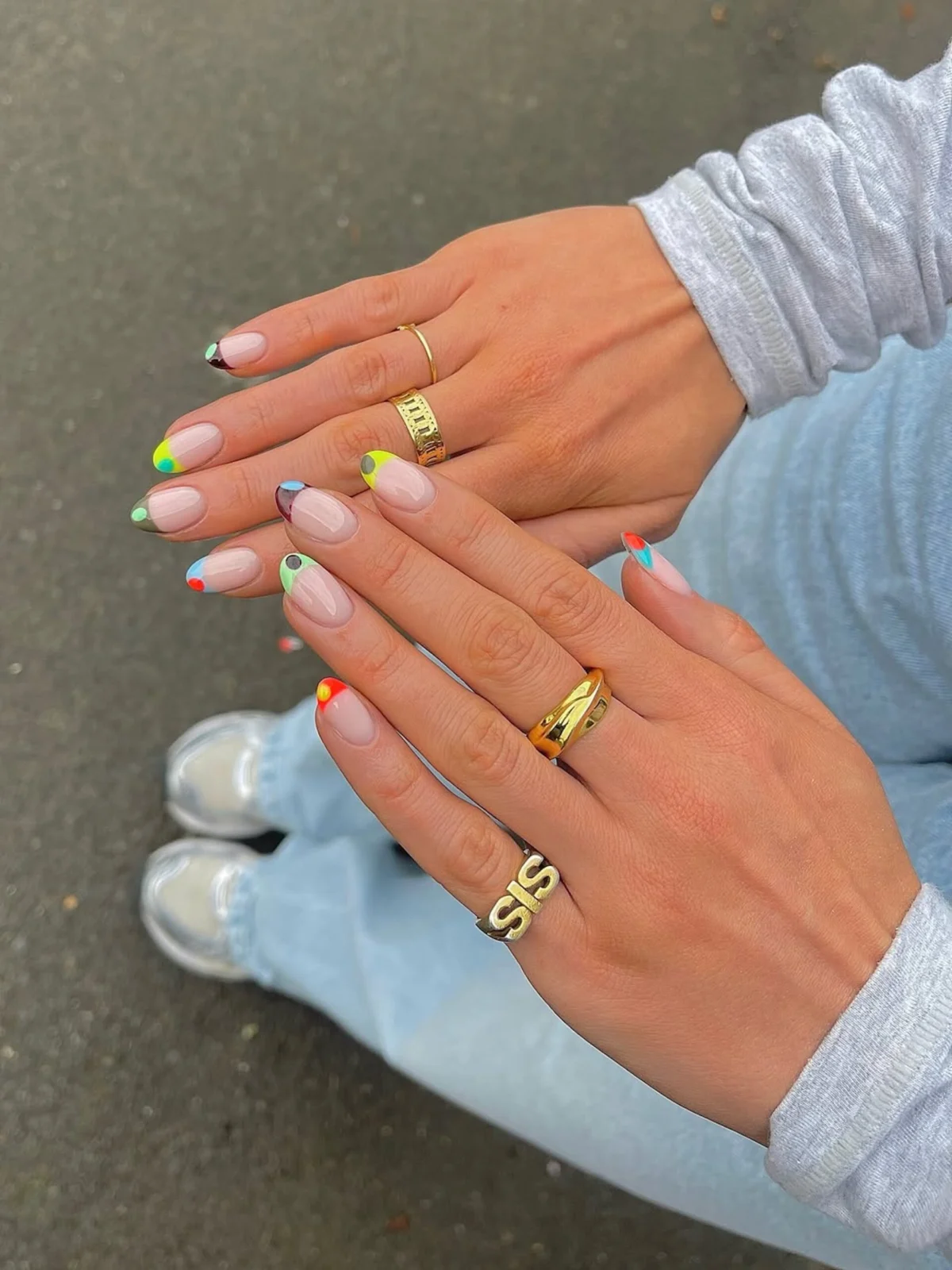
In the fast-paced world of digital beauty trends, where maximalism often reigns supreme—think chrome powders, 3D charms, and intricate hand-painted landscapes—a quiet revolution is taking place at the tips of our fingers. The latest movement sweeping across Instagram and TikTok feeds isn’t a complex design requiring hours in the chair, but rather a singular, precise, and undeniably chic evolution of the classic French manicure: the "Single-Dot French."
This trend represents a departure from the cluttered, busy nail art styles that have dominated the last few years. By swapping clusters of polka dots for a solitary, oversized stipple, nail artists are proving that less is not just more—it is the new standard for sophisticated, high-fashion nail design.
The Anatomy of the Trend: What Defines the Single-Dot French?
At its core, the single-dot French manicure is a masterclass in intentionality. The design begins with the traditional structure of a French manicure—a clean, nude, or sheer base color that acts as a canvas. The classic white tip, however, is replaced with vibrant, pigmented, or muted shades. The pièce de résistance is the addition of a single, contrasting dot placed strategically on the tip of each nail.
Unlike traditional polka-dot patterns, which require meticulous spacing and repetitive motions, the single-dot technique demands only one precise movement. Despite its simplicity, the visual impact is significant, offering a retro, mid-century modern aesthetic that feels both nostalgic and distinctly contemporary.
Placement and Precision: The Rules of Engagement
There are no rigid laws governing where that singular dot should reside, which is perhaps why the trend has gained such widespread traction. Nail artists are currently experimenting with three primary placements:
- The Anchor: A centered dot acting as the visual weight of the French tip.
- The Off-Center Accent: A slightly misaligned dot that adds an asymmetrical, "cool-girl" edge to the set.
- The Half-Moon Edge: A dot dabbed onto the very edge of the tip, creating a subtle, organic curve that mimics a soft silhouette.
A Chronology of the Minimalist Shift
To understand how we arrived at this moment, one must look at the recent history of nail trends. For the past three years, the beauty industry has been obsessed with "complexity." We saw the rise of the "coquette" aesthetic, which involved tiny bows and pearl accents, followed by the "glazed donut" chrome craze.
However, as of late 2024, a "correction" began to emerge. Industry experts noted a fatigue among salon-goers regarding high-maintenance, time-consuming nail art.
- Early 2024: Subtle nods to the 1960s began appearing on social media, with muted, earthy tones replacing neon gradients.
- Mid-2024: The "French tip" underwent a renaissance. Artists like Lucy Inman began experimenting with color-blocking, using vibrant neons to usher in the summer season.
- Late 2024: The solitary dot emerged as a way to "finish" these French tips. By adding a contrasting color to the tip, artists discovered they could add depth and "pop" without overwhelming the nail.
- Present Day: The trend has moved from niche Instagram accounts to the mainstream, with top-tier salons adopting the single-dot motif as a staple "quick-but-chic" menu item.
Supporting Data: Why It Works Across All Lengths
One of the most persistent myths in the nail industry is that complex designs are reserved for long, almond-shaped extensions. The Single-Dot French shatters this narrative.
Data from salon appointment trends suggests that the Single-Dot French is equally popular among those sporting "squoval" short nails and those with dramatic, long-coffin extensions. On short nails, the single dot provides a point of focus that makes the nail appear more elongated and intentional. On longer canvases, specifically the "Deep French" style—where the tip is painted further down the nail bed—the dot provides a perfect, bold focal point that balances the extra surface area.
The Role of Innovative Formulas
The rise of this trend has been bolstered by advancements in gel technology. Specifically, "blooming gel" has changed how artists execute the dot. By applying a base of blooming gel before dropping a contrasting color, the dot expands slightly upon contact, creating a soft, ethereal outline that looks like a watercolor smudge rather than a rigid circle. This technical shift has allowed artists to move beyond simple geometry into more artistic, "lived-in" looks.
Professional Perspectives: The Art of Color Pairing
While the technique is simple, the success of the manicure rests entirely on color theory. Industry professionals, including Chelsea Holmes and Harriet Loynes, have utilized social media to educate clients on why certain pairings resonate.
According to professional colorist logic, the most successful Single-Dot French sets rely on the "contrast principle."
- The Complementary Strategy: Pairing colors on opposite ends of the color wheel—such as electric blue and bright orange—creates high-impact, energetic sets.
- The Retro Strategy: Utilizing "mushroom" browns, avocado greens, and butter yellows creates a 1970s-coded palette that feels nostalgic.
- The Muted Strategy: Combining a muted base with a vibrant pop (e.g., a forest green dot on an orange tip) creates a sophisticated contrast that is perfect for professional environments where loud designs might otherwise be discouraged.
Implications for the Beauty Industry
The shift toward the Single-Dot French has wider implications for the future of professional nail services.
Economic Efficiency
For the salon owner, the Single-Dot French is a highly efficient service. It requires minimal time compared to intricate nail art, allowing for higher turnover in appointment slots without sacrificing the "premium" feeling of the manicure. It bridges the gap between a standard color-change and an elaborate art session, making it a lucrative middle-ground offering.
The Return of "Quiet Luxury"
This trend is a sub-sector of the "Quiet Luxury" movement that has permeated fashion. Clients are increasingly moving away from logo-heavy or overly embellished styles in favor of designs that are "if you know, you know." The Single-Dot French is the perfect expression of this; it is visually striking to those who appreciate detail, but clean and understated enough to remain elegant in any setting.
Future Outlook
As we move into the next season, we expect to see the single-dot motif evolve further. While current iterations focus on solid colors, there is already talk of incorporating metallic foils, chrome dots, and even minimalist crystals into the center of the French tip.
Furthermore, as sustainable beauty practices become a priority, the efficiency of this style—which requires less product wastage than a full-set hand-painted design—positions it as an environmentally conscious choice for the modern consumer.
Conclusion: A Small Detail with a Big Impact
The Single-Dot French is more than just a passing social media fad. It is a reflection of a broader cultural desire for simplicity, precision, and high-impact minimalism. By stripping away the clutter of multiple patterns and focusing on the power of a single, deliberate gesture, the beauty industry has found a way to keep the French manicure relevant for a new generation.
Whether you opt for the retro charm of muted greens and browns, or the high-voltage energy of neon blue and red, the single dot serves as a reminder that in design—much like in life—the most impactful statements are often the ones made with the most restraint. As you head to your next appointment, consider this: sometimes, all you need is a single point of focus to make a profound impression.
