

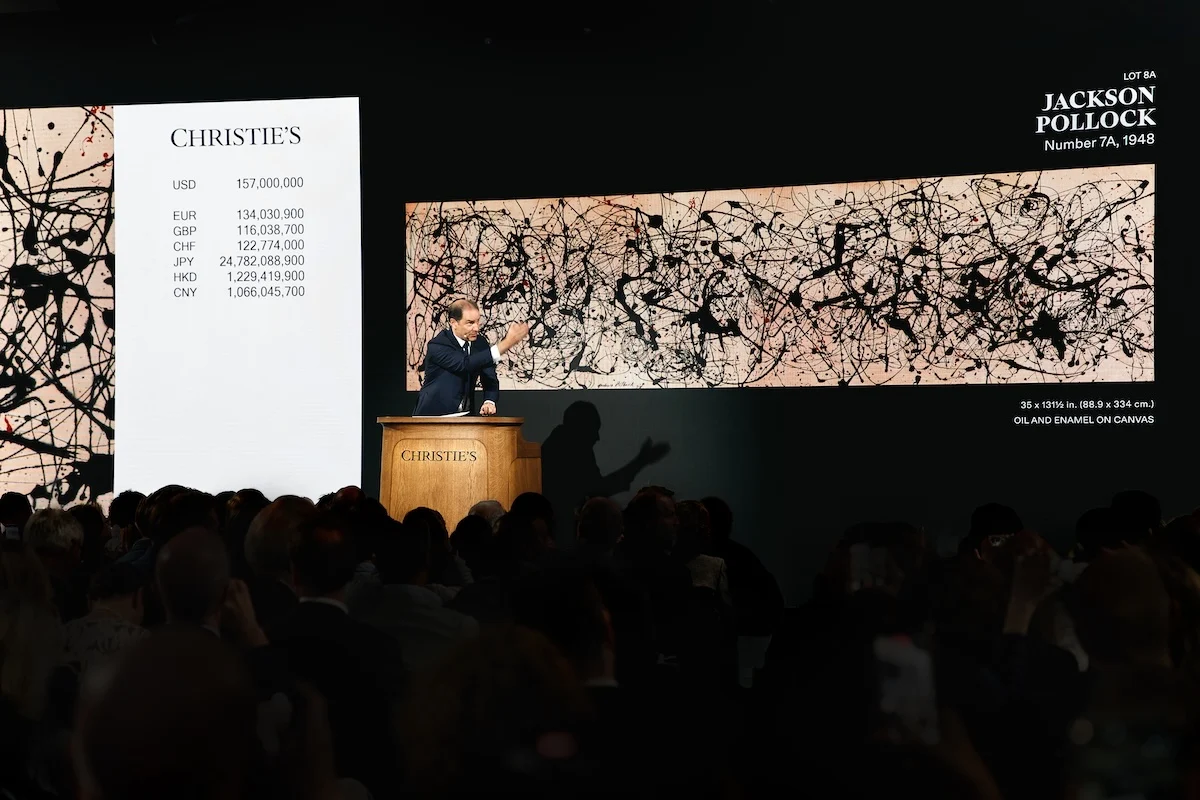
The international art market, which has spent the better part of the last two years navigating a landscape defined by cautious correction and economic uncertainty, appears to have found its footing. This week’s blockbuster evening sales at Christie’s served as a definitive bellwether, signaling a robust—albeit selective—return to form for the high-end secondary market.
The Headlines: A Return to Form at the Auction Block
Monday night’s proceedings at Christie’s were marked by a series of high-profile acquisitions that underscored the enduring demand for blue-chip masterworks. The star of the evening was an 11-foot-wide Jackson Pollock drip painting, which commanded a staggering $181.2 million. This result, alongside the $107 million sale of a gilded bronze head sculpture by Constantin Brâncuși and a $98.4 million realization for Mark Rothko’s 1964 abstraction, No. 15 (Two Greens and Red Stripe), provided the kind of headline-grabbing numbers that investors have been waiting for since the cooling trend began.
However, the narrative of the night was not solely defined by these "trophy" sales. Market analysts pointed to a significant, often overlooked trend: a depth of bidding in the $5 million to $20 million range. This tier of the market had been notably thin during recent cycles, and its resurgence suggests a renewed confidence among established collectors.
The Macroeconomic Perspective
Secondary-market dealer Evan Beard, in an interview with ARTnews, noted that the psychological landscape of the art world has undergone a significant transformation. "Collectors have a lot of capital to play with," Beard explained. "They’ve psychologically adjusted to higher interest rates. The stock market is at record highs and feeling frothy, and the art market has reset to more inviting levels over the past few years."
This "reset" has created an environment where collectors are no longer paralyzed by the volatility of the past eighteen months. Instead, they are actively seeking value, finding it in the established mid-to-high-tier segment. It is worth noting, however, that this bullishness remains highly stratified. While the titans of the 20th century are seeing consistent growth, the market for young, emerging artists remains notably sluggish, suggesting that the current wave of capital is seeking the safety of historical precedent rather than the risk of the speculative fringe.
Chronology of Market Dynamics: From Contraction to Confidence
To understand the current state of the market, one must look at the trajectory of the past 24 months.
- Late 2022: The art market began to feel the cooling effects of rising interest rates and geopolitical instability. Auction houses saw a decline in the "froth" that had characterized the post-pandemic boom.
- 2023: A period of "market normalization" ensued. Sellers were hesitant to release major works, and buyers became increasingly selective, leading to a dip in overall volume.
- Early 2024: The market reached a floor. The lack of supply of blue-chip works kept prices stable but muted activity.
- Present: The latest Christie’s results represent the first major "thaw." The concentration of activity among U.S. buyers—while European and Asian clients maintained a lower profile—highlights a geographical imbalance that may define the coming season.
Supporting Data: The Global Distribution of Capital
The data from the most recent evening sales reveals a clear shift in the source of liquidity. While the global art market has historically been a tripartite struggle between North America, Asia, and Europe, the current momentum is overwhelmingly driven by American capital.
The relative absence of Asian and European bidders in the top-tier lots suggests that the U.S. economic recovery, characterized by record-high stock market performance, is currently the primary engine of art world spending. This concentration of wealth within domestic U.S. circles raises questions about the long-term sustainability of price growth if global economic conditions do not harmonize.
Official Responses and Institutional Tensions: The Case of Guernica
While the auction market enjoys a moment of relative triumph, the institutional world is grappling with its own set of pressures. The Reina Sofía Museum in Madrid recently found itself at the center of a politically charged debate regarding the potential loan of Pablo Picasso’s Guernica.
For the first time, Museum Director Manuel Segade addressed the controversy head-on. Responding to requests from the Basque government to move the masterpiece, Segade clarified the administrative reality: "I hadn’t spoken about it before for a very basic reason: this museum hasn’t been asked for the piece."
The request, it appears, was directed exclusively toward Spanish President Pedro Sánchez and Culture Minister Ernest Urtasun. Segade expressed frustration with this bypass of institutional protocols, noting that "a president can’t lend it." He further cited a technical report that concluded the structural integrity of the massive canvas could be compromised by transport. "Taking [their loan request] outside the museum and turning it into a matter of state policy makes me rather sad," he remarked during an International Museum Day event.
Museum Funding: The "Champions League" Problem
In a rare and candid display of solidarity, Segade shared the stage with Prado Museum Director Miguel Falomir. The two leaders addressed the chronic underfunding that plagues Spanish institutions. Falomir summarized the frustration of the cultural sector with a biting metaphor: "We compete in the Champions League of museums with budgets from the second division." This public acknowledgement highlights a growing trend of institutional leaders demanding more robust state support to match the global prestige of their collections.
Broader Implications and The Changing Landscape
The art world is currently defined by a tension between the hyper-financialization of the secondary market and the institutional struggle for cultural relevance and financial survival.
Ethical and Political Scrutiny
The art world is not isolated from broader social and ethical concerns. In the UK, Shadow Culture Secretary Nigel Huddleston has called for an investigation into allegations of antisemitism directed at Southbank Center Chairman Misan Harriman. This move, which includes a request to review institutional funding, reflects a growing trend where public funding for arts organizations is increasingly tied to the personal and political conduct of their leadership.
Globalization and Identity
The opening of the Centre Pompidou Hanwha in Seoul on June 4 marks another milestone in the global expansion of European institutions. However, it is not without its critics. As Korean residents question whether local culture might be sidelined by this foreign-branded initiative, the project highlights the complex "soft power" dynamics inherent in the global art museum franchise model.
Redefining the Gallery Space
Even at the micro-level, the industry is experimenting with new formats. The Paris-founded CiaciaLevi Gallery’s decision to move its Milan location to an experimental space in Turin—an apartment within the Bottega d’Erasmo building—is a rejection of the traditional white-cube gallery model. By displaying works in the kitchen, bathroom, and bedroom of the owners’ living space, the gallery is testing a more intimate, domestic approach to art sales.
The Kicker: Dissolving Boundaries
As the industry pivots toward the future, designers like Isamaya Ffrench are leading the charge in breaking down traditional genre hierarchies. Her new initiative, "Studio Iron," aims to dissolve the distinction between fine art and functional design. By bringing together artists like Paul McCarthy, Marina Abramović, and Kelly Wearstler to create design objects, the project seeks to move beyond the narrow labels that often constrain creative output.
"Creativity is creativity. It’s all magic," Ffrench stated. Her initiative, which will hold a pop-up at Saatchi Yates before moving to a permanent home in London’s Soho, underscores a fundamental shift in how the next generation of collectors views the world. In this new era, the "liminal space between art and function" is where the most compelling, and perhaps the most valuable, innovations are occurring.
As the auction houses return to record-breaking highs, the rest of the ecosystem—from the public museums fighting for their existence to the galleries experimenting with domestic spaces—suggests that the art world is not merely recovering; it is fundamentally evolving. The bullish market of 2026 is one where capital is finding its home in the familiar, while the intellectual and institutional centers are finding new ways to challenge the status quo.
