

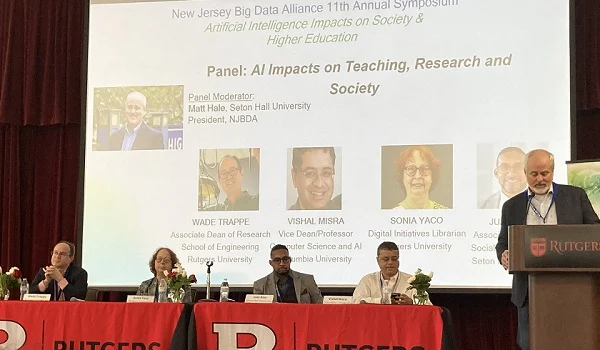
The landscape of higher education is undergoing its most significant transformation since the invention of the printing press. At the 2024 New Jersey Big Data Alliance Symposium, hosted at Rutgers University–New Brunswick, leading academics and technology experts converged to address the defining challenge of our time: the profound, multi-faceted impact of artificial intelligence (AI) on society and the university system.
The symposium, which served as a think tank for the region’s intellectual leaders, reached a consensus that AI is not merely an auxiliary tool but a structural disruptor. From the mechanical logistics of student admissions to the nuanced pedagogy of social work, AI is poised to overhaul every facet of academic life, including grading, lecture formats, and the fundamental architecture of scientific research.
The Panelists: A Multidisciplinary Perspective
The core of the discussion took place during a panel titled "AI Impacts on Teaching and Research," moderated by Matthew Hale, associate professor and chair of the Master of Public Administration program at Seton Hall University. The panel represented a cross-section of academic expertise:
- Vishal Misra: Professor of Computer Science and Vice Dean of Computing and AI, Columbia University.
- Juan Rios: Associate Professor, Master of Social Work program, Seton Hall University.
- Wade Trappe: Associate Dean for Research and Development, Rutgers School of Engineering.
- Sonia Yaco: Digital Initiatives Librarian, Rutgers University.
Operational Efficiency: Administrative and Research Shifts
The symposium opened with a pragmatic look at how universities function as massive, data-driven organizations. Wade Trappe of Rutgers identified that the "back-office" of higher education is ripe for optimization through AI.
Admissions and Strategic Cohorts
Trappe suggested that admissions administrators could utilize AI to curate more balanced student bodies. "I’ve got a whole bunch of athletes already coming in, but I need some artists and so on," Trappe illustrated. By leveraging machine learning, universities can accelerate the selection process, ensuring that incoming cohorts are diverse in both background and academic interest, a task that has historically been manual and prone to bottlenecking.
Institutional Oversight
Beyond recruitment, AI is moving into faculty support. Trappe highlighted the integration of data visualization tools like Tableau at Rutgers. These systems can analyze faculty grant-submission patterns, identifying those who have not applied for funding in years. This allows university deans to intervene proactively, offering resources and mentorship to bolster the institution’s research output.
The Columbia Model
Vishal Misra, Columbia University’s first Dean of AI, provided an institutional view of the rollout. He described a university-wide task force commissioned by the president’s office to audit operations. "There have been 70 different use cases identified across the university," Misra noted. Columbia is currently prioritizing these, ranging from optimizing dining services and managing technology ventures to streamlining the licensing office and pre- and post-grant processing for researchers.
Preserving the Past: AI in Special Collections
One of the most compelling narratives at the symposium came from Sonia Yaco, whose work focuses on the intersection of library science and historical preservation. Yaco pointed out that as the art of reading cursive handwriting declines among younger generations, special collections risk becoming inaccessible.
AI acts as a bridge between the physical past and the digital present. Yaco explained that AI can transcribe handwritten manuscripts, describe typewritten material, and even provide detailed metadata for thousands of unlabeled, decades-old photographs.
"The AI can be phenomenally accurate," Yaco said, describing how these systems can generate MARC (MAchine-Readable Cataloging) records, allowing librarians to turn static images into searchable, multimedia collections. By linking text to previously silent visual media, AI is effectively democratizing access to historical archives for students with varying learning styles.
The Research Revolution: From Months to Seconds
Moderator Matthew Hale provided a stark contrast between historical research methods and the modern AI-assisted workflow. Reflecting on a project regarding television news coverage of the 2000 U.S. election, Hale recounted a process that was both labor-intensive and expensive.
"We hired people in 50 television markets… to insert VHS tapes into their machines, pull the tapes out and send them to the University of Southern California, where we hired people to sit down and watch them and code them," Hale recalled. The process took roughly a year for each election cycle. "I think it would be done in 37 seconds today," he remarked, underscoring the revolutionary potential for AI to compress data processing timelines from years to moments.
Implications for Pedagogy: Ethics and Imagination
While the efficiency gains are clear, the panel turned toward the more sensitive task of teaching students how to interact with these tools.
Teaching the Guardrails
Wade Trappe argued that because 18-year-olds are already native users of platforms like ChatGPT, the university’s role has shifted from technical instruction to ethical oversight. "We need to teach them the guardrails," Trappe emphasized. He argued that the most critical skill in the AI age is skepticism. Students must be trained to identify "hallucinations"—instances where AI produces confident but entirely fabricated information. The goal is to move students away from blindly trusting tool-generated outputs.
Stretching the Academic Imagination
Juan Rios of Seton Hall University offered a pedagogical approach that embraces generative AI as a tool for "future-thinking." In his social work courses, Rios uses AI to help students model solutions for complex societal issues like homelessness and substance misuse.
By asking students to use AI to generate detailed scenarios of a future where these problems have been addressed, Rios encourages them to "stretch their minds." This process of "localizing" these futuristic scenarios to their own communities—such as the city of Newark—allows students to move beyond the constraints of current policy and imagine transformative social change.
Challenges and Future Outlook
Despite the enthusiasm, the symposium did not shy away from the underlying tensions of integrating AI into academia. The primary challenge remains the "black box" nature of these technologies. As faculty and students integrate AI into their workflows, the institution must remain vigilant regarding:
- Data Integrity: Ensuring that the foundational data for AI tools is not biased or fundamentally flawed.
- Cognitive Autonomy: Ensuring that students continue to develop critical thinking skills even as they leverage AI for writing and analysis.
- Equitable Access: Ensuring that the benefits of AI-assisted research and learning are distributed across all departments, not just those with significant funding.
The symposium made it clear that the question is no longer if AI will change higher education, but how quickly institutions can adapt to manage that change. The university of the future will be a hybrid space where human intellect is augmented by machine efficiency, where historical archives are unlocked by automated cataloging, and where the classroom serves as a sandbox for simulating solutions to the world’s most pressing problems.
As the 2024 New Jersey Big Data Alliance Symposium concluded, the prevailing sentiment was one of cautious optimism. The tools are powerful, the implications are vast, and the responsibility for guiding this transition rests squarely on the shoulders of the faculty, researchers, and administrators tasked with shaping the next generation of thinkers.
