

By Esther Surden, Founder and Editor-in-Chief, NJTechWeekly.com
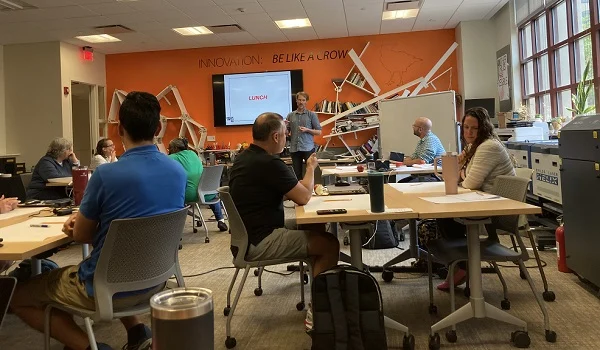
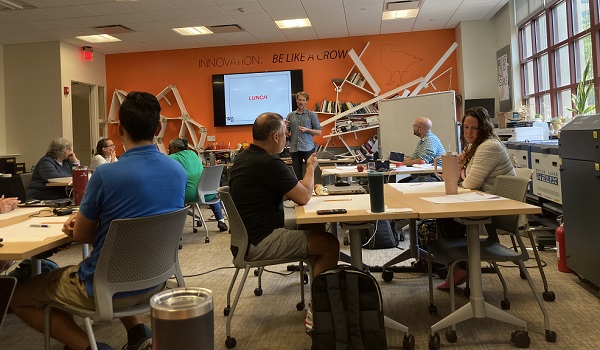
In the rapidly evolving landscape of 21st-century education, the bridge between abstract conceptualization and physical manifestation has never been more critical. This past August, NJTechWeekly.com visited the Montclair State University (MSU) campus to observe a high-impact workshop that is fundamentally changing how educators approach technology in the classroom. Led by professors Jason Frasca and Iain Kerr, this intensive 3D printing and innovation workshop is designed to transform teachers into facilitators of creativity, equipping them with the tools to foster agency and autonomy in K-12 students.
The initiative represents a strategic partnership between the Picatinny Arsenal—a prestigious U.S. Army research facility based in Rockaway, New Jersey—and the MIX Lab at Montclair State University. By subsidizing these workshops, the Picatinny Arsenal is making a long-term investment in the regional STEM (science, technology, engineering, and math) and STEAM (science, technology, engineering, arts, and math) ecosystems, ensuring that New Jersey schools are not just consumers of technology, but pioneers of its application.
The Objective: Beyond Mere Technical Proficiency
While the primary medium of the workshop is 3D printing, the ultimate objective extends far beyond teaching educators how to operate a printer. The program is designed to instill a pedagogical philosophy that emphasizes digital design literacy, the fostering of creative confidence, and the practical application of 21st-century skills.
"Picatinny Arsenal supports STEM and STEAM education in New Jersey K-12 school systems by providing 3D printers and support for 3D printing and robotics teams in high schools," Frasca explained. "They engaged us many years ago to teach the teachers how to use their 3D printers, but the scope has grown significantly."
The current curriculum focuses on how educators can translate digital-design software and computer-aided design (CAD) proficiency into classroom environments that prioritize student autonomy. By modeling this behavior in the workshop, Frasca and Kerr empower teachers to move away from rigid, step-by-step instruction and toward a more fluid, discovery-based model of learning.
A Chronology of the Workshop Experience
The workshop is meticulously structured to break down the psychological barriers that often accompany the adoption of new, complex technologies. The day begins not with manuals or lines of code, but with analog movement.
The Analog-to-Digital Bridge
During the morning session, Professor Iain Kerr led the participants through a series of rudimentary design exercises. Rather than sitting statically behind a computer, teachers were encouraged to use their whole bodies to conceptualize designs. This movement-based approach is intended to bypass the self-censorship and rigid expectations that often stifle creativity.
Frasca describes this as "bridging the gap between the analog and the digital." By drawing simple shapes—rectangles, circles, and lines—on paper before translating them into CAD software, educators build a "muscle memory" of the design process. This grounding technique allows them to understand how to manifest an idea from the mental space into the physical space, creating a smoother transition when they eventually open the software.
The 25-Minute Threshold
One of the most radical departures from traditional software instruction is the workshop’s speed. In most institutional settings, CAD software is taught by introducing every single tool in the interface over a period of months, often leaving students disengaged and unable to create anything tangible.
"Our approach is to, within 25 minutes, get everybody actually creating something that they could 3D-print," says Frasca. By limiting the toolset to the essentials—showing how a simple cube can be manipulated into a sphere or any other complex form—the professors show participants that one object can be the foundation for infinite possibilities. This rapid gratification is crucial for teachers to experience, as it provides them with a template for how they can keep their own students motivated and productive from day one.
Supporting Data and Pedagogical Frameworks
The methodology employed by the MIX Lab is rooted in the idea that traditional "ideation" is often limited by a student’s existing knowledge base. "We can only ideate what we know, what you’ve already seen and been exposed to, heard or engaged with," Frasca notes. "Therefore, we can never ideate anything novel or unique on our own."
To transcend these cognitive boundaries, the workshop introduces frameworks within the design software that force users to think differently. By learning to use these tools, students are simultaneously learning how to design beyond what they currently imagine.
During the afternoon, the focus shifted to independent problem-solving. Professor Kerr emphasized that the goal is not for the teacher to be the sole source of knowledge, but for students to learn how to find and use tools independently. Kerr introduced the concept of the "loft" tool, which allows for greater flexibility and the modification of designs in real-time. He encouraged the teachers to keep multiple software tools and browser tabs open simultaneously, reinforcing the idea that there is no "one right way" to solve a design problem.
Official Responses and Strategic Vision
The collaboration between the Picatinny Arsenal and the MIX Lab is part of a broader, statewide effort to bolster the talent pipeline for defense, engineering, and manufacturing sectors. By providing the funding for these workshops, the U.S. Army is essentially helping to build the infrastructure of the future workforce.
The teachers who attend these sessions are expected to act as conduits for this knowledge. By experiencing the "gallery walk"—a final exercise where participants present their work and discuss techniques with peers—teachers are taught to foster a collaborative classroom culture. In this environment, students learn from one another’s mistakes and successes, mirroring the iterative design processes used in high-level engineering and product design firms.
The enthusiasm in the room was palpable. By the end of the workshop, educators were not just operating printers; they were drafting complex concepts that they previously would have deemed impossible. The shift in confidence was clear, marking a successful transition from "technology user" to "technology creator."
Implications for the Future of K-12 Education
The implications of this training extend far beyond the classroom walls. By fostering agency and autonomy, the MSU/Picatinny workshop prepares students for a future where adaptability is the most valuable currency.
1. The Rise of Student Agency
When students are taught that they have multiple ways to arrive at a solution, their relationship with failure changes. It is no longer an endpoint, but a part of the iterative process. This resilience is a hallmark of 21st-century skills that will serve students in any career path they choose, whether in STEM or the arts.
2. Democratizing Innovation
By bringing professional-grade 3D design tools into the K-12 environment, this initiative democratizes the ability to innovate. Students from all backgrounds gain access to the same technology that is currently being used to prototype military equipment, medical devices, and consumer electronics.
3. Sustainable Professional Development
The "train the trainer" model adopted by the MIX Lab is highly sustainable. One workshop, hosting a dozen teachers, can potentially impact hundreds of students over the course of a single academic year. As these teachers return to their districts, they carry with them the pedagogical strategies necessary to keep their curricula fresh and responsive to technological shifts.
Conclusion
The collaboration between the MIX Lab at Montclair State University and the Picatinny Arsenal is a model for how public-private partnerships can drive educational excellence. By focusing on the intersection of human creativity and digital capability, Jason Frasca and Iain Kerr are doing more than teaching software—they are teaching a way of thinking.
As these educators integrate these practices into their classrooms, they are planting the seeds for a more innovative, agile, and technically proficient generation. For the teachers, the workshop is a gateway to a new way of engaging their students. For the students, it is an invitation to move beyond the limitations of their own imagination and start building the future, one 3D-printed layer at a time.
