


As we navigate the fifth decade of life and beyond, the natural physiological shifts in our body—specifically the loss of muscle mass known as sarcopenia—can make the arms feel softer and less resilient. For many, the focus turns to "arm jiggle," a common shorthand for the loss of tone in the triceps. However, fitness experts are increasingly shifting the narrative: achieving a sculpted, athletic, and functional upper body after 55 isn’t about isolated bicep curls; it’s about a holistic approach that integrates the entire kinetic chain.
By prioritizing compound movements that engage the shoulders, chest, upper back, and core, you don’t just improve the aesthetics of your arms—you build a foundation of strength that supports daily functional tasks, posture, and metabolic health.
The Science of Total-Body Strength
The most effective training programs for those over 55 are rooted in "compound movements." These are exercises that involve multiple joints and muscle groups simultaneously. When you perform a push-up or a row, you are teaching your body to function as a cohesive unit.
Research consistently supports this, suggesting that older adults benefit more from multi-joint exercises because they mirror the demands of real-life activity. By starting with larger movements before transitioning into isolation exercises (like curls or extensions), you create a superior training stimulus. This approach ensures that the arms are supported by a strong back and a stable core, preventing injury and ensuring that your efforts yield noticeable results in both strength and firmness.
Building Your Home Armory: The Equipment Essentials
One of the greatest barriers to consistency in fitness is complexity. Many believe that to see results, one must join a commercial gym filled with expensive, intricate machinery. On the contrary, science suggests that simple, consistent resistance training—even at home—is highly effective.
For this routine, your "gym" is simple:
- A pair of adjustable dumbbells: These allow for progressive overload as you get stronger.
- A set of resistance bands: Perfect for tension-based movements that protect your joints.
- Your own bodyweight: The ultimate tool for building functional strength and coordination.
The Five-Step Foundation: A Chronological Routine
To maximize your gains, follow this routine in the order presented. By starting with the most demanding compound movements, you ensure your central nervous system is fresh, allowing you to maintain perfect form throughout the workout.
1. Close-Grip Incline Push-Up
The close-grip incline push-up is the gold standard for chest and triceps engagement. By elevating your hands on a counter or sturdy table, you reduce the strain on your shoulders while keeping the focus on your arms.
- Why it works: The narrow hand placement forces the triceps to work harder during the extension phase, while the incline allows you to maintain a perfect plank position, engaging the core.
- Execution: Place your hands on an elevated surface slightly closer than shoulder-width. Keep your body in a straight line from heels to head. Lower your chest toward the surface, keeping your elbows tucked close to your ribs, then press back up.
- Protocol: 3 sets of 8–12 repetitions. Rest 45–60 seconds between sets.
2. Dumbbell Bent-Over Row
The upper back is the "anchor" of your arms. If your back is weak, your arms will appear less defined. Rows target the lats, rear deltoids, and biceps simultaneously.
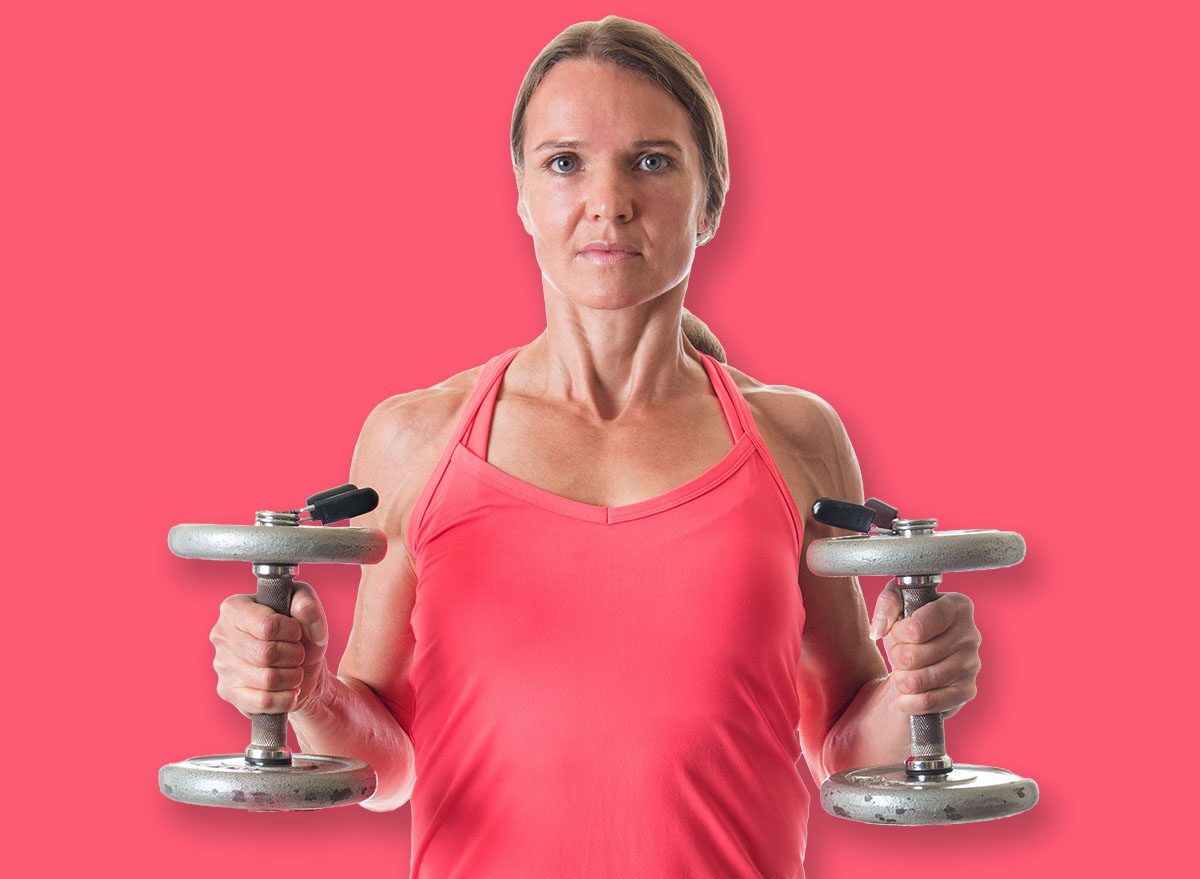
- Why it works: It corrects the "slumping" posture often associated with aging, drawing the shoulders back and opening the chest.
- Execution: Hinge at your hips with a slight bend in your knees. Keep your back flat. Pull the dumbbells toward your hips, squeezing your shoulder blades together at the top of the movement.
- Protocol: 3 sets of 8–12 repetitions. Rest 45–60 seconds between sets.
3. Standing Dumbbell Shoulder Press
The shoulder press is a vital movement for maintaining overhead mobility, which is essential for tasks like reaching for items on high shelves.
- Why it works: It forces the core to stabilize the spine while the shoulders and triceps drive the weight upward.
- Execution: Stand with feet shoulder-width apart, core engaged. Press the dumbbells directly overhead without leaning back. Lower slowly to ear level.
- Protocol: 3 sets of 8–10 repetitions. Rest 45–60 seconds between sets.
4. Band Triceps Pressdown
Now that your triceps have been exhausted by the push-ups and presses, use the band to "finish" them. This isolation movement is gentle on the joints and provides constant tension.
- Why it works: It focuses exclusively on the long head of the triceps, the muscle responsible for the "jiggle" many wish to minimize.
- Execution: Anchor a resistance band high. Keep your elbows glued to your sides and extend your arms downward, squeezing the back of your arms at the bottom.
- Protocol: 3 sets of 12–15 repetitions. Rest 30–45 seconds between sets.
5. Dumbbell Hammer Curl
The hammer curl is superior to the standard palm-up curl for those over 55 because it is more wrist-friendly and engages the brachialis (a muscle that adds thickness to the arm).
- Why it works: It provides direct bicep work while improving grip strength.
- Execution: Stand tall with palms facing your torso. Curl the weights toward your shoulders while maintaining a neutral (hammer) grip. Lower slowly.
- Protocol: 3 sets of 10–12 repetitions. Rest 30–45 seconds between sets.
Supporting Data and Physiological Implications
The importance of resistance training after 55 cannot be overstated. According to the National Institutes of Health, the loss of skeletal muscle mass contributes significantly to metabolic slowdown. By performing these movements 2–3 times per week, you are not just firming your arms; you are improving your resting metabolic rate.
Furthermore, these movements improve bone density. The "loading" of the bones during weight-bearing exercises like the shoulder press and push-up sends a signal to the body to reinforce bone structure, a critical defense against osteoporosis.
Implications for Long-Term Health
The implications of a stronger upper body go far beyond the mirror. A study published in the Journal of Gerontology suggests that grip strength and upper body power are strong predictors of "healthy aging." Those who maintain their muscle mass are less prone to falls, more independent in their daily living, and have better cardiovascular health.
Expert Recommendations for Success
To ensure your safety and success, consider these three pillars of expert advice:
- Controlled Eccentrics: Do not just lift the weight; control the descent. The "lowering" phase (eccentric) is where most muscle growth occurs. Take two seconds to lower the weight for every one second you spend lifting it.
- Progressive Overload: Once 12 repetitions feel "easy," it is time to increase the weight or the tension of the band. Your body will only change if it is challenged.
- Mind-Muscle Connection: Don’t just move the weight from A to B. Focus on the muscle you are trying to work. If you are doing a row, feel your back muscles contracting. This intentionality increases muscle fiber recruitment.
Final Thoughts
Building a firmer, stronger set of arms after 55 is a realistic and rewarding goal. By moving away from the "isolation-only" mindset and embracing a total-body approach that includes pressing, pulling, and targeted finishing movements, you create a sustainable path to health. Remember, consistency is the true "secret ingredient." Start slow, prioritize your form, and watch as your strength—and your confidence—begins to grow.
