

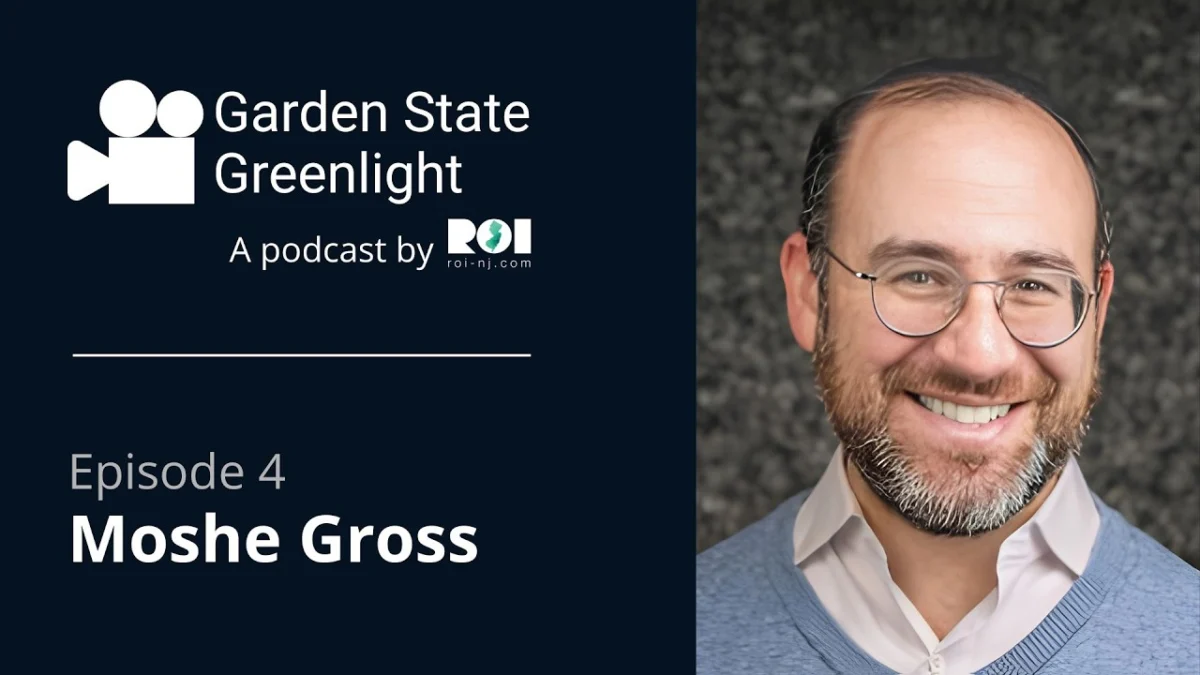
New Jersey, USA – The Garden State is experiencing a significant surge in film and television production, a trend that is extending its economic ripple effects far beyond traditional studio soundstages. This burgeoning industry has sparked an unprecedented demand for unique and diverse filming locations, unlocking new revenue streams and entrepreneurial opportunities for property owners and specialized service providers across the state.
At the forefront of this dynamic shift is Reset Locations, a company dedicated to bridging the gap between film productions and the vast array of potential filming sites New Jersey has to offer. In a recent insightful discussion on the podcast Garden State Greenlight, Moshe Gross, the founder and CEO of Reset Locations, sat down with ROI-NJ Multimedia Journalist Thomas Philip to illuminate the intricate workings of his business and the broader implications for New Jersey’s economy.
Gross’s journey into the world of film production is a testament to his keen observation of evolving market needs. His background in commercial real estate provided him with a unique vantage point, particularly during his involvement in the redevelopment of the iconic Bell Works building in Holmdel. It was there that he witnessed firsthand the substantial economic benefits that film productions could bring to large-scale commercial properties. This realization ignited a vision for a specialized agency that could systematically connect these properties with the ever-growing needs of the entertainment industry.
The Genesis of Reset Locations: From Real Estate Acumen to Location Scouting Expertise
Moshe Gross’s transition from the established world of commercial real estate to the fast-paced and often unpredictable realm of film production is a narrative rooted in strategic foresight. His early career was deeply entrenched in the tangible aspects of property development and management. However, a pivotal experience during the revitalization of Bell Works in Holmdel, New Jersey, served as the catalyst for his entrepreneurial pivot.
Bell Works, a former Bell Labs research facility, is a sprawling complex with an architecturally distinct and historically significant presence. As Gross was involved in its redevelopment, he began to understand the inherent value of such large, versatile spaces for purposes beyond their original intent. He observed how the presence of film and television crews, even for smaller projects, could bring a significant influx of economic activity to the area. This observation sparked a crucial realization: the film industry was actively seeking authentic, real-world locations, and New Jersey, with its diverse landscape and infrastructure, possessed an untapped reservoir of such assets.
"We were looking at Bell Works and seeing its potential for offices, residential spaces, retail, and all the usual components of a mixed-use development," Gross explained on Garden State Greenlight. "But then, you start to consider the sheer scale and the unique architectural elements. I began to think about how these kinds of spaces, along with many others across the state, could be incredibly valuable to productions looking for something beyond a sterile studio environment."
This initial insight evolved into a business model. Gross recognized that while property owners possessed the physical assets, they often lacked the specific knowledge, connections, and logistical expertise to navigate the complexities of working with film crews. Conversely, productions were constantly on the hunt for accessible, suitable, and often unique locations, facing challenges in identifying and securing them efficiently.
"The gap was clear," Gross stated. "There were incredible properties out there, from sprawling office campuses and functioning hospitals to industrial warehouses and charming private residences, that could be perfect for a wide range of scenes. But connecting these properties with the right productions, and ensuring a smooth process for both parties, required a specialized intermediary."
This realization directly led to the founding of Reset Locations. The company was established not just as a directory of available properties, but as a comprehensive service provider. Reset Locations acts as the crucial conduit, meticulously vetting locations, understanding their suitability for various production needs, and managing the intricate details of the permitting, scheduling, and logistical coordination required for on-site filming. This includes everything from ensuring adequate power supply and access for equipment to managing parking, security, and the often-sensitive needs of property owners and residents.
The Transformative Power of the New Jersey Film Tax Incentive
The landscape of New Jersey’s film and television industry has been profoundly reshaped by the reinstatement and enhancement of its film tax incentive program. This legislative action has not only attracted major productions back to the state but has also fostered a robust ecosystem of ancillary businesses that support the industry’s intricate operations. Moshe Gross emphasized the critical role this incentive has played in the growth of Reset Locations and the broader economic benefits it has generated.
"The restored film tax incentive has been an absolute game-changer," Gross asserted. "For years, New Jersey was losing productions to states with more competitive incentives. The renewed commitment from the state government has fundamentally altered the equation. It has made New Jersey a serious contender, not just a secondary option, for major film and television projects."
The tax incentive program, which offers significant rebates on qualified production expenses, directly lowers the overall cost of filming in New Jersey. This financial advantage, coupled with the state’s inherent strengths, has created a powerful magnet for production companies. For companies like Reset Locations, this translates into a consistent and increasing demand for their services.
"We’ve seen a direct correlation between the strength of the incentive and the volume of inquiries and bookings we receive," Gross explained. "When productions know they can achieve significant cost savings by filming here, they actively seek out locations and resources within the state. This creates a virtuous cycle where more productions lead to more opportunities for businesses like ours, which in turn supports the local economy."
Beyond the direct financial benefits to productions, the tax incentive has spurred the development of a comprehensive support infrastructure. This includes a growing demand for services such as location scouting, set construction, catering, transportation, equipment rental, and specialized labor. Reset Locations, by facilitating the use of real-world locations, plays a pivotal role in this ecosystem.
"It’s not just about finding a pretty building or a scenic vista," Gross elaborated. "It’s about understanding the practicalities of filmmaking. We work with productions to identify spaces that not only fit their creative vision but also meet their technical requirements – things like power, accessibility, soundproofing, and the ability to accommodate large crews and equipment. This requires a deep understanding of both the properties and the filmmaking process."
The success of the incentive program has also encouraged property owners who might not have previously considered renting their spaces for film shoots. The prospect of generating substantial income from underutilized properties, coupled with the support provided by agencies like Reset Locations, has opened up new avenues for passive income and economic diversification.
The Expanding Horizon of Location Scouting: Beyond the Obvious
The demand for filming locations in New Jersey extends far beyond the readily apparent. Moshe Gross highlighted how the evolving needs of modern filmmaking require a diverse and often unexpected range of sites, pushing the boundaries of traditional location scouting. Reset Locations’ expertise lies in identifying and facilitating the use of these varied spaces.
"When people think of filming locations, they often picture grand estates or iconic landmarks," Gross commented. "While those are certainly valuable, the reality of film production is far more granular and diverse. We are constantly looking for and facilitating the use of spaces that might not be immediately obvious but are crucial for specific scenes."
This includes a wide spectrum of commercial and industrial properties. Office buildings, for instance, are in high demand for scenes depicting corporate environments, government agencies, or even as temporary production offices themselves. Hospitals, with their sterile corridors and specialized equipment, are invaluable for medical dramas or thrillers. Warehouses, with their vast open spaces and industrial aesthetic, can be transformed into anything from clandestine meeting spots to futuristic laboratories.
"The beauty of New Jersey is its sheer variety," Gross continued. "We have bustling urban centers, serene rural landscapes, historic towns, and a robust industrial backbone. This allows us to cater to a vast array of creative briefs. A production might need a gritty, abandoned factory one day and a sleek, modern art gallery the next. We have the inventory to meet those demands."
Private residences also play a significant role, offering the intimacy and authenticity that studios often struggle to replicate. From suburban homes to urban apartments, these personal spaces can imbue a film or television show with a sense of lived-in reality. Reset Locations works diligently to ensure that the process of using a private home for filming is as unobtrusive and respectful as possible, building trust with homeowners who are often initially hesitant.
"Building trust is paramount," Gross emphasized. "For property owners, it’s about feeling confident that their property will be treated with care and that the process will be managed professionally. For filmmakers, it’s about knowing that the locations we present are suitable, accessible, and that all the logistical hurdles have been anticipated and addressed. We act as the crucial bridge of confidence between these two parties."
The expansion of location needs also extends to the infrastructure that supports productions. As the industry grows, so does the demand for production offices, equipment storage facilities, and even temporary housing for cast and crew. Reset Locations is strategically positioned to identify and facilitate the use of these essential support spaces, further embedding itself within the industry’s operational framework.
Building Trust and Navigating Logistical Complexities
The success of Reset Locations hinges on its ability to foster strong relationships built on trust and transparency with both property owners and film production teams. Moshe Gross underscored the meticulous approach his company takes in navigating the often-complex logistical and operational considerations involved in hosting a film shoot.
"Filmmaking is inherently a collaborative process, and our role is to ensure that collaboration is seamless and productive," Gross stated. "This means understanding the unique needs and concerns of everyone involved. For property owners, it’s about ensuring their property is protected, that they are adequately compensated, and that the disruption to their lives or businesses is minimized. For production companies, it’s about delivering reliable, accessible, and appropriate locations on time and within budget."
Reset Locations employs a rigorous vetting process for every property they represent. This involves detailed site inspections to assess not only the aesthetic appeal but also the practical aspects of filming. Factors such as power availability, access for large vehicles and equipment, sound insulation, potential noise issues, and the overall safety and security of the site are all carefully evaluated.
"We don’t just take a few photos and list a property," Gross explained. "We conduct thorough assessments, often accompanied by representatives from the production company, to ensure a mutual understanding of what the location can offer and what it requires. This proactive approach helps prevent surprises down the line."
The company also plays a vital role in managing the intricate web of logistics that accompanies a film shoot. This can include:
- Permitting and Approvals: Navigating local municipal regulations and obtaining necessary permits for filming, parking, and street closures.
- Scheduling and Access: Coordinating shooting schedules with property owners and ensuring timely access for crews and equipment.
- Security and Safety: Implementing appropriate security measures to protect the property and ensure the safety of cast and crew.
- Insurance and Liability: Ensuring that all necessary insurance is in place to cover potential damages or liabilities.
- Communication and Coordination: Acting as the central point of contact for all communication between the production team and the property owner, addressing any issues or concerns promptly.
Gross highlighted the importance of clear and consistent communication as a cornerstone of their operation. "We act as the buffer and the facilitator," he said. "We translate the needs of the production into actionable steps for the property owner, and we communicate the property owner’s concerns and limitations to the production team. This constant dialogue is key to a successful shoot."
The emphasis on building trust extends to fostering long-term relationships. Many property owners who have had positive experiences with Reset Locations become repeat clients, and successful productions often return to the state, seeking out familiar and reliable location resources. This network of trust and reliability is a significant asset for New Jersey’s growing film industry.
The Future of Location Scouting: Technology, AI, and the Enduring Appeal of Authenticity
As the film and television industry continues its rapid evolution, Moshe Gross offered a forward-looking perspective on the trends shaping location scouting, emphasizing the growing role of technology and artificial intelligence, while firmly asserting the enduring value of authentic, real-world locations.
"The landscape of filmmaking is constantly changing, and the tools we use are evolving with it," Gross observed. "We are seeing a growing need for specialized infrastructure to support productions. This includes not only more production offices and soundstages but also significant requirements for storage space, especially for props, equipment, and set pieces. Furthermore, the temporary housing needs for cast and crew are also expanding as productions become larger and stay longer."
Reset Locations is actively adapting to these emerging demands by identifying and facilitating the use of properties that can fulfill these ancillary needs. This proactive approach ensures that New Jersey can accommodate the full spectrum of production requirements.
The integration of technology, particularly artificial intelligence, is poised to revolutionize aspects of location scouting. Gross anticipates that AI could play a significant role in streamlining the process of identifying suitable locations.
"Imagine an AI system that can analyze vast databases of property information, cross-referencing them with the specific visual and logistical requirements of a script," Gross posited. "It could quickly identify potential matches based on architectural style, geographical features, accessibility, and even zoning regulations. This could significantly speed up the initial search phase and allow scouts to focus on more nuanced aspects of location selection."
AI-powered tools could also assist in tasks such as virtual site surveys, analyzing environmental factors like sunlight patterns throughout the day, or even predicting potential logistical challenges based on historical data. However, Gross was quick to emphasize that technology will likely augment, rather than replace, the human element in location scouting.
"While AI can be a powerful tool for data analysis and initial identification, it cannot replicate the intuition, experience, and creative vision of a seasoned location scout," he stated. "There’s an art to understanding how a space will feel on camera, how it will interact with light and sound, and how it will serve the narrative. That human touch, that understanding of cinematic storytelling, will always be invaluable."
Crucially, Gross believes that despite the advancements in virtual production and the increasing sophistication of digital environments, the demand for authentic, real-world locations will remain a cornerstone of filmmaking.
"Audiences connect with the tangible," Gross asserted. "There’s a certain truth and texture that you get from filming in a real place that is difficult, if not impossible, to replicate entirely in a studio. Whether it’s the patina of age on a historic building, the unique character of a neighborhood, or the natural beauty of a landscape, these elements bring a depth and authenticity to storytelling."
New Jersey, with its rich tapestry of diverse geography, robust infrastructure, and strategic proximity to major media hubs, is exceptionally well-positioned to capitalize on this enduring demand. The state’s ability to offer a wide range of authentic locations, coupled with its increasingly competitive film incentive program and a growing ecosystem of support services, solidifies its status as a prime destination for the future of film and television production.
"We are seeing a sustained and growing interest in New Jersey," Gross concluded. "The combination of our unique assets, our commitment to supporting the industry, and the talent and dedication of our local professionals makes this a very exciting time. Reset Locations is proud to be a part of this growth, helping to connect the stories being told with the incredible locations that New Jersey has to offer."
For those interested in delving deeper into the intricacies of New Jersey’s burgeoning film industry and the vital role of location scouting, the full conversation with Moshe Gross can be accessed on the latest episode of Garden State Greenlight.
