


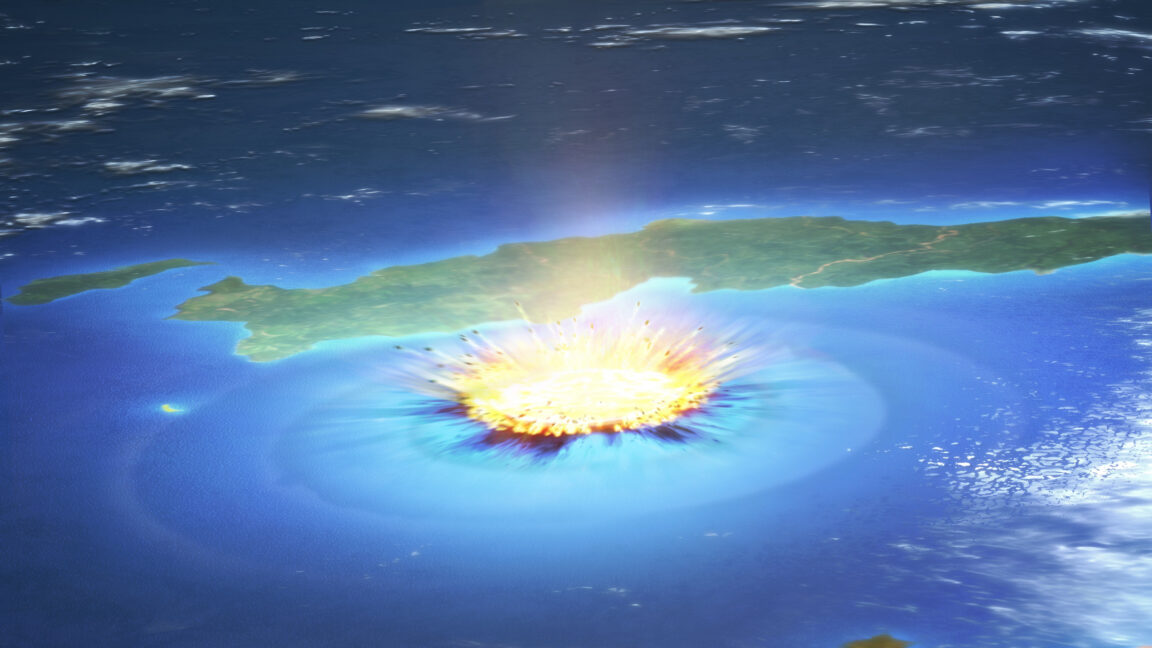
Sixty-six million years ago, a mountain-sized asteroid collided with the Yucatan Peninsula, triggering a global cataclysm that extinguished the non-avian dinosaurs and fundamentally altered the trajectory of life on Earth. While the Chicxulub impact is remembered primarily for its destructive fire and fury, new research suggests the event also acted as a planetary-scale incubator. According to a study recently published in Communications Earth & Environment, the massive energy release from the strike forged a gargantuan, long-lived hydrothermal system beneath the impact crater—a subterranean oasis that likely persisted for eight million years, potentially serving as a sanctuary for microbial life in a cooling, chaotic world.
The Cataclysmic Forge: Understanding the Chicxulub Impact
The Chicxulub impact was an event of near-unfathomable magnitude. When the bolide struck the shallow seas of what is now Mexico, it vaporized rock, triggered tsunamis that scoured coastlines globally, and injected enough debris into the atmosphere to plunge the planet into a prolonged winter. However, the destruction on the surface was only half the story.
Beneath the impact site, the sheer force of the collision caused catastrophic deformation of the Earth’s crust, reaching depths of up to 35 kilometers. This intense kinetic energy melted vast volumes of rock, creating a massive, fractured subterranean landscape. As the Earth’s crust cooled, seawater from the surrounding ocean was drawn into these newly created pores and fissures. Heated by the still-molten rock deep underground, this water began to circulate, creating a sophisticated, planet-sized hydrothermal system—essentially a massive, hidden network of "geysers" and mineral-rich plumbing systems buried beneath the seafloor.
Chronology of a Subterranean Oasis
For years, the scientific community believed that such hydrothermal systems were transient, fleeting features of impact craters that would fade within a couple of million years. However, a team of researchers led by geologist Annemarie Pickersgill of the University of Glasgow’s SUERC Center for Isotope Sciences has fundamentally rewritten this timeline.
By drilling into the impact zone and analyzing core samples from one kilometer beneath the surface, the team utilized advanced potassium-argon dating techniques to determine the lifespan of the system.
- T+0 (66 Million Years Ago): The asteroid strikes, causing immediate crustal melting and the birth of a high-temperature hydrothermal system.
- T+2 Million Years: Previously, researchers hypothesized this was the end of the system’s lifecycle. The new data, however, reveals this was merely the beginning of a long cooling phase.
- T+5 Million Years: Computer simulations indicate the system remained at temperatures conducive to microbial life (below 50°C/122°F).
- T+8 Million Years: The final cessation of significant fluid flux occurs, marking the end of the hydrothermal cradle.
This eight-million-year window is at least four times longer than previous estimates, providing a vastly extended "window of opportunity" for prebiotic chemistry and the evolution of complex microbial ecosystems.
Supporting Data: The Isotopic Signature of Time
The methodology behind these findings relies on the radioactive decay of potassium-40 into argon-40. When rock is molten, any argon gas trapped within the mineral structure is released. Once the rock solidifies, the argon begins to accumulate again as the potassium decays.
By measuring the ratio of potassium to argon within feldspar samples extracted from the drill site, Dr. Pickersgill’s team was able to calculate exactly how long the rock had been cool enough to trap these gases. The data consistently pointed to a hydrothermal system that was still active—or cooling from a state of intense activity—as late as 58 million years ago.
To corroborate these isotopic findings, the team ran high-fidelity computer simulations of the crater’s thermal evolution. These models accounted for the heat dissipation of the melted rock mass and the cooling effects of seawater circulation. The simulation results mirrored the isotopic data: the center of the crater would have maintained temperatures of 90°C (194°F) for over two million years, slowly trending down to more hospitable temperatures for another three million years, remaining active until the eight-million-year mark.
Official Perspectives and Scientific Implications
The implications of this study extend far beyond the history of the Yucatan. Hydrothermal systems are widely regarded as potential "cradles of life" because they provide the three essential ingredients for biological existence: heat, minerals, and chemical energy.
"Longer periods of hydrothermal activity will generate extended windows of opportunity for prebiotic chemical reactions to occur, life to develop, and micro-organisms to thrive and propagate beyond their point of origin," Dr. Pickersgill stated in the study.
While the study does not definitively prove that the Chicxulub crater was inhabited, it provides the strongest evidence to date that it could have been. Out of 70 known underwater impact craters, only eight have shown clear evidence of microbial colonization. The longevity of the Chicxulub system suggests that duration is a key, if not the primary, factor in determining whether an impact site becomes a "hotbed" for life rather than a sterile scar.

The Broader Context: Life Beyond Earth
The discovery also informs our search for life elsewhere in the solar system. Many planets and moons, such as Mars or the icy moons of Jupiter and Saturn, are heavily cratered. If impact-induced hydrothermal systems can persist for millions of years, they become prime targets for astrobiological exploration.
"Chicxulub is still relatively small compared to the impact basins expected on early Earth and observed on other planetary bodies," Pickersgill noted. "It is therefore possible that these larger impacts could have created even longer-lived hydrothermal systems and, hence, could have been able to maintain the temperatures and fluid flux required for habitable environments for a minimum of several million years."
The Legacy of the Impact
The narrative of the asteroid impact is shifting from one of singular, absolute destruction to one of complex ecological transformation. While the extinction of the dinosaurs was an undeniable tragedy for the species involved, the subterranean hydrothermal system acted as a hidden laboratory.
If life can take root and propagate in the wake of such a massive, world-altering collision, it suggests that Earth’s history—and potentially the history of life throughout the universe—is far more resilient than previously thought. The Chicxulub impact, once viewed only as a tombstone for the Mesozoic era, may have also been a quiet, warm nursery, fostering microbial colonies in the dark, mineral-rich depths of the post-impact ocean.
As researchers continue to analyze the drill samples and refine their models, the Chicxulub crater remains a vital site for understanding not just the end of the dinosaurs, but the tenacity of life itself. The eight million years of heat provided by this impact may not have prevented the extinction of the surface world, but it almost certainly provided a refuge, proving once again that in the face of even the most extreme cataclysms, life finds a way.
