

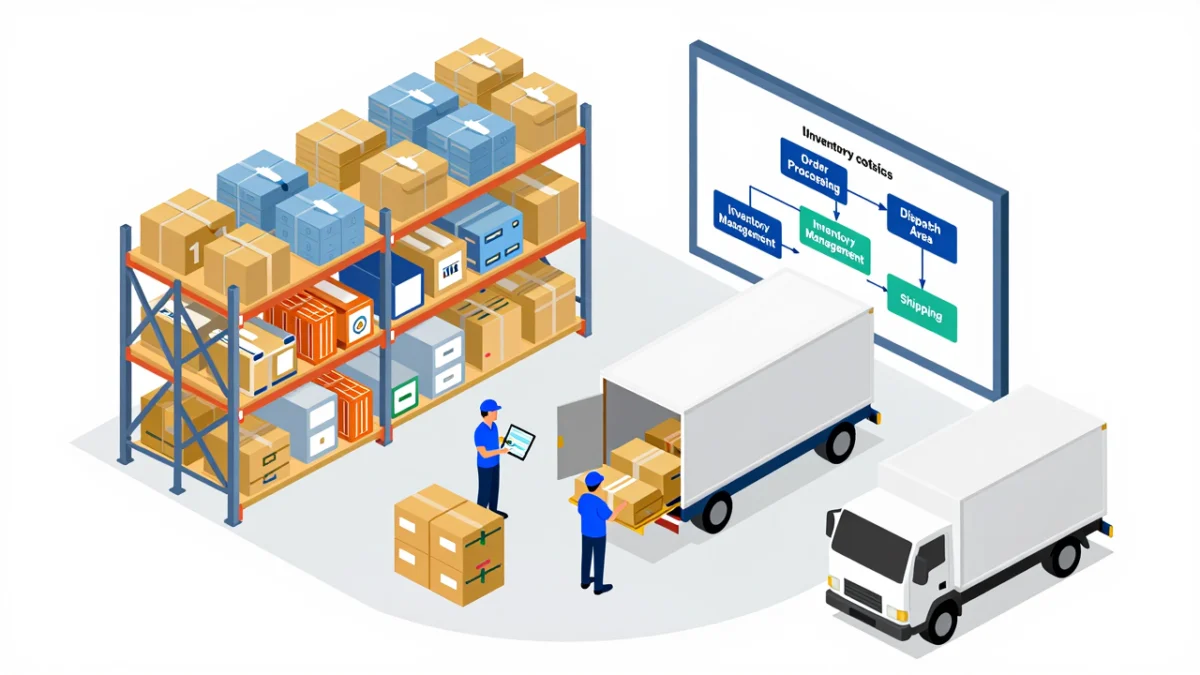
In the current volatile global marketplace, inventory logistics has evolved from a back-office administrative task into a core pillar of competitive advantage. For small and medium-sized enterprises (SMEs) and large corporations alike, the ability to manage the flow of goods—from raw material sourcing to the final delivery at a customer’s doorstep—is the difference between market leadership and obsolescence. Mastering this discipline requires a blend of rigorous process management, cutting-edge technology integration, and proactive demand forecasting.
Main Facts: The Anatomy of Inventory Logistics
At its core, inventory logistics is the orchestrated movement and storage of assets. It is not merely about "having stuff on hand"; it is about having the right items in the right quantity at the right time. The primary components that define this ecosystem include:

- Sourcing and Procurement: Establishing a resilient supply chain that ensures high-quality inputs.
- Inventory Control: The systematic monitoring of stock levels to balance supply with demand.
- Storage and Organization: Optimizing warehouse space to facilitate rapid picking and packing.
- Order Fulfillment: The final execution phase where efficiency dictates customer retention.
- Transportation Management: The logistics of moving goods from the warehouse to the consumer, often the most costly segment of the chain.
The failure to align these components leads to the "bullwhip effect," where small fluctuations in retail demand cause massive, inefficient oscillations in inventory levels throughout the supply chain.
Chronology: The Lifecycle of a Product Journey
To understand the complexity of inventory management, one must trace the lifecycle of a product:

- Demand Signal: The process begins with predictive analytics, where historical sales data and market trends are synthesized to anticipate upcoming needs.
- Procurement Execution: Based on the forecast, procurement teams engage suppliers. Modern businesses are moving away from reactive ordering toward collaborative partnerships, often utilizing Vendor Managed Inventory (VMI) to share risk.
- Inbound Logistics and Warehousing: Goods arrive and undergo quality control. They are then indexed within an Inventory Management System (IMS) and allocated to specific storage zones using ABC analysis—a strategy that prioritizes high-value, high-velocity items.
- Picking, Packing, and Fulfillment: Upon an order trigger, warehouse teams (or automated robotics) retrieve items. Precision here is paramount; a single error at this stage degrades the customer experience and incurs "reverse logistics" costs.
- Distribution and Last-Mile Delivery: The final journey involves selecting the most cost-effective yet reliable carrier, utilizing real-time tracking to maintain transparency for the end user.
Supporting Data: Why Precision Matters
The financial implications of inventory mismanagement are severe. Industry benchmarks suggest that businesses failing to optimize their logistics experience significantly higher "carrying costs"—the expense of storing unsold goods.
- Efficiency Gains: Implementing advanced AI-driven demand forecasting can boost inventory turnover rates by 10% to 20%.
- Cost Reduction: Strategic warehouse layout optimization and the use of automation can reduce labor costs and fulfillment errors by up to 30%.
- Accuracy: Relying on manual spreadsheets often results in low accuracy. Conversely, integrating IoT-enabled tracking and cloud-based IMS platforms brings inventory accuracy closer to the 99% threshold, drastically reducing the need for costly emergency stock purchases.
Strategic Best Practices for Inventory Control
To thrive, organizations must move beyond reactive management. This requires the implementation of robust, data-backed methodologies:

1. Advanced Demand Forecasting
Forecasting is the heartbeat of logistics. By utilizing historical sales data alongside real-time market signals, businesses can avoid the dual traps of "stockouts" (lost revenue) and "overstocking" (tied-up capital). Utilizing predictive analytics allows firms to pivot quickly when consumer behavior shifts unexpectedly.
2. The Just-In-Time (JIT) and EOQ Approach
JIT inventory practices aim to reduce carrying costs by aligning orders precisely with production or demand cycles. When paired with the Economic Order Quantity (EOQ) model—a calculation used to determine the ideal order size that minimizes the sum of ordering and holding costs—businesses can achieve a "lean" operation that maximizes cash flow.

3. Rigorous Inventory Audits
Periodic cycle counting and full-scale annual audits are non-negotiable. These audits ensure that the digital record within the IMS matches the physical reality on the warehouse floor. A discrepancy of even 5% can cascade into significant operational failures during peak seasons.
Official Perspectives: The Role of Technology
Industry experts emphasize that the future of logistics is inseparable from digital transformation. The integration of AI and IoT is no longer a luxury; it is a requirement.

"The modern supply chain is a data-driven ecosystem," notes one industry analyst. "By utilizing sensors and blockchain technology, companies can achieve end-to-end traceability. This transparency is not just for efficiency; it is for trust."
Companies that invest in scalable, cloud-based software are better positioned to integrate their suppliers into their own ecosystem. This creates a "network effect," where data sharing reduces lead times and improves the quality of raw materials entering the facility.

Implications for Future Growth
As consumer expectations continue to rise—driven largely by the "Amazon effect" of rapid, transparent delivery—the implications for businesses are clear:
- Scalability: Logistics systems must be modular. As a business grows, its inventory software must be able to handle increased throughput without requiring a total system overhaul.
- Sustainability: Efficient logistics is inherently sustainable. Better route planning reduces fuel consumption, and smarter inventory control reduces waste, particularly for perishable or fashion-forward goods.
- Customer Centricity: The ultimate goal of logistics is not just moving a package; it is managing a relationship. Real-time tracking and accurate fulfillment are the primary touchpoints that turn a one-time buyer into a loyal customer.
Challenges and Overcoming Obstacles
Even with the best technology, challenges persist. Supply chain disruptions, labor shortages, and inaccurate data remain constant threats. To overcome these, businesses must:

- Foster Human-AI Collaboration: While robots handle the heavy lifting, human oversight is needed to manage complex exceptions and strategic supplier relationships.
- Invest in Training: High-tech tools are only as effective as the employees using them. Staff training on IMS software and warehouse safety is a prerequisite for success.
- Build Agility: The ability to switch suppliers or change shipping routes on short notice is what separates resilient companies from those that collapse during market shocks.
Conclusion: The Path Forward
Mastering inventory logistics is a continuous journey, not a destination. It requires an unwavering commitment to accuracy, a willingness to adopt new technologies, and a strategic focus on the customer experience. By optimizing sourcing, refining inventory control, and leveraging the power of data-driven forecasting, businesses can transform their logistics operations from a cost center into a powerful competitive weapon.
As you look toward the future, ask yourself: Is your inventory system supporting your growth, or is it holding you back? The answers lie in the data you track, the partnerships you nurture, and the efficiency you demand at every step of the supply chain. Through meticulous planning and agile execution, your organization can turn the complexities of logistics into a seamless, profit-driving machine.
