

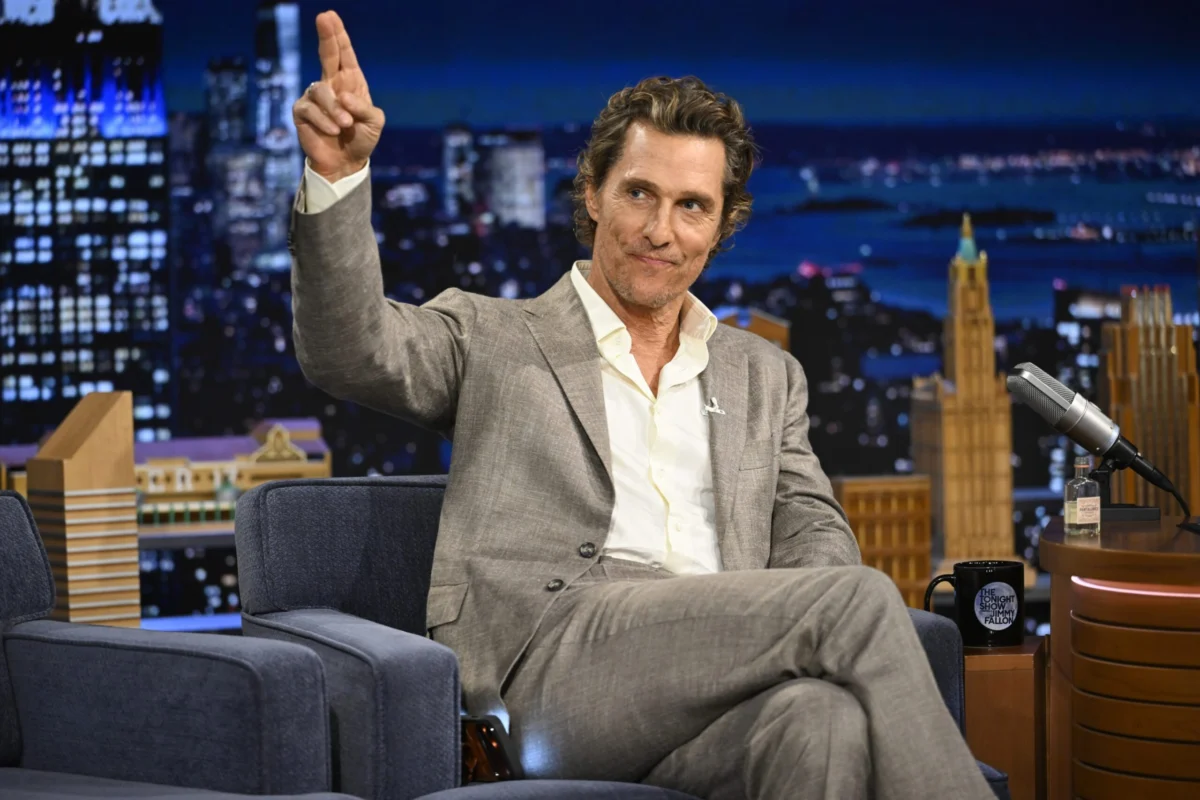
In the rarefied air of global success—where Oscars, multi-million-dollar net worths, and corporate empires reside—the loudest noise often comes from the critics. For Matthew McConaughey, a man whose career has spanned three decades of highs and lows, the path to sustained relevance wasn’t paved with gold, but with a thick, physical compilation of every scathing review he had ever received.
While most people in the public eye go to great lengths to insulate themselves from negativity, the Academy Award-winning actor chose a different, more grueling path. He retreated to the solitude of the West Texas desert, armed with nothing but his catalog of failures, and spent 48 hours reading every word of condemnation. This experiment in vulnerability revealed a profound truth about growth: not all criticism is created equal, and learning to distinguish between malicious noise and constructive insight is the hallmark of a true master of one’s craft.
The Anatomy of Criticism: Sorting Noise from Insight
McConaughey’s desert retreat, which occurred around 2018 or 2019 during the composition of his bestselling memoir Greenlights, served as a masterclass in emotional regulation. In a recent interview with Build or Break, the actor reflected on the intensity of the experience. "I took them on as a thick book—not all the positive, the negative ones—and I sat with them," he shared. "It was hard."
Through the process of reading, McConaughey began to categorize his critics. He identified two distinct archetypes: the "malicious observer" and the "constructive analyst."
The first category, he realized, was not worth his mental bandwidth. These critics, he noted, had decided on their stance before the film even began. "From the very first sentence, this person has it out for me," he explained. "It didn’t matter if they saw the movie or not. They just don’t like me. They were going to write a negative review."
However, the second category proved to be the bedrock of his professional evolution. These critics were often fans of his work who felt he had missed the mark on a specific performance. By stripping away his ego, McConaughey was able to view these critiques objectively. "They were looking at the work and objectively criticizing it," he said. "They applauded some things, but also shone a light on where I came up short."
His takeaway was a simple, transformative question: What can I learn from this? By separating the personal bias of the "noise" from the objective truth of the "feedback," he turned years of professional scars into a roadmap for improvement.
A Chronology of Resilience: From ‘Dazed’ to ‘Interstellar’
To understand why McConaughey felt the need to confront his past, one must look at the arc of his career. Rising to fame with his iconic 1993 breakout role in Dazed and Confused, McConaughey spent the 1990s and 2000s as a quintessential romantic comedy lead. While financially lucrative, this period invited a specific brand of criticism that pigeonholed his talent.
The "McConaissance"—his shift toward darker, more complex roles in True Detective, Dallas Buyers Club, and Interstellar—was not an accident. It was a conscious effort to challenge the narrative surrounding his work. By the time he sat in the desert to read his reviews, he was looking back at a body of work that had transitioned from the "easy-going Texan" trope to an Oscar-winning dramatic force.
This desire for self-improvement is echoed by other industry heavyweights. Jason Bateman, in a candid interview with Esquire, noted that he reads reviews for his television shows and films not because he is thin-skinned, but because he views his work as a service to the public. "I am doing these projects for public consumption, so it matters to me what the public thinks about them," Bateman noted. For these performers, the audience’s reaction—even when harsh—is an essential data point for the next project.
Corporate Culture: Why CEOs Are Bringing the "Pain"
The philosophy of embracing, and even soliciting, negative feedback has migrated from the silver screen to the boardroom. In the modern, high-stakes environment of Fortune 500 leadership, the ability to accept—and act upon—harsh criticism is being treated as a vital survival skill.
Jensen Huang and the Culture of Anxiety
Nvidia CEO Jensen Huang, the architect of a $5.5 trillion tech titan, embodies a philosophy of "productive suffering." Despite his monumental success, Huang maintains a state of constant, self-imposed anxiety. He argues that comfort is the enemy of innovation. "In order to do something incredible, you have to suffer," he told the Korea Society. "If it’s a walk in the park, anybody could do it."
Huang does not reserve this intensity for himself; he applies it to his workforce. He admits that he critiques nearly everything presented to him, viewing it as his duty as a leader to help his staff improve. "Just like a Taiwanese parent, once the feedback is given, you’re back to loving the person again," he noted. "I’m always critical of everybody’s work so that I can help them be better."
The "2×4" Approach to Leadership
Ralph Lauren CEO Patrice Louvet is equally blunt about the necessity of directness. In an era where corporate jargon often softens the blow, Louvet advocates for the "2×4 across the forehead" method of feedback. He suggests that sugar-coating weaknesses often leads to stagnation, whereas addressing them directly—and immediately—is the fastest way for both individuals and businesses to scale.
The Hiring Frontier: Testing for "Feedback Fitness"
Perhaps the most significant implication of this shift is that the ability to take criticism is no longer just a "soft skill"—it is becoming a filter for talent acquisition.
Gagan Biyani, CEO of the education platform Maven and cofounder of Udemy, has formalized this into a "red flag" test during job interviews. Biyani now delivers live, unvarnished critiques to candidates while they are in the interview room. This is not meant to be cruel; it is a diagnostic tool.
"If this is their nightmare, the candidate freezes up or even gets offended," Biyani says. For him, this reaction is an immediate disqualifier. Conversely, candidates who treat the critique as a collaborative moment of improvement—who lean into the feedback—are the ones who succeed. "If this is exciting, they are more likely to join," he notes.
Implications: The Growth Mindset as a Competitive Advantage
The common thread between a Hollywood A-lister, a tech visionary, and an ed-tech CEO is the rejection of fragility. In a digital age where public opinion is instant, constant, and often vitriolic, the ability to remain "un-offendable" is a distinct competitive advantage.
1. The Death of the Ego
The primary hurdle to growth is the ego’s defense mechanism. When we feel criticized, our instinct is to justify, deflect, or attack. McConaughey’s desert exercise proves that the only way to bypass this mechanism is through the deliberate, calm exposure to the "noise." By reading the criticism in a vacuum, he rendered the emotional sting powerless, leaving only the information behind.
2. Feedback as Data
In business, data is everything. Yet, many leaders treat performance reviews as personal attacks. By reframing feedback as "data on performance," individuals can iterate more quickly. Whether it is a line of code at Nvidia or a scene delivery in a film, the feedback loop is the only way to bridge the gap between "good" and "exceptional."
3. The Necessity of Brutal Candor
The examples set by leaders like Huang and Louvet suggest that the most "caring" thing a mentor or boss can do is provide honest feedback. If the goal is excellence, silence is a form of betrayal. A culture that prioritizes feelings over facts will inevitably plateau, whereas a culture that embraces "the pain" of critique will find new ways to scale.
Conclusion
The lesson from the desert is universal: there will always be people who wish you ill, and there will always be people who see your potential more clearly than you do. The task of the high performer is to develop the discernment to ignore the former and the humility to listen to the latter.
Whether you are a creative professional, a corporate leader, or an entry-level candidate, your capacity to process criticism is the ceiling of your potential. As Matthew McConaughey learned in his solitude, the most difficult reviews aren’t the ones that break you; they are the ones that, if you are brave enough to listen, force you to build something better. In a world that is increasingly sensitive to pushback, the ability to say "thank you for that, how can I use it?" remains the rarest and most valuable talent of all.
