

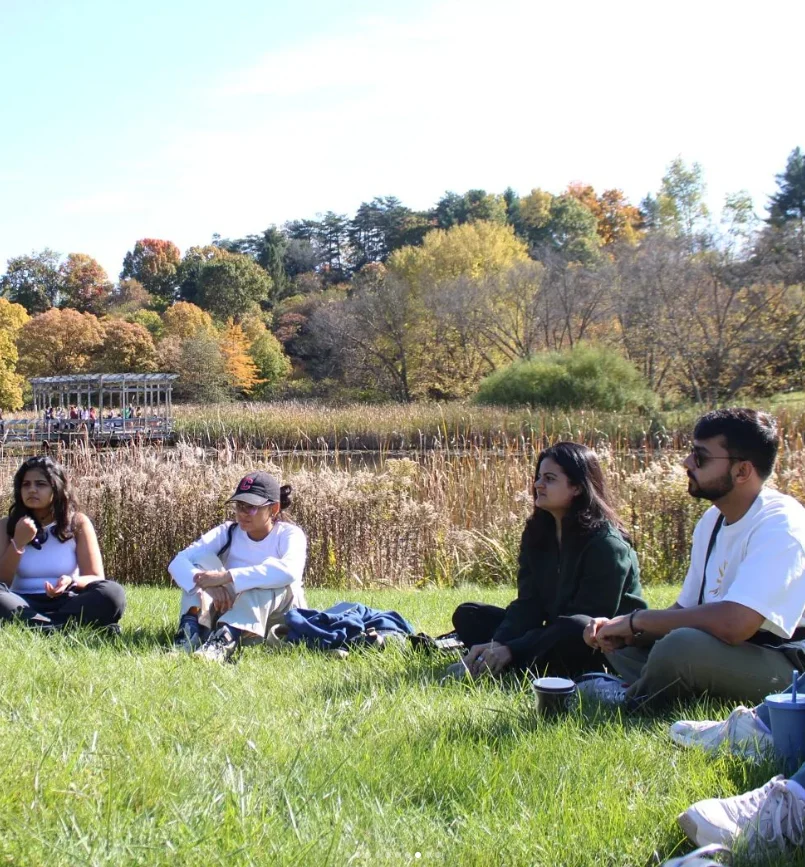
In 1984, Don Rakow was a graduate student at Cornell University, navigating the high-pressure environment of Ivy League academia while enduring a profoundly difficult personal period. He found his lifeline not in a counseling office or a pill bottle, but in the quiet, meticulously tended campus gardens. "They were my sanctuaries—those gardens were essential for me to maintain balance and to survive," Rakow recalls.
Thirty years later, that memory resurfaced as Rakow, by then a professor of plant science, looked at a new generation of students struggling with an unprecedented mental health crisis. He proposed an unconventional, yet scientifically rooted solution: leveraging the university’s natural landscape as a legitimate tool for clinical health. This spark of an idea would eventually evolve into "NatureRx," one of the first dedicated programs in the United States to formalize nature as a medical prescription for student well-being.
As U.S. colleges grapple with an overwhelming demand for mental health services that often outpaces their capacity, a new paradigm is emerging: social prescribing. By connecting students with nature, art, movement, and community service, universities are creating a holistic safety net that complements traditional therapy and psychiatry.
The Evolution of a Campus Movement
The concept of social prescribing originated in the United Kingdom during the 1980s, gaining traction as a way to address health through community-based, non-clinical interventions. The premise is simple: many health issues, particularly those rooted in stress, isolation, and anxiety, are better addressed by re-integrating individuals into their communities and the natural world than by medication alone.
For Cornell, the transition to this model was born of necessity. In the early 2010s, a series of student suicides prompted a university-wide reckoning regarding mental health. The administration expanded counseling services and faculty training, but they also recognized that traditional clinical models were insufficient to handle the sheer scale of the crisis. With the university’s support, Rakow co-founded NatureRx.
The program initially operated as a student-led club hosting nature-based activities. However, it quickly evolved into a formal health initiative. Today, Cornell Health physicians embed "nature referrals" directly into students’ electronic health records. These are not merely suggestions; they are treated as part of a patient’s care plan, with outcomes tracked and measured by medical professionals.
A Growing Crisis: Data and Demand
The urgency behind these initiatives is supported by grim statistics. While American universities have offered mental health services for over a century—Princeton first hired a dedicated psychiatrist in 1910 to address student attrition due to emotional distress—it took decades for such services to become mainstream. By the early 21st century, the demand began to skyrocket.
Data from 373 campuses between 2013 and 2021 revealed a staggering trend: during this eight-year period, student depression rates rose by 135 percent, and anxiety by 110 percent. The number of students meeting clinical criteria for at least one mental health disorder effectively doubled.

According to the 2024-25 Healthy Minds Study, which surveyed over 84,000 students, 37 percent report moderate to severe depressive symptoms, and nearly one in four report feeling chronically isolated. A survey by Timely Care found that 86 percent of campus counseling leaders believe student mental health needs are currently increasing, leaving many centers under-resourced and unable to keep up with the volume of requests.
The Science of the "Nature Prescription"
While skeptics might view nature walks as a "soft" intervention, the physicians at Cornell argue that the efficacy of NatureRx is grounded in physiology. Dr. Jonathan Keffer, a participating physician at Cornell Health, explains that nature is not just a "nice-to-have" amenity; it is a medically recognized treatment for stress, which often acts as a precursor to anxiety and depression.
"This is actually physiologically proven medical treatment," Keffer says. Time in nature triggers the parasympathetic nervous system, which acts as the body’s "rest and digest" mechanism, effectively countering the sympathetic nervous system’s "fight or flight" response. Studies have shown that even a brief, 10-minute exposure to natural environments can measurably reduce cortisol levels—the body’s primary stress hormone.
For students living in a world of constant digital connectivity and sociopolitical pressure—ranging from climate anxiety to economic instability—this "cooling down" of the nervous system is a vital therapeutic tool. By medicalizing the experience, doctors like Keffer can help students see nature as a component of their treatment plan, similar to how one might view a prescription for antidepressants or therapy.
Implementing Social Prescribing: From Cornell to the Nation
Following his retirement from Cornell, Rakow co-founded the Campus Nature Rx Network with Dorothy Ibes of the College of William & Mary. Supported by the REI Cooperative Action Fund, the network provides free resources and guidance to universities looking to build their own programs. To date, approximately 120 colleges and universities have joined the movement.
The implementation varies by institution, reflecting the specific needs and cultures of different campuses:
- Stanford University: Through a partnership with SocialRx (formerly Art Pharmacy), Stanford refers students to a "care navigator." This navigator assesses the student’s needs and prescribes up to nine "doses" of arts and cultural experiences—such as museum visits, dance workshops, or pottery classes—at no cost. Early data shows an 80 percent improvement in self-reported mental health among participants.
- University of Michigan: Facing a paradox where students felt lonely despite an abundance of campus activities, Michigan conducted an informal survey of 1,400 students. The primary barrier was not a lack of opportunity, but time and social anxiety. This led to the launch of ExperienceRx and a dedicated Institute for Social Prescribing, which aims to formally research the impact of these interventions.
- New York University: Professor David Hollander takes an academic approach, teaching a course titled "How Basketball Can Save the World." Students learn how sports can function as a social prescription and then lead campaigns for HoopsRx, a program that provides structured recreational basketball to middle school students suffering from anxiety.
Overcoming Barriers: The "Time" Factor
One of the most persistent hurdles for these programs is the belief among students that they are "too busy" for extracurricular wellness activities. This is where the framing of the program becomes critical.
Dr. Kent Bullis, a physician at Cornell Health, notes that he often frames these activities as a productivity booster. "When students get back to work [after a nature prescription], they feel more clear, more receptive," he says. By positioning nature as a tool for time management and cognitive clarity rather than a distraction, physicians can overcome the "I don’t have time" objection.

Emily Dunuwila, the health initiatives coordinator at Cornell, adds that the program is highly customizable. "It’s not necessarily ‘join this group,’" she explains. "It’s more about how we can integrate this into your busy schedule in a way that works for you."
Looking Toward the Future: A Holistic Standard of Care
The anecdotal and quantitative evidence for social prescribing is promising. At Cornell, 88 percent of surveyed students who received a nature prescription reported an improvement in mood, and 85 percent reported feeling less stressed.
However, the true impact of these programs may lie in their ability to bridge the gap between clinical care and daily life. As students like Sofia Mattson, who founded a guided walking group at Cornell, have observed, the act of "touching grass"—a colloquialism that has taken on a literal, therapeutic meaning—can be a transformative experience for a student buried in academic labor.
"I have literally been on my laptop for hours today," one student remarked during a walk. "This is the first time I’ve actually touched grass."
As the landscape of higher education continues to evolve, the integration of social prescribing signals a shift in how universities view student success. It is an acknowledgment that a student’s mental health is not separate from their environment, their community, or their physical activity. By treating the whole student—rather than just the symptoms of their distress—universities are not only alleviating the burden on counseling centers but are also fostering a culture of well-being that may prove far more sustainable than any single medical intervention.
"There seems to be greater awareness that there need to be more tools for addressing student well-being," Rakow says. With over 100 campuses now part of the movement, the "nature prescription" is rapidly moving from the fringes of academia to the center of the student experience.
