

Introduction: A New Paradigm in Automotive Safety
For decades, the gold standard of automotive crash testing has relied on static barriers and standardized crash carts. These weighted sleds, designed to mimic the mass and structural rigidity of a generic vehicle, have provided the data necessary to refine crumple zones and restraint systems. However, as the automotive landscape shifts toward a heterogeneous mix of heavy electric vehicles (EVs) and traditional internal combustion engine (ICE) cars, the industry is entering uncharted territory.
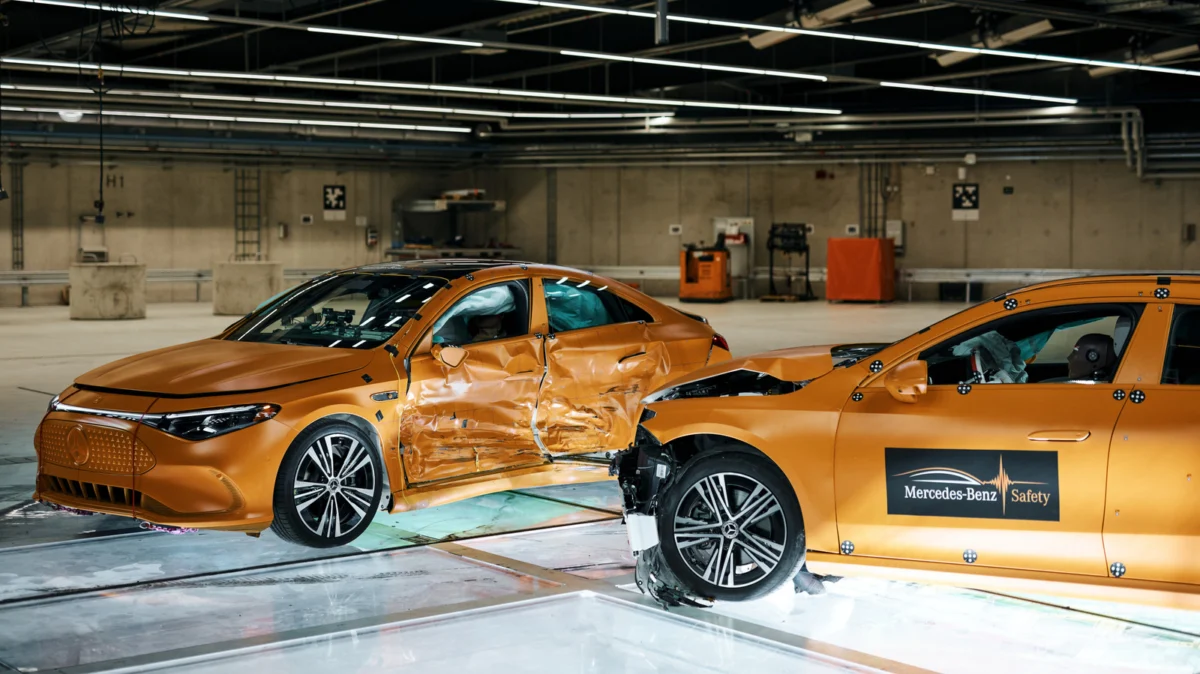
In a move that signals a departure from traditional simulation, Mercedes-Benz has conducted an unprecedented, real-world crash test involving two moving vehicles: a petrol-powered CLA Shooting Brake and an all-electric CLA sedan. This high-stakes demonstration serves not only as a marketing showcase for the next-generation CLA’s safety credentials but also as a critical study into how disparate powertrain architectures interact under the extreme duress of a T-bone intersection collision.
Main Facts: Replicating the "Intersection Reality"
The test, conducted at the Mercedes-Benz Technology Centre in Sindelfingen, Germany, was designed to simulate one of the most common and dangerous types of accidents: a side-impact collision at an intersection.
Both the CLA Shooting Brake and the electric CLA sedan were accelerated to a velocity of 56 km/h (approximately 35 mph). The Shooting Brake was directed to strike the side of the electric sedan at a 90-degree angle. By using two actual production-ready vehicles rather than a standardized crash barrier, Mercedes-Benz was able to observe the dynamic interaction of structural load paths, energy absorption, and the efficacy of modern electronic safety protocols in a live environment.
The results, according to Mercedes-Benz engineers, were definitive. The crumple zones of the Shooting Brake functioned as intended, dissipating kinetic energy upon impact, while the electric sedan’s side structure successfully mitigated cabin intrusion. Crucially, the test confirmed the integrity of the electric sedan’s high-voltage battery housing, which remained intact despite the severe lateral force.
Chronology of the Collision
To fully understand the mechanics at play, one must analyze the milliseconds of the event:
- T-Minus 0.0s (Pre-Impact): Both vehicles enter the test intersection at 56 km/h. Sensors in both vehicles detect the impending collision, priming the Pre-Safe systems.
- T-Plus 0.05s (Initial Contact): The front-end of the Shooting Brake contacts the B-pillar and door panels of the electric CLA. The Shooting Brake’s front structure begins to deform, converting kinetic energy into heat and structural deformation.
- T-Plus 0.10s (Deployment): Within a fraction of a second, the electric sedan’s side-curtain airbags and central airbags—designed to prevent occupants from colliding with each other—deploy. The sedan’s pop-out door handles, a point of significant scrutiny in modern design, extend to allow for emergency egress.
- T-Plus 0.20s (Post-Impact Stabilization): Both vehicles come to a controlled halt. In the electric CLA, the high-voltage battery management system (BMS) triggers an automatic, irreversible disconnect from the drivetrain, isolating the energy source. Simultaneously, the Shooting Brake’s fuel supply is severed by the inertia switch to mitigate fire risks.
- T-Plus 1.0s (Safety Response): The cabin lights illuminate, the emergency call (eCall) system activates, and the side windows automatically lower to facilitate ventilation and rescue access.
Supporting Data: Biomechanical Integrity
The success of a crash test is not measured by the aesthetics of the wreckage, but by the "survivability" of the occupants. Mercedes-Benz utilized eight highly sophisticated crash-test dummies, each equipped with an array of sensors to measure acceleration, force, and pressure on the head, neck, chest, abdomen, and limbs.
The findings were categorical: all measured values remained well below the established biomechanical injury criteria. This suggests that in a real-world scenario of this magnitude, the probability of life-threatening injury is significantly reduced.
Furthermore, the integrity of the electric sedan’s battery is a critical data point. Critics of electrification often cite the risk of thermal runaway in the event of a crash. Mercedes-Benz’s ability to demonstrate that the battery module remained undisturbed within its protective frame provides empirical weight to the argument that modern EV architectures are, in many ways, safer than their ICE counterparts due to the placement of heavy components in the vehicle floor, which lowers the center of gravity and aids in structural rigidity.
Official Responses and Engineering Philosophy
Mercedes-Benz’s commitment to safety has long been the brand’s hallmark. Speaking on the test, company engineers emphasized that the "overdramatic" nature of the presentation was not merely for show, but to highlight a paradigm shift in their "Real-Life Safety" philosophy.
"We do not build cars to pass tests; we build cars to survive the realities of the road," a spokesperson stated. Addressing the controversial pop-out door handles—which have been the subject of debate regarding their reliability in emergencies—the company provided proof of concept. By programming the handles to extend and the windows to drop upon the detection of a high-impact event, they have effectively mitigated the risk of being locked inside a vehicle post-collision.
The company also addressed the intersectional nature of the test. By testing an ICE vehicle against an EV, Mercedes-Benz is acknowledging the changing composition of the global vehicle fleet. As consumers transition to EVs, the weight disparity between these vehicles and traditional cars is a growing concern for safety regulators. This test serves as an early indicator of how these two classes of vehicles will "shake hands" during a collision.
Implications: The Future of Crash Standards
The implications of this test ripple far beyond the Mercedes-Benz CLA. First, it sets a new benchmark for transparency. By allowing the public to witness a vehicle-to-vehicle crash, manufacturers are building consumer trust in an era of rapid technological change.
Second, it highlights the importance of "Connected Safety." The integration of the drivetrain, the body shell, and the electronic control units (ECUs) means that the car is now an active participant in its own survival. The fact that the fuel system and high-voltage electrical system shut down autonomously indicates that "fire prevention" is now as much about software as it is about hardware.
However, the test also raises questions about the future. As noted by industry analysts, the current test is limited to two vehicles of relatively similar mass. As vehicles grow heavier—such as the upcoming AMG GT SUV, which dwarfs the CLA—the physics of a crash change exponentially. The kinetic energy involved in a collision with a 2,700kg SUV is significantly higher than that of a standard sedan. The next logical step for the industry, as suggested by observers, is to subject lighter, high-tech sedans to impacts from these massive electric utility vehicles to ensure that the "crumple zones" of the future are prepared for the weight of the future.
Conclusion: Engineering for the Unknown
Mercedes-Benz has successfully utilized this test to reassure a skeptical public that the transition to electric power does not necessitate a compromise in safety. By successfully simulating a high-velocity, side-impact T-bone collision, the automaker has provided a roadmap for how modern vehicle architecture can protect occupants through a synergy of passive structural engineering and active electronic safety systems.
While this demonstration may be the first of its kind, it is unlikely to be the last. As global safety regulations (such as Euro NCAP and IIHS) continue to evolve, they will likely adopt more of these vehicle-to-vehicle scenarios, moving away from the static, laboratory-bound tests of the past. For now, the Mercedes-Benz CLA stands as a testament to the fact that, regardless of whether a vehicle is powered by a combustion engine or a lithium-ion battery, the priority remains the same: ensuring that the occupants emerge from the worst-case scenario unscathed.
This test, therefore, serves as both a conclusion to a development cycle and a prologue to a safer era of automotive transport—a reminder that in the high-stakes world of automotive engineering, progress is measured in milliseconds, and safety is the only metric that truly matters.
