

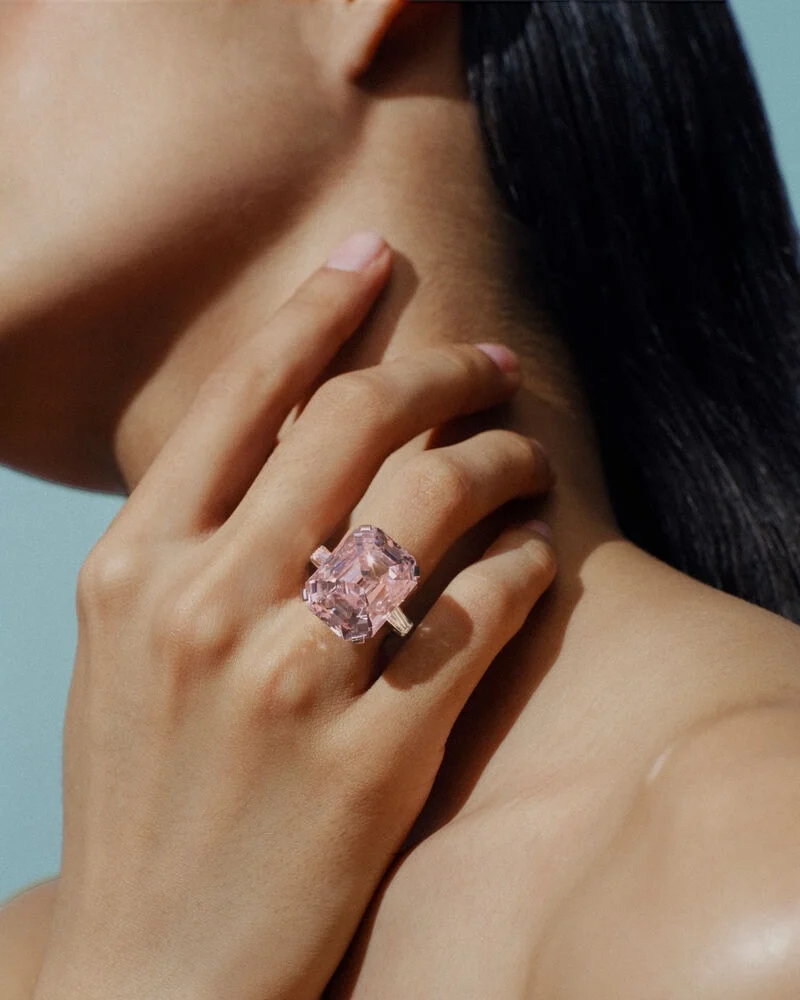
In the rarefied world of high-stakes jewelry collecting, certain artifacts transcend mere aesthetic value, becoming historical documents of an era defined by opulence, romance, and the post-war rebirth of European luxury. This November, Christie’s “Magnificent Jewels” auction in Geneva is set to unveil a piece that perfectly encapsulates this convergence of history and geological rarity: a breathtaking 24-karat “Fancy Intense Pink” diamond ring, masterfully crafted by Bulgari in the 1950s.
With a staggering pre-sale estimate ranging from $12 million to $18 million, the ring is poised to become the centerpiece of the Autumn Luxury Week festivities. However, its value is not merely a product of its carat weight or color grade; it is inextricably linked to a provenance that spans continents and over seven decades of aristocratic legacy.
Main Facts: A Geological and Historical Marvel
The centerpiece of the upcoming auction is a singular, 24-karat pink diamond, a gemstone of such profound rarity that it occupies the highest echelon of mineralogical classification. Classified as Type IIa, this diamond belongs to a group comprising less than two percent of all diamonds found globally. Type IIa diamonds are prized for their exceptional purity, as they contain little to no nitrogen or boron impurities, resulting in a crystalline structure that offers unmatched brilliance and transparency.
The ring itself is a testament to the mid-century craftsmanship of Bulgari. Commissioned by a “distinguished European noble family” in the 1950s, the design reflects the bold, architectural elegance that defined the Roman jeweler during its most transformative decade. The diamond, which was originally sourced in India, has remained in the possession of the same family for over 70 years, a rarity in an era where provenance is often fragmented by repeated sales and shifting ownership.
The upcoming auction on November 10 represents the first time this artifact has been available to the public market in seven decades, a fact that has already sent ripples of anticipation through the global community of diamond collectors and high-net-worth investors.
Chronology: From Indian Mines to the Via Condotti
To understand the weight of this diamond, one must look back to its journey, which began long before it was set into its platinum mount in a Roman workshop.
The Indian Origin
The diamond was acquired in India by the current owner’s great-grandfather in the early 20th century. During this era, India remained the primary source of the world’s most significant pink diamonds, many of which had been unearthed in the historic mines of Golconda. The diamond was held as a family heirloom for decades before the decision was made to elevate it from a raw stone to a piece of wearable art.
The Rome Commission (1950s)
In the 1950s, the family commissioned Bulgari to transform the diamond into a ring. At the time, Rome was undergoing a profound cultural shift. Known as the "Hollywood on the Tiber," the city became a playground for the international elite, drawn by the cinematic grandeur of the Cinecittà Studios. Bulgari’s boutique at the Via Condotti emerged as the epicenter of this cultural confluence, a place where the lines between aristocracy and cinema blurred.
The Decades of Seclusion (1960–2024)
For the better part of three-quarters of a century, the ring remained a private secret of the noble family. While trends in jewelry design shifted from the bold geometries of the 1950s to the minimalist aesthetics of the modern era, the ring remained a constant fixture in the family’s collection, shielded from the public eye and preserved in its original, untouched state.
Supporting Data: The Science of the "Fancy Intense" Hue
The allure of the pink diamond is not merely a matter of prestige; it is a matter of profound geological anomaly. As reported by Forbes, the distinctive hue of such a stone is the result of a rare distortion of the crystal lattice during the diamond’s formation.
The Physics of Pink
Pink diamonds do not derive their color from chemical impurities, as is the case with yellow or blue diamonds. Instead, they are the result of "plastic deformation"—a process occurring deep within the Earth’s mantle where intense, subterranean pressure forces the diamond’s crystal structure to shift. This structural misalignment alters the way light enters and travels through the stone, effectively filtering out certain wavelengths and leaving the observer with the coveted rose-hued radiance.
Rarity and Grading
The Gemological Institute of America (GIA) and other leading authorities assign color grades to diamonds based on the intensity of their saturation. The "Fancy Intense" designation is a high-tier grade that indicates a strong, saturated color that is not muted by overtones. Given the extreme rarity of large, high-clarity pink diamonds, the market for such stones has remained incredibly robust, often outperforming traditional equity markets during periods of economic uncertainty.
Official Responses and Cultural Context
In a press release regarding the upcoming sale, Christie’s highlighted the intersection of history and glamour that the ring represents. By situating the ring within the timeline of the "Hollywood on the Tiber" movement, the auction house is framing the object not just as a commodity, but as a cultural artifact.
“Bulgari’s boutique at Via Condotti became a social and cultural meeting point,” the press release noted. “It welcomed many of the world’s most renowned celebrities, including Elizabeth Taylor and Richard Burton, Audrey Hepburn and Mel Ferrer, to name two Hollywood couples.”
By associating the ring with this specific period of history, Christie’s is appealing to a class of buyer that values the story behind the stone. The piece serves as a physical connection to a time when cinema stars and European nobility interacted on a daily basis in the cafes and boutiques of Rome, a romanticized epoch that continues to command a premium in the luxury sector.
Implications: A New Benchmark for the Market
The sale of this diamond is expected to have significant implications for the wider gemstone market. As natural diamond supplies from traditional mines continue to dwindle—particularly those yielding rare colored stones—the value of existing, high-quality inventory is projected to climb.
The Investment Landscape
For ultra-high-net-worth individuals, colored diamonds are increasingly viewed as "portable wealth." In a world of digital volatility, the tangible, permanent nature of a Type IIa pink diamond offers a sense of security that few other assets can provide. The $12–$18 million estimate is a reflection of the current "flight to quality" observed in the luxury auction market.
The Legacy of Provenance
The fact that this diamond comes from a private noble collection—rather than a commercial inventory—adds a layer of "freshness" to the market. Auction houses frequently emphasize the importance of "fresh to market" pieces, as repeat offerings can sometimes dampen collector enthusiasm. By remaining in one family’s possession for over 70 years, the ring carries a clean, verified history that is highly desirable to provenance-conscious buyers.
What Lies Ahead
As the November 10 date approaches, the global jewelry industry will be watching the Christie’s auction with bated breath. Should the ring exceed its $18 million estimate, it would signal a continued, aggressive appetite for rare colored diamonds among the world’s elite collectors. Conversely, even if it falls within the expected range, the sale will serve as a poignant reminder that even in a rapidly changing world, the allure of the rare and the beautiful—forged in the fires of the Earth and polished by the masters of the mid-century—remains an immutable force in the market of fine treasures.
The Bulgari ring is more than a piece of jewelry; it is a relic of the Roman Dolce Vita, a feat of geological mystery, and a premier investment-grade asset. Whether it ends up in a private vault, a museum display, or on the hand of a modern-day icon, its story—begun in India and matured in the salons of Rome—is destined to enter a new and equally glamorous chapter.
