

As we navigate our fifties and beyond, the biological landscape of our bodies begins to shift. One of the most common complaints among fitness-minded adults in this demographic is the appearance of "arm jiggle"—the loosening of skin and soft tissue around the triceps and upper arms. While the beauty industry often pushes localized creams and gadgets, the reality of physiology is far more straightforward: as muscle mass naturally declines with age (a process known as sarcopenia) and the body redistributes its fat storage, the upper arms often lose their structural firmness.
However, the solution is not to be found in endless sets of isolated bicep curls or expensive machines. According to expert trainers, the secret to achieving stronger, more defined arms lies in functional, standing, full-body movements.
The Physiology of Arm Changes After 50
To understand why our arms change, we must look at the intersection of aging and muscle metabolism. Sarcopenia typically begins in our 30s but accelerates significantly after age 50. As muscle fibers shrink, the skin—which loses elasticity due to reduced collagen production—begins to appear looser. Furthermore, metabolic shifts cause the body to store more subcutaneous fat in the upper extremities.
Many gym-goers respond to this by over-emphasizing isolated movements. They spend hours performing repetitive curling motions, hoping that "spot reduction" will tighten the area. Unfortunately, isolation exercises are rarely the most efficient way to build the lean muscle tissue required to provide a firmer "scaffolding" for the skin. By ignoring the shoulders, back, and core, these individuals miss out on the metabolic boost and postural improvements that come from multi-joint, compound movements.
The Functional Advantage: Why Standing Beats Sitting
When you move to a standing position for your resistance training, you fundamentally change the nature of the exercise. A seated machine exercise locks your body into a specific plane, removing the need for stabilization. Conversely, standing exercises require your legs, glutes, and—most importantly—your core to engage to keep you upright and balanced.
This "total-body" approach provides three distinct advantages:
- Postural Correction: By strengthening the upper back and shoulders, you naturally pull your chest open and stand taller. This creates an immediate visual improvement in the arm silhouette, as the muscles are no longer "hidden" by a rounded, slumped posture.
- Increased Caloric Expenditure: Engaging the entire kinetic chain requires more energy, helping to combat the metabolic slowdown associated with aging.
- Coordination and Balance: Standing movements train the body as a single, connected unit, which improves functional movement patterns for everyday life—like lifting groceries or reaching for items on high shelves.
The Four Essential Moves for Stronger Arms
For those looking to reclaim their upper-body strength, professional trainer Tyler Read recommends a routine centered on four key standing exercises. These movements require minimal equipment and can be integrated into even the busiest schedules.
1. The Standing Overhead Press
The overhead press is the gold standard for shoulder health. It targets the deltoids and the triceps while demanding immense stability from the core.
- Why it works: It mimics real-world movements, such as placing a heavy object on a high shelf. As you press the weight upward, your body must stabilize, preventing arching in the lower back.
- The Technique: Begin with feet shoulder-width apart, holding light dumbbells or resistance bands at shoulder height. Keeping the core tight, press the weights directly overhead until arms are fully extended, then return slowly. Focus on a controlled descent to maximize muscle tension.
2. The Standing Resistance Band Row
If pushing movements define the front of the body, pulling movements define the back. Resistance band rows are essential for correcting the "desk-hunch" posture that many adults develop.
- Why it works: By engaging the lats, rhomboids, and rear deltoids, you create a stronger, more stable foundation for the shoulders. A strong back is the secret to making the arms look more toned, as it provides the skeletal support necessary for proper limb alignment.
- The Technique: Anchor a resistance band at chest height. With a slight bend in the knees, pull the handles back toward your ribcage, squeezing your shoulder blades together. Ensure your elbows track close to your body.
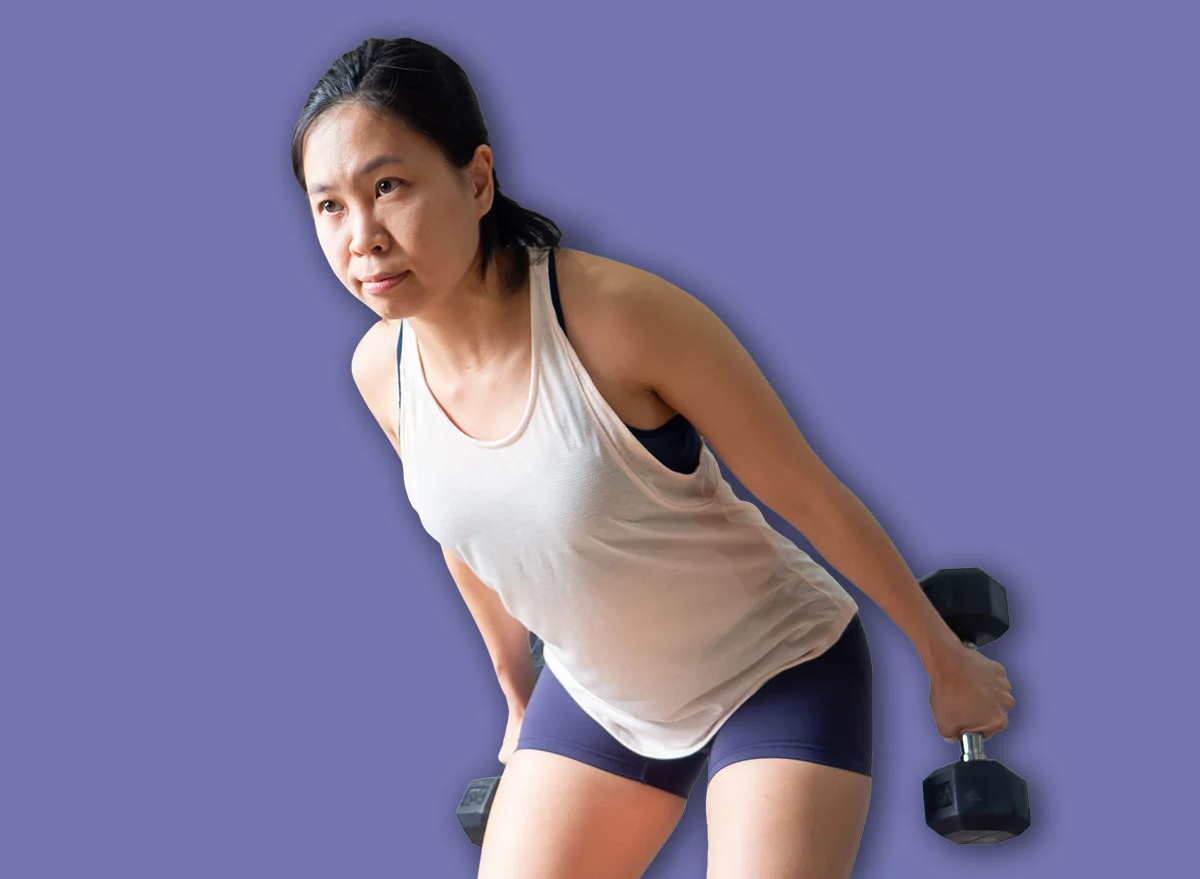
3. The Standing Triceps Kickback
The triceps make up two-thirds of your upper arm mass. Strengthening this muscle group is the most effective way to address the "jiggle" that often appears on the underside of the arm.
- Why it works: By performing this standing, you remove the reliance on benches, forcing the core to work harder to maintain your hinge position.
- The Technique: Lean forward slightly at the hips with a flat back. Keep your upper arms pinned to your sides. Extend your forearms backward until your arms are straight, focusing on the squeeze at the back of the arm. Avoid swinging the weight; the movement should be slow and deliberate.
4. Standing Cross-Body Punches
This move serves as an excellent "finisher" for any workout, combining cardio endurance with muscular engagement.
- Why it works: The rotational component engages the obliques and core, while the rapid extension and retraction of the arms hit the triceps and shoulders repeatedly.
- The Technique: With feet wide and knees soft, punch across your body, rotating your torso with the movement. Keep the core engaged throughout, ensuring the power comes from your midsection, not just your arm extension.
Implications for Long-Term Health
The importance of this training approach extends far beyond aesthetics. For adults over 50, the ability to lift, pull, and push is directly tied to independence and longevity. By focusing on functional, standing strength, you are not merely addressing the appearance of your arms; you are investing in the stability of your joints and the integrity of your skeletal system.
Consistency is the ultimate metric for success. Rather than seeking the "burn" of an exhausting one-hour gym session, prioritize high-quality, controlled repetitions three to four times a week. As you maintain this discipline, the cumulative effect on your muscle density, posture, and self-confidence will become apparent.
Expert Insight: Quality Over Quantity
As Tyler Read, BSc, CPT, notes, the most significant transformations occur when clients move away from the "more is better" mentality. "I’ve coached adults over 50 for years, and I’ve seen the biggest changes come from people who consistently perform simple movements with excellent technique," Read explains.
By focusing on controlled, intentional movement, you give your body a reason to maintain and build muscle. Whether you incorporate these exercises into a morning routine or a quick lunch break, the shift from isolated movements to functional, whole-body engagement will yield the strongest, most capable version of yourself. When you stand taller and move with purpose, your arms—and your entire body—will reflect that renewed vitality.
