

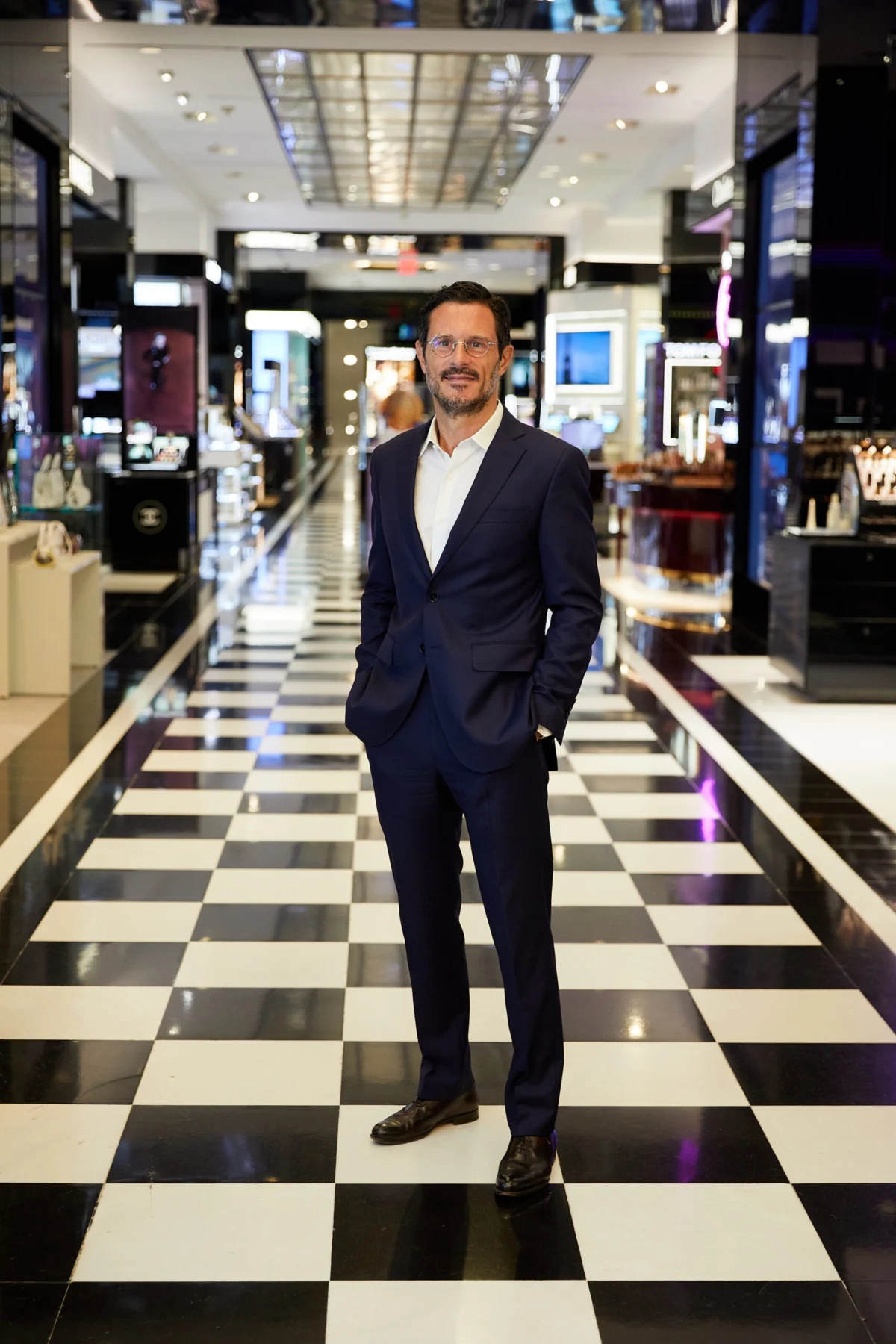
In an era where retail discourse is dominated by artificial intelligence, algorithmic supply chains, and the relentless pursuit of digital efficiency, Olivier Bron, the chief executive officer of Bloomingdale’s, is advocating for a return to the fundamentals: emotion, atmosphere, and the "art" of human connection. Speaking at the recent Wharton Baker Retailing Center CEO Summit in Manhattan, Bron offered a provocative critique of the American retail landscape, suggesting that the industry’s obsession with short-term quarterly metrics has come at the expense of long-term brand equity.
For Bron, the path forward is not found in a pivot away from brick-and-mortar, but rather in a radical reimagining of it. As he navigates the complexities of a "K-shaped" economy, his leadership at Bloomingdale’s is proving that the department store model—often dismissed as an artifact of the past—remains a potent, if underutilized, vessel for luxury storytelling.
The Philosophy of Balance: Art Meets Science
At the heart of Bron’s strategy is a tripartite philosophy: balance in merchandise, balance in time horizons, and a delicate equilibrium between data and intuition.
"It can’t only be about data, data, data," Bron told Christine Barton, CEO Advisory, North American Lead at the Boston Consulting Group, during their onstage conversation. "At some point, it’s about relationship building. It’s about experience. It’s about emotions, which are very important. We probably lost a bit of that in the U.S."
Bron argues that the American retail sector has become dangerously skewed toward short-term financial returns. This pressure, he suggests, is antithetical to the slow-burn process of building a luxury brand. To combat this, Bloomingdale’s has been intentionally diversifying its portfolio, maintaining a careful mix between premium contemporary and high-luxury brands, while balancing its fashion-forward apparel business with a robust home furnishings division.
A Chronology of Success: Record-Breaking Performance
The efficacy of Bron’s strategy is reflected in the brand’s recent financial trajectory. Bloomingdale’s recorded a standout performance in the second quarter of the current fiscal year, posting a comparable sales gain of 11.3 percent. This surge brought the brand’s quarterly volume to $922 million—the highest second-quarter sales total in the history of the company.
Industry analysts estimate that the brand generated approximately $4 billion in total sales for the 2025 fiscal year. This momentum is not merely a product of market tailwinds, though the "K-shaped" economy—which has seen the luxury sector rebound in the U.S. more aggressively than in European or Asian markets—has certainly played a role.
"The economy is not bad for us," Bron observed, noting that the brand’s Net Promoter Scores (NPS) are currently at an all-time high. This surge in customer satisfaction has created a "vibe and energy" within the stores that Bron believes is palpable to the consumer.

The Competitive Landscape: Seizing the Opening
Bron’s success has been bolstered by the instability of his peers. In what was an apparent reference to the Exemplar Luxury Group—which operates Saks Fifth Avenue, Neiman Marcus, and Bergdorf Goodman—Bron noted that the market has been shaped by the missteps of others.
"We know some competitors have been unfocused recently, which gives us some room and some opportunities," Bron said. "It probably helped the great performance of Bloomingdale’s over the past 24 months. 2025 has been the new high-water mark for Bloomingdale’s. In 2026, I hope we will be well above that, so it definitely helped. About probably 25 percent of this performance is due to the challenges that others faced at some point over the past 12 to 24 months. But I really believe it’s our strategy that’s providing the biggest impact."
Reimagining the Physical Space: Moving Beyond the "Forest of Racks"
One of the most damning critiques Bron offered during the summit was directed at the aesthetic and operational stagnation of the typical American department store. He described the standard experience as a "forest of racks," packed with products but devoid of soul.
"Some department stores have great products. But it’s boring," he remarked.
His vision for Bloomingdale’s is to transform the department store floor into an immersive, boutique-style experience. He draws inspiration from retailers like Le Bon Marché in Paris, which famously eschews a heavy reliance on digital metrics in favor of an all-in approach to in-store theater—occasionally removing entire sections of merchandise to host exclusive fashion shows or cultural events.
"When you close the door of Bloomingdale’s behind you, you have to feel something different," Bron explained. "It has to feel good. It’s a lot about emotions."
This shift requires taking risks. While the retailer has historically been risk-averse, Bron has shifted the internal culture over the last three years to favor investments that do not offer immediate, short-term ROI. A significant portion of this involves the company’s wholesale model, where 80 percent of products are purchased outright. While this carries more inventory risk than a consignment or concession model, it allows for better control over the brand presentation and, ultimately, higher profit margins.
The Digital-Physical Symbiosis
Despite his emphasis on in-store "theatre," Bron is far from an anti-digital Luddite. Instead, he views the physical store as the anchor for the digital business. He revealed a telling statistic: 80 percent of Bloomingdale’s digital sales originate from geographic areas where the brand already operates a physical storefront.

"Investing in our stores is really reinforcing our digital business," he said. "If you close your eyes and think about your best experience at Bloomingdale’s, you will never refer to that big, nice brown box delivered to your front door. Never. You are going to refer to an experience in the store where you met someone you loved or found products you were not expecting to discover."
This symbiotic relationship is why, despite the erosion of foot traffic in certain sectors, Bron remains bullish on the relevance of the department store. With 31 department stores, 25 outlets, and four "Bloomie’s" small-format locations, the brand is doubling down on its physical footprint as the primary vehicle for customer acquisition and retention.
Official Response: The Future of Luxury Retail
As the retail industry continues to grapple with the "death of the department store" narrative, Bron remains steadfast in his rebuttal. He argues that the model is far from dead; rather, it is in a state of necessary evolution.
"It’s still a very relevant model, maybe slightly eroding in traffic and in number of customers here and there, but it’s not a fatality," he said. "If we do it right—and this is what we’re experiencing at Bloomingdale’s—the number of customers are increasing and the sales are increasing. I think we’re more relevant than we used to be."
Ultimately, Bron believes that luxury retail is not just about selling a product, but about selling an identity. "You’re buying a brand. You’re buying a social marker. You’re buying an experience that makes it worth what you bought," he noted.
Implications: A New Era of Emotional Retail
The implications of Bron’s leadership are clear: the next decade of luxury retail will not be won by the retailer with the best AI-driven recommendation engine, but by the one that best understands the human psychological need for status, community, and aesthetic pleasure.
As Bloomingdale’s continues to push for a more curated, boutique-like environment, the industry will be watching closely. If Bron can successfully marry the scale of a traditional department store with the intimacy of a luxury atelier, he will have successfully rewritten the playbook for the 21st-century retailer. In his own words, the goal is simple: "We’re selling products that actually you don’t need. So why would you buy another handbag? Why would you buy another shirt or skirt? Because it feels good. Because it’s rewarding. It’s good for your self-esteem."
For Bloomingdale’s, the future of the department store is not in the data points, but in the feeling the customer carries out the door.
