

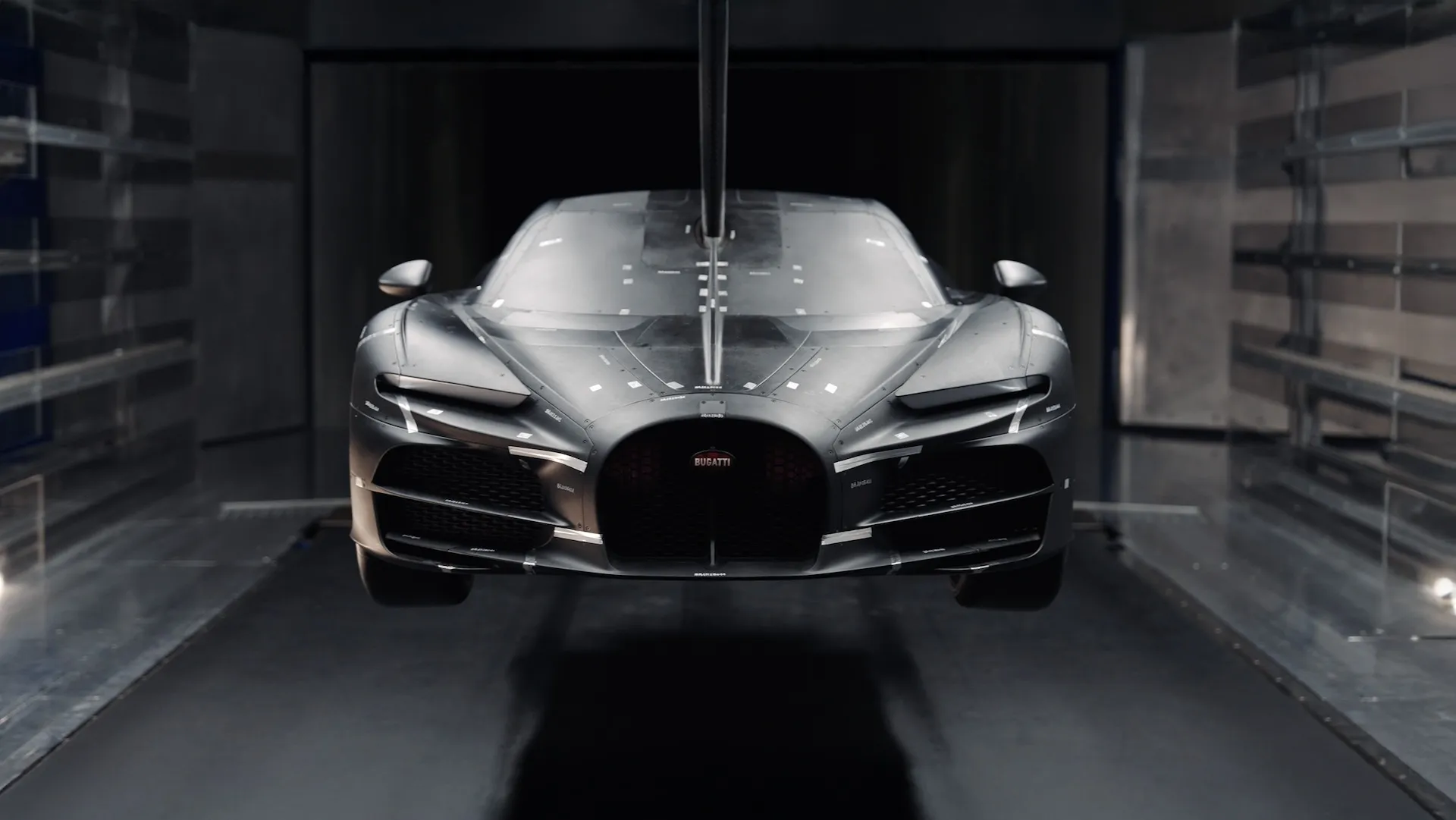
The automotive world is rarely shaken as profoundly as it was when Bugatti pulled the silk sheet off the Tourbillon in June 2024. While the headline figures—a staggering 1,800 horsepower and an 8.3-liter naturally aspirated V-16 engine—grabbed the immediate attention of enthusiasts, the true genius of the Tourbillon lies in the invisible battle fought against the air. As Bugatti transitions into a new era of electrified performance, the brand’s engineers have recognized that brute force is only half the equation; the other half is the masterful manipulation of fluid dynamics.
The Pursuit of "Slipperiness": The Core Mission
For the Tourbillon, Bugatti’s objective was clear: surpass the aerodynamic efficiency of the Chiron. To the casual observer, the Chiron was already the pinnacle of hypercar design, but for the engineering team led by Chief Engineer Paul Burnham, the Chiron was merely the baseline.
In a recent video feature released by the company, Burnham underscored that reducing aerodynamic drag is not merely an aesthetic choice; it is a fundamental requirement for the Tourbillon to reach—and likely exceed—the legendary top-speed benchmarks established by the Veyron and the Chiron. To hit the projected targets, which rumors suggest could push beyond 310 mph, the vehicle must cut through the atmosphere with unprecedented precision.
The most striking departure from the Chiron’s architecture is the Tourbillon’s reduced greenhouse. By shrinking the cabin volume and tapering the bodywork, the design team successfully minimized the car’s frontal area. This reduction in the "face" of the car serves as the primary barrier to wind resistance. However, as any aerospace engineer will attest, the most significant gains are often found in the margins—the subtle sculpting of air intakes, the curvature of the underbody, and the transition points where air detaches from the bodywork.
A Chronology of Innovation: From Digital to Reality
The development of the Tourbillon’s silhouette was not a process of artistic whim, but a rigorous, multi-year scientific undertaking. The journey began roughly 15 months prior to the June 2024 unveiling, starting in the realm of Computational Fluid Dynamics (CFD).
The CFD Phase
Before a single piece of carbon fiber was molded, the Tourbillon existed as millions of lines of code. CFD allowed the team to simulate how air would behave at speeds exceeding 250 mph. This digital-first approach enabled engineers to iterate rapidly, testing thousands of permutations of rear wings, splitters, and diffusers without the overhead of physical manufacturing.
The Half-Scale Model
Once the digital models showed promise, the team moved to physical validation. This involved the creation of a half-scale model—an intricate piece of engineering in its own right. Composed of over 250 3D-printed components, the model was studded with more than 100 pressure taps. These sensors provided the empirical data necessary to bridge the gap between digital simulations and real-world performance, ensuring that the airflow patterns observed on computer screens manifested identically in the wind tunnel.
Full-Scale Validation
By early 2024, the process transitioned to full-scale prototypes. According to Burnham, this phase was not about discovery, but validation. By the time the full-scale car hit the wind tunnel, the team had already "solved" the aerodynamic puzzle through the small-scale testing. The full-scale sessions served to confirm that the complex thermal management systems—required to cool the massive V-16 and the trio of electric motors—were not disrupting the laminar flow of air across the car’s exterior.
Supporting Data: The Powertrain and Chassis Integration
The aerodynamic bodywork of the Tourbillon is draped over an entirely new, clean-sheet chassis. Unlike the Veyron and Chiron, which shared a common lineage, the Tourbillon represents a complete break from the past. This was a necessity, not just a preference; the integration of an 8.3-liter naturally aspirated V-16 engine with three electric motors and an 8-speed dual-clutch transmission required a bespoke structural layout.

The Power Density
The result of this integration is an 1,800-hp plug-in hybrid powertrain capable of launching the car from 0-60 mph in a blistering 2.0 seconds. While the electric motors provide instantaneous torque to mask the inherent lag of a combustion engine, the aerodynamic efficiency ensures that the car does not "hit a wall" of air as it approaches its terminal velocity.
Thermal Management as Aerodynamics
A unique challenge for the Tourbillon was managing the heat signature of the new V-16. Naturally aspirated engines, unlike the quad-turbocharged W-16 of the past, require different intake and exhaust dynamics. The aerodynamic team worked in tandem with the powertrain engineers to ensure that the cooling ducts were positioned in high-pressure zones, effectively using the air itself to force cooling into the radiators without creating unnecessary drag.
Official Perspectives: A Vision of Timelessness
Bugatti’s design philosophy for the Tourbillon stands in stark contrast to the industry trend of "digital overload." While competitors are racing to fill dashboards with massive, distracting screens, Bugatti has opted for an intricate, mechanical gauge cluster.
"We wanted to design a car that feels as relevant in 50 years as it does today," said a representative for the design department. By utilizing watch-like analog instrumentation, the Tourbillon avoids the planned obsolescence of consumer-grade electronics. This ethos extends to the exterior; the bodywork is meant to be a timeless sculpture, shaped by the wind, rather than a trend-driven aesthetic that will look dated in a decade.
Implications for the Hypercar Market
The Tourbillon is a rare beast in the current automotive landscape. At a price point starting at approximately $4 million, it is positioned as a collector’s piece from day one. With only 250 examples slated for production, and every single one already spoken for, the Tourbillon is less a mass-market product and more an artifact of the internal combustion era’s final, most brilliant flourish.
The End of an Era
The transition from the W-16 to the hybrid V-16 marks a critical juncture for the Volkswagen-owned marque. By maintaining the combustion engine’s soul while integrating the efficiency and torque of electrification, Bugatti has successfully navigated the most difficult challenge in modern hypercar design: evolving without losing identity.
The Benchmark for 2026 and Beyond
As production gears up for 2026, the industry will be watching closely. The success of the Tourbillon will likely dictate the direction of ultra-luxury performance for the next twenty years. If the Tourbillon can achieve its top-speed targets while maintaining the handling dynamics of a car significantly lighter than its predecessors, it will cement the legacy of the Bugatti brand as the master of both the mechanical and the atmospheric.
In conclusion, the Bugatti Tourbillon is a triumph of integration. It is a vehicle where the wind tunnel and the engine bay are not separate entities, but parts of a singular, harmonious system. As we await the first customer deliveries in 2026, one thing is certain: the Tourbillon is not just a car; it is a high-speed watch, a masterpiece of fluid dynamics, and the ultimate farewell to the age of pure, unadulterated, naturally aspirated power.
