

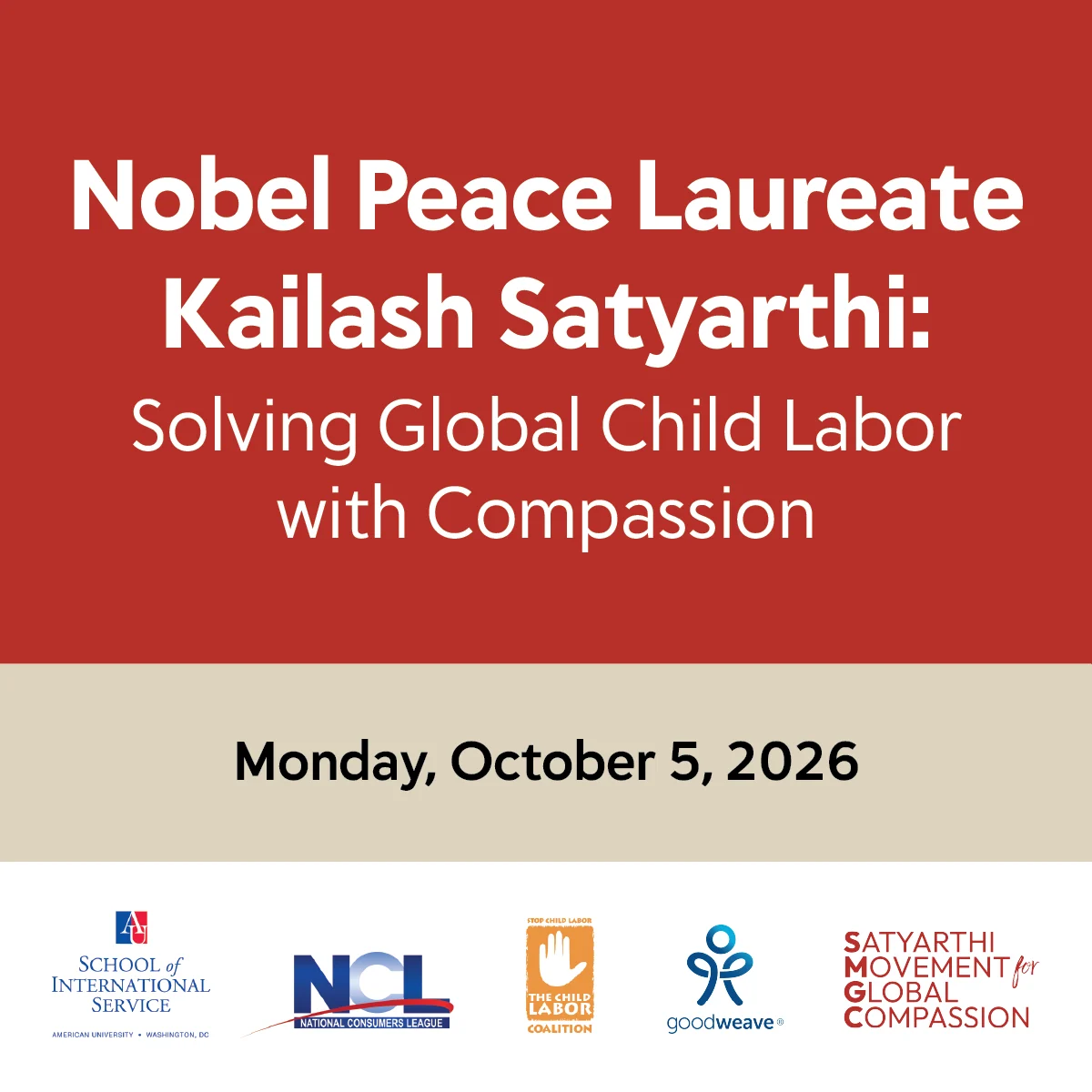
WASHINGTON, DC – As the international community grapples with the persistent and evolving crisis of child exploitation, a high-profile assembly of advocates, scholars, and policymakers is set to take place in the nation’s capital. On Monday, October 5, 2026, the National Consumers League’s (NCL) Child Labor Coalition (CLC) will host "Solving Global Child Labor with Compassion," a landmark public forum held at American University’s School of International Service (SIS).
The event will feature a keynote address by Nobel Peace Laureate Kailash Satyarthi, a seminal figure in the global fight against the enslavement of children. The gathering aims to bridge the gap between academic research, legislative policy, and grassroots activism, fostering a collaborative roadmap for eradicating hazardous child labor in global supply chains.
The Core Objective: A Multidisciplinary Approach
The crisis of child labor remains one of the most stubborn challenges in international development. Despite decades of advocacy, millions of children remain trapped in sectors ranging from agriculture and textile manufacturing to illicit mining and domestic servitude. The upcoming forum at American University is designed not merely to highlight these grim statistics, but to move the needle toward actionable, compassion-driven solutions.
"We are at a crossroads," said a spokesperson for the National Consumers League. "The persistence of child labor is not a failure of information; it is a failure of collective action and systemic accountability. By bringing together the intellectual rigor of the School of International Service with the practical experience of the Child Labor Coalition, we hope to forge a new path forward."
The event will open with formal remarks from Rachel Sullivan Robinson, Interim Dean of the School of International Service, and Sally Greenberg, Co-Chair of the Child Labor Coalition. Their participation underscores the critical partnership between academic institutions, which provide the data-driven framework for understanding human rights violations, and advocacy groups, which provide the political and social pressure necessary to drive change.
Chronology: The Evolution of the Anti-Child Labor Movement
The struggle to protect children from economic exploitation has a long and complex history. To understand the significance of the October 5 event, one must look at the progression of the global movement.
The Foundation of Reform (Late 20th Century)
The modern anti-child labor movement gained significant momentum in the 1990s as global trade increased and supply chains became more opaque. It was during this era that organizations like the Child Labor Coalition began to form, recognizing that localized efforts were insufficient to combat a global, interconnected problem.
The Satyarthi Catalyst (2014)
The profile of the movement changed permanently in 2014 when Kailash Satyarthi was awarded the Nobel Peace Prize, alongside Malala Yousafzai. Satyarthi’s lifelong commitment to the "Bachpan Bachao Andolan" (Save the Childhood Movement) brought international visibility to the plight of children in India and beyond. His work demonstrated that child labor is inextricably linked to poverty, illiteracy, and a lack of social safety nets.
The Current Landscape (2026)
In the years since the pandemic, global supply chains have faced unprecedented disruptions, often pushing vulnerable families deeper into poverty and increasing the risk of child labor. The October 5 forum comes at a time when the International Labour Organization (ILO) and other global bodies are warning that progress toward the total elimination of child labor has stalled. This event represents a renewed effort to recalibrate global strategies in an era of heightened economic volatility.
Supporting Data: The Scope of the Crisis
The challenge of eradicating child labor is daunting, characterized by complex economic drivers that often prioritize cost-efficiency over human dignity.
Economic Drivers and Vulnerability
Recent research indicates that child labor is most prevalent in regions with weak regulatory enforcement and high levels of informal economic activity. When families face a choice between immediate survival and long-term education, the structural pressures of the global economy often force children into the workforce.
The Role of Supply Chain Transparency
A key focus of the upcoming panel discussion will be the role of corporations in monitoring their own supply chains. Experts, including those from GoodWeave International, have long argued that certification programs are not merely "nice to have" but are essential tools for consumer protection. By tracing products from the source, organizations can identify instances of child labor that would otherwise remain hidden in the depths of the global market.
The Accountability Gap
Judy Gearhart, a Research Professor at the Accountability Research Center at American University, will moderate the afternoon panel. Her work consistently highlights the "accountability gap"—the space between corporate pledges to eliminate child labor and the actual conditions on the ground. The event aims to address how governments and private entities can move beyond voluntary commitments toward mandatory human rights due diligence.
Official Responses and Key Voices
The caliber of the speakers attending the event reflects the gravity of the situation.
- Kailash Satyarthi: As the keynote speaker, Satyarthi is expected to call for a "globalization of compassion." His philosophy posits that the world cannot be truly globalized unless it is also morally integrated. He advocates for a systemic shift where children are viewed as the most valuable resource for a nation’s future, rather than an inexpensive labor commodity.
- Tim Ryan, Chairman of the Global March Against Child Labor: Ryan represents the grassroots element of the movement. The Global March has been instrumental in keeping the issue of child labor on the agenda of the United Nations and the ILO. His perspective is expected to bridge the gap between high-level international policy and the reality of the frontlines.
- Jon Jacoby, CEO of GoodWeave International: Jacoby’s involvement signifies the critical role of the private sector and non-governmental standard-setting bodies. GoodWeave’s model of rigorous inspection and remediation has become a gold standard for those attempting to rid their supply chains of exploitation.
Implications: A New Era for Advocacy?
The gathering at American University is not intended to be a one-off event. It is designed to serve as a catalyst for future research and policy development. By hosting this at a premier institution like the School of International Service, the organizers are signaling that child labor is a fundamental issue of international security, economic development, and human rights.
Policy Implications
For policymakers in Washington, the event serves as a reminder that the United States continues to be a major importer of goods produced through exploitative labor. The discussions regarding legislation, import bans, and corporate transparency are expected to influence the ongoing dialogue in Congress regarding trade agreements and human rights mandates.
Academic Implications
For the academic community, the event highlights the need for more granular, longitudinal studies on the efficacy of various anti-child labor interventions. By engaging researchers alongside activists, the forum creates a feedback loop where theoretical findings can be tested against the practical realities of the field.
Consumer Implications
Finally, the event serves as a call to action for the public. As the National Consumers League emphasizes, consumers have power. By demanding transparency and supporting organizations that certify products as "child-labor-free," the public can exert pressure on multinational corporations. The event is open to the public, and organizers encourage students, activists, and concerned citizens to register.
Conclusion: Toward a Future of Dignity
As the world looks toward the future, the goal of eliminating child labor remains a moral imperative. The event on October 5, 2026, represents a vital moment of convergence. When Nobel Laureates, researchers, and global advocates stand together on the stage at American University, they are not just discussing a policy issue—they are reaffirming the fundamental right of every child to a childhood free from exploitation.
The "Solving Global Child Labor with Compassion" forum promises to be a pivotal point in the ongoing effort to transform the global economic system into one that protects, rather than exploits, the most vulnerable among us.
Event Registration Details:
- Date: Monday, October 5, 2026
- Time: 2:30–4:00 p.m.
- Location: Abramson Family Founders Room, School of International Service, American University, 3468 Nebraska Ave. NW, Washington, DC
- Admission: Free and open to the public; registration is required via the official event page.
About the Child Labor Coalition (CLC):
Co-chaired by the National Consumers League and the American Federation of Teachers, the CLC is a network of 38 organizations dedicated to ending exploitative child labor. Through research, advocacy, and public awareness campaigns, the coalition works to ensure that the health, safety, and education of children remain a global priority.
